January 16, 2009

Why should Hamas want a truce?

A few hours ago exiled Hamas leader Khaled Meshaal told Arab leaders, in an emergency summit on Gaza, in Doha, Qatar, that his group would not accept Israeli conditions for a truce. It’s bad news, but there is nothing surprising about that. What could be slightly surprising, instead, is that Khaled Meshaal also accused Israel of waging war against all Palestinians, including women and children. Why surprising? Simply because the accusation can backfire on Hamas, if only for the fact that a specular purpose can be traced back to Hamas charter itself:

Hamas has been looking forward to implement Allah’s promise whatever time it might take. The prophet, prayer and peace be upon him, said: “The time will not come until Muslims will fight the Jews (and kill them); until the Jews hide behind rocks and trees, which will cry: O Muslim! there is a Jew hiding behind me, come on and kill him!”

As it was not enough, this document includes reference to the notorious anti-Semitic forgery 'The Protocols of the Elders of Zion' that is to say the myth of a Jewish plan to dominate the world (via Norm):

Today it is Palestine and tomorrow it may be another country or other countries. For Zionist scheming has no end, and after Palestine they will covet expansion from the Nile to the Euphrates. Only when they have completed digesting the area on which they will have laid their hand, they will look forward to more expansion, etc. Their scheme has been laid out in the Protocols of the Elders of Zion, and their present [conduct] is the best proof of what is said there.

And that’s how the whole matter is summarized by Hamas charter:

Israel will rise and will remain erect until Islam eliminates it as it had eliminated its predecessors.

So why on earth should they want a truce “before” they wipe out their hateful enemies from the face of the earth? And, what is more, why should they want to stop the suffering of so many people in Gaza when their sacrifice is being used to disseminate hate propaganda against Israel?

Galileo, 400 years later


2009 is the 400th anniversary of Galileo Galilei’s first observations at the telescope, and will be celebrated all over the world as the International Year of Astronomy (IYA). The two-day official launch of IYA are taking place in Paris (January 15-16), but Tuscany will play a very special role in the yearlong initiative, as the birthplace and home of the great physicist, mathematician, astronomer, and philosopher who is considered the father of modern observational astronomy, or simply the father of modern science.

In fact, as part of the celebrations, a new museum will be opened in Tuscany, where guided observations of the night sky and three exhibitions, part of 12-million-euro “Galileo Package,” will be also held. But the biggest show of the year will be a multimedia event at Florence’s Palazzo Strozzi, starting from March, entitled “Galileo: Images of the Universe from Antiquity to the Telescope.”

It’s curious that even Pope Benedict gives the impression of being well prepared for this appointment. “The great Galileo said that God wrote the book of nature—he said in his homily for the feast of the Epiphany—in the form of the language of mathematics. He was convinced that God has given us two books: the book of Sacred Scripture and the book of nature. And the language of nature – this was his conviction – is mathematics, so it is a language of God, a language of the Creator.”

Well, the days of the controversy between the Catholic Church and the Tuscan astronomer about heliocentrism are long over. Who does not remember when, back in 1992, Pope John Paul II expressed “regret” for how the Galileo affair was handled at the time, and officially conceded that the Earth was not stationary? But it is also worth recalling that all traces of official opposition to heliocentrism by the Church disappeared in 1835 when these works were finally dropped from the “Index of prohibited books.”

Yet, in a speech delivered at the Sapienza University of Rome on February 15, 1990, the then Cardinal Joseph Ratzinger quoted a statement by the famous philosopher of science Paul Feyerabend: “The Church at the time of Galileo kept much more closely to reason than did Galileo himself, and she took into consideration the ethical and social consequences of Galileo’s teaching too. Her verdict against Galileo was rational and just and the revision of this verdict can be justified only on the grounds of what is politically opportune.”

Once again, the truth seem to lie in the middle, despite all extremist philosophical and cultural views, as even secularist and atheist Beltolt Brecht guessed in his famous play Life of Galileo. That’s why it is to be hoped that celebrations won’t be transformed into the umpteenth occasion for a confrontation between secularists and their religious counterparts.

January 14, 2009

It's time to see the Eternal City


The Eternal City, the largest archaeological site in the world, is unsurpassed in it’s architectural splendor. Take this mini Grand Tour on Cnn.com/Travel (source: Oxford Archaeological Guides: Rome, Oxford University Press, 1988), and you will enjoy the stunning view of the Roman Forum: the temple of Antonius and Faustina, the Temple of Vesta, in which a sacred flame was tended by the Vestal Virgins, the handmaidens of the hearth goddess of the Roman state, and that of Romulus, Pons Fabritius—that is the oldest working bridge on the Tiber, built in Julius Caesar’s time—and the Pantheon, originally built as a temple to all the gods of Ancient Rome, and rebuilt circa 126 AD during Hadrian’s reign, and more recent architectural masterpieces.

Otherwise, if you are a history and architecture lover, but are more techno-oriented at the same time, you can enjoy Rome as it looked in 320 AD and fly down to see famous buildings and monuments in 3D. Just download Google Earth at http://earth.google.com/, then select the “Ancient Rome 3D” layer under “Gallery.” Some of the buildings even have interiors. Read this November 12, 2008 New York Times article to learn more, or watch the video below.


January 12, 2009

Bush's farewell interview

It was aired yesterday on Fox News Sunday, and it was what we might call a “farewell interview” (here is the transcript) with the outgoing U.S. President George W. Bush, perhaps something like a moral testament. “We’ve got to be compassionate conservatives,” he said using the same phrase he used during his 2000 campaign.

It’s very important for our party not to narrow its focus, not to become so inward-looking that we drive people away from a philosophy that is compassionate and decent, […]. We should be open-minded about different people’s opinions.
We shouldn't have litmus tests as to whether or not you can be a Republican. And we should be open-minded about big issues like immigration reform, because if we're viewed as anti-somebody — in other words, if the party is viewed as anti-immigrant — then another fellow may say, well, if they're against the immigrant, they may be against me. We've got to be a party for a better future, and for hope.

“We’ve got to be open-minded, compassionate conservatives,” that’s what some of the Bush administration’s efforts, such as expanding the federal government’s role in education through the No Child Left Behind Act and proposing an easier path to citizenship for illegal immigrants, were all about. But that’s also what have come under fire right from some of Bush’s fellow Republicans, though evidently of different school of thought.

Was that internal confrontation only a prelude to the “final battle” which could be fought in the months and years ahead within the GOP?

Who is to blame for Gaza?

“Israel hasn’t killed a single civilian in the Gaza Strip. Over a hundred civilians have died, and Israeli bombs or shells may have ended their lives. But Israel didn't kill them.
Hamas did.”


This is a must read, in my view: Ralph Peters, a retired U.S. Army officer and the author of Looking For Trouble, in the New York Post: (thanks: Sandra)

There is no moral equivalence between Hamas terrorists and Israeli soldiers. There is no gray area. There is no point in negotiations.

Hamas is a Jew-killing machine. It exists to destroy Israel. What is there to negotiate?

When Hamas can't kill Jews, it's perfectly willing to drive Palestinian civilians into the line of fire - old men, women and children. Hamas herds the innocent into "shelters," then draws Israeli fire on them. And the headline-greedy media cheer them on.

Hamas isn't fighting for political goals. "Brokered agreements" are purely means to an end. And the envisioned end is the complete destruction of Israel in the name of a terrorist god. Safe in hidden bunkers or in Damascus, the Hamas leadership is willing to watch an unlimited number of civilians and even street-level terrorists die.

[...]

All Israel can do is to fight for time and buy intervals of relative calm with the blood of its sons and daughters. By demanding premature cease-fires and insisting that we can find a diplomatic solution, we strengthen monsters and undercut our defenders.

And don't believe the propaganda about this conflict rallying Gaza's Palestinians behind Hamas. That's more little-brown-brother condescension, assuming all Arabs are so stupid they don't know who started this and who's dragging it out at their expense.

Gaza's people may not care much for Israelis, but they rue the day they cast their votes for Hamas. Hamas is killing them.


The 2008 Weblog Awards

Do you like this blog? Vote for me for BEST EUROPEAN BLOG (Non UK) 2008. Voting ends Monday, January 12 at 22h00 GMT
(11 pm in Rome, 5 pm in New York, 2 pm in LA)

January 11, 2009

How Leftists turned out to be humans

At last they got it right, and the old motto “better late than never” definitely applies here: Left and honesty, in Italy, are not synonymous, not anymore. So spoke the Economist, despite its distrustfulness, if not its ill-concealed hostility, towards Silvio Berlusconi and the ruling center-right coalition, and despite what Walter Veltroni, leader of Italy’s main opposition Democratic Party, recently asserted about his own party (“a party of good people”).

Italy’s center-left, writes the Economist, may be “a bit dull and worthy, and somewhat tarnished by the communist past of many of its leaders (including Mr Veltroni),” but “it has always seemed fundamentally honest.” Yet …

in little more than a month, that benign view has been swept away in a slew of prosecutors’ warrants and summonses. On January 5th the centre-left mayor of Naples, Rosa Russo Iervolino, unveiled a new and reshuffled city administration. There were six new faces in her 16-strong team. Four of their predecessors had been arrested on suspicion of taking part in what prosecutors claim was a plan for the “systematic looting” of public funds. A fifth had committed suicide after he too came under investigation for corruption and other alleged offences.

The scandal in Naples, which revolves around a €400m ($545m) public-services contract, is the most substantial but by no means the only one to have assailed the opposition. Since the end of November, centre-left politicians have been put under suspicion, or even arrest, in seven other cities and regions.

So, yet another myth—and that of the honesty of the left was a very though and persistent one—has been swept into the trash can. Not that, of course, such scandals are in my opinion a good thing in themselves, nor do I rejoice because my political opponents are in a very bad fix. Rather I rejoice because, if political myths can be understood as “narratives through which we orient ourselves, and act and feel about our political world,” as political philosophy scholar Chiara Bottici puts it, they—or at least a certain kind of them—often are nothing more than “comedy of misunderstandings.” That is to say that they are more or less useless, if not pernicious, and that we can do well without them.

But that of the honesty of the left wasn’t the only myth to collapse, there was also that of the honesty of Italy of Principles, the party led by Antonio Di Pietro, a former prosecutor who leapt to national prominence in the days of Mani pulite (“clean hands”), the nationwide Italian judicial investigation into political corruption held in the 1990s, which led to the demise of the so-called First Republic, resulting in the disappearance of many parties. In fact, Mr Di Pietro too has now had his wings clipped:

His son, Cristiano, a provincial lawmaker, quit the party after he was caught up in the Naples sleaze inquiry. Transcripts were leaked of telephone conversations in which he seemed to be asking for jobs and advancement for his friends.

Who would ever have predicted that? Very few, actually. I mean, very few would have thought that things came before the courts—not just that the left might be involved in bribery or other official corruption, and believe me, there is a difference …—, given that both the left and Di Pietro’s party had always been in very good terms with the judges. But things have changed in the last couple of years, and some taboos seem to have fallen away in certain public realms, especially in the judicial one. That’s also why what looks like bad news could actually turn out to be a very exciting time, even though not for the left itself, nor for Di Pietro. Yeah, now everybody knows—even the Economist (better late than never!)—that they are humans, too, after all.


The 2008 Weblog Awards

Do you like this blog? Vote for me for BEST EUROPEAN BLOG (Non UK) 2008. Voting ends Monday, January 12 at 22h00 GMT
(11 pm in Rome, 5 pm in New York, 2 pm in LA)

January 9, 2009

Sarah Palin's interview

I must confess that I still cannot make out how it could have happened that, during the 2008 U.S. presidential campaign, so many intellectuals, academics and mainstream media so often showed their bias and a certain distrustfulness towards Republican vice presidential candidate Sarah Palin. Ok, I thought at the time, they may want to be non-bipartisan, they have the right to be non-neutral in the presidential race, but they could be more decent and less black and white …

“If she were Obama’s Veep, would she have been savaged?” asks today Melissa Clouthier in her awesome blog—by the way, she is one of ten finalists for the Best Individual Blogger in the 2008 Weblog Awards, and also my favourite one in that category. Well, my answer is, I don’t think so. Not at all.

That is also why the video below is, in my humblest opinion, very, very interesting. It offers excerpts from Sarah Palin’s interview with filmmaker John Ziegler, for his forthcoming documentary “Media Malpractice,” in which the Alaska Governor, for the first time at length, takes on the media coverage of her and the 2008 campaign. It’s a rather shocking record of a media assassination—of Sarah Palin, her character and family—which remains “one of the greatest public injustices of our time,” as Ziegler puts it on his website.


The 2008 Weblog Awards

Do you like this blog? Vote for me for BEST EUROPEAN BLOG (Non UK) 2008. Voting ends Monday, January 12 at 22h00 GMT
(11 pm in Rome, 5 pm in New York, 2 pm in LA)

January 7, 2009

Islamizing Europe

Let’s update my previous post by linking to the Times and the Daily Mail, which reported about what happened last Saturday in Milan and Bologna, as well as about the Vatican’s reactions.

In particular we learn that the Vatican yesterday expressed its “unease” at the hundreds of Muslims who gathered in prayer outside the the Duomo in Milan and the Basilica of San Petronio in Bologna, with thousands of prostrate Muslims facing Mecca. In an interview with the Vatican’s official newspaper Osservatore Romano, Cardinal RenatoMartino, head of the Vatican's Pontifical Council for Justice and Peace, said: “For me the sight of people at prayer does not trouble me, it is good that people pray. But what really troubled me and left me uneasy was the fact that Israeli flags were burnt and there were slogans, all manifestations of hate and which followed a prayer session.” “What matters is the spirit in which one prays—and prayer excludes hate,” he added.

Monsignor Luigi Manganini, archpriest of Milan cathedral, said in turn he could imagine the Islamic reaction if Christians prayed en masse outside a mosque (well, er, actually I think there are very few people who would have difficulty in imaging what would have happened …).

We also learn that the rally in Milan was led by the city’s Muslim Imam Abu Imad, who, as MP Maurizio Gasparri noted, has been convicted in Italy of terrorism related offences, and that, according to the Imam, the demonstration had ended up on the cathedral square “by chance” at the hour of prayer, “and so we prayed, there was no provocation or insult intended,” he said. Fantastic.

Yet, Gasparri thinks that “when 10,000 Muslims arrive in front of Milan Cathedral, led by an Imam who has convictions for terrorism then public order needs to be looked at,” and that “it is evident that this was intended as a threat and the decision to pray and hold the rally in front of the Cathedral is very significant.”

Who do you agree with? Abu Imad or Gasparri?


The 2008 Weblog Awards

Do you like this blog? Vote for me for BEST EUROPEAN BLOG (Non UK) 2008. Voting ends Monday, January 12 at 22h00 GMT
(11 pm in Rome, 5 pm in New York, 2 pm in LA)

January 6, 2009

'They want to Islamize Europe'


Last Saturday thousands of people marched in cities across Europe to demand a halt to Israeli bombing in the Gaza Strip. In Paris, for instance, more than 20,000 demonstrators, many wearing Palestinian keffiyeh headscarves, marched through the city center chanting slogans such as “Israel murderer!” Expectedly, groups of protesters clashed with police, some cars were set alight and some others overturned by demonstrators, etc.

They seemed quite routine events, but they weren’t, at least not all of them, not what happened in Milan and in Bologna, Italy. In Milan the protesters, mostly young Arabs and Muslim families, had gathered in Porta Venezia, obviously waving banners and flags, and chanting slogans such as “Bush, Barak, assassins.” Normal. Ah, I forgot, they obviously set fire to some Israeli flags. Perfect. So what? What’s new? Well, the demonstration came to an interesting end when the protesters reached Piazza Duomo, in downtown Milan, and held a collective prayer session right in front of the cathedral. Even the parvis was occupied, so that the cathedral turned out to be closed.

What happened in Milan was very similar to what happened in Bologna at the same time: thousands of Muslims gathered right in front the Basilica di San Petronio, Bologna’s great cathedral, to hold an analogue collective prayer session.

Are the two events connected? What’s their real meaning? When asked in an interview with Il Resto del Carlino newspaper about the meaning of the event, Assistant bishop of Bologna monsignor Ernesto Vecchi, said:

This was a signal to ponder upon. This is not simply a prayer, this is a challenge more to our democratic and cultural system than to the basilica. […] From what happened in Bologna, but also in other cities, we received confirmation that here is a project piloted from the outside. What is it all about? What is it aimed at? They want to Islamize Europe.

This recalls a Friday Sermon by Hamas MP and cleric Yunis Al-Astal, which aired on Al-Aqsa TV on April 11, 2008. A clip is available to paid subscribers of MEMRI’s Jihad and Terrorism Threat Monitor (via Paolo Guzzanti). Here are some excerpts from the address:

Allah has chosen you for Himself and for His religion, so that you will serve as the engine pulling this nation to the phase of succession, security, and consolidation of power, and even to conquests thorough da'wa and military conquests of the capitals of the entire world. Very soon, Allah willing, Rome will be conquered, just like Constantinople was, as was prophesized by our Prophet Muhammad. Today, Rome is the capital of the Catholics, or the Crusader capital, which has declared its hostility to Islam, and has planted the brothers of apes and pigs in Palestine in order to prevent the reawakening of Islam – this capital of theirs will be an advanced post for the Islamic conquests, which will spread through Europe in its entirety, and then will turn to the two Americas, and even Eastern Europe.
I believe that our children or our grandchildren will inherit our Jihad and our sacrifices, and Allah willing, the commanders of the conquest will come from among them. Today, we instill these good tidings in their souls, and by means of the mosques and the Koran books, and the history of our Prophets, his companions, and the great leaders, we prepare them for the mission of saving humanity from the hellfire on the brink of which they stand.


All the pieces of the puzzle seem to fit together. Don’t they?


The 2008 Weblog Awards

Do you like this blog? Vote for me for BEST EUROPEAN BLOG (Non UK) 2008. Voting ends Monday, January 12 at 22h00 GMT
(11 pm in Rome, 5 pm in New York, 2 pm in LA)

January 5, 2009

Best European Blog

The 2008 Weblog Awards


I got the news a couple of days ago that my blog had been named as one of ten finalists for the Best European Blog (Non UK) category in the 2008 Weblog Awards.

This was totally unexpected but highly welcomed! In fact, the Weblog Awards are the world’s largest blog competition, with over 500,000 votes cast in the 2007 edition for finalists in 45 categories, and in the past I have perused them over the years to discover some great blogs to add to my blog reader. So I am both stunned and honored to be considered worthy of inclusion in the list of finalists for the Best European Blog.

There is a small window of opportunity for readers to vote for their favorite nominees (January 5th through the 12th). I have added a direct-link badge in the right sidebar to make it easier for you to vote.

Voting rules:

  1. You may vote once every 24 hours in each poll.
  2. After voting in an individual poll you will be locked out from voting again in that poll (on the computer you voted from) for 24 hours.
  3. Each poll has its own separate 24 hour lockout control. Voting in, for example, Best European Blog will not lock you out of voting in other categories.

Needless to say, I would be very grateful and honored if you would consider voting for me ...

January 4, 2009

Moral clarity in Gaza


Pulitzer Prize-winning columnist Charles Krauthammer in yesterday’s Washington Post:

Some geopolitical conflicts are morally complicated. The Israel-Gaza war is not. It possesses a moral clarity not only rare but excruciating.

Israel is so scrupulous about civilian life that, risking the element of surprise, it contacts enemy non combatants in advance to warn them of approaching danger. Hamas, which started this conflict with unrelenting rocket and mortar attacks on unarmed Israelis -- 6,464 launched from Gaza in the past three years -- deliberately places its weapons in and near the homes of its own people.

This has two purposes. First, counting on the moral scrupulousness of Israel, Hamas figures civilian proximity might help protect at least part of its arsenal. Second, knowing that Israelis have new precision weapons that may allow them to attack nonetheless, Hamas hopes that inevitable collateral damage -- or, if it is really fortunate, an errant Israeli bomb -- will kill large numbers of its own people for which, of course, the world will blame Israel. [...]

The full article is worth reading from beginning to end.

January 3, 2009

Mysterious Italy!

It’s a commonplace that Italy is a beautiful but strange, unmanageable, unreliable country, and that it was just its own oddness that recently led—after a spectacular post-war growth record—to a gradual impoverishment.Italy and its economy are like the Titanic hitting the iceberg,” said once Gianni De Michelis, deputy prime minister in 1988 and 1989. An he was right, at least in part.

That is also why the kind of news we are getting these days on the economic front have the power to overtake us, I mean news such as this. So we learn that the GDP (gross domestic product) per average Briton, which was $45,970 in 2007, is expected to slump to just $35,243 this year, “lower than even Italy”—as the Telegraph puts it—on $37,866 the fifth-placed economy. And Britain falls into sixth place for the first time since 1996. Ok, this is because of the plunging value of the sterling, but

[e]ven stripping out effects of the currency, all economists predict that Britain will be hit hard this year, with forecasting house IHS Global Insight predicting the economy would shrink by an alarming 2.7 per cent, causing the country to suffer from the deepest recession since the Second World War.

Who would have ever predicted this? Certainly not the British newspapers (er, no, actually …) neither the Italian ones, to speak frankly, nor the Italian bloggers. Mysterious Italy!


P.S. I would like to say “we Italians got it right this time,” but the truth is that, this time, the Brits got it wrong. So sorry my British friends …

January 2, 2009

Canova and Neoclassicism

A. Canova, Love and Psiche, Louvre, Paris
It is not just because Antonio Canova was born in a small village located a few miles from the North-Eastern Italian town where I live that I feel the need to write this post, but rather because he is the greatest Italian sculptor of modern times, the artist who in 1802, by special request of Napoleon I, went to Paris and modeled a colossal figure of the emperor, which on the fall of the emperor himself was presented by Louis XVIII to the British government, which in turn gave it to the Duke of Wellington—sic transit gloria mundi … but Canova’s time of glory was destined to last far longer than that of Napoleon! In 1818 he was also commissioned to make a heroic statue of George Washington for the State House, Raleigh, N.C., while his “Bust of Napoleon” is in the Corcoran Gallery, Washington, and other masterpieces are in the Vatican and in the Louvre Museum.

Ok, I don’t want to indulge in unnecessary vaunting (and parochialism), nor do I want to beat about the bush … the reason of this post is an upcoming exhibition in the North-Central Italian city of Forlì, starting from January 25 through June 21. The exhibit will be focused on the ties between Antonio Canova and international neoclassical art. Don’t miss it, if you can help it. Read here to understand why.

January 1, 2009

Time to pay the bills

“Europe was created by history. America was created by philosophy,” once said Margaret Thatcher. Maybe that’s what the difference between Europe and America is all about. But what the “American Philosophy”—or better still, if you prefer, the American Spirit—is all about? As a European by birth and an “American by philosophy,” I’d have some ideas about how to answer, but this piece by David Ignatius, focused on the ongoing financial crisis and government bailout, can be helpful to get a down-to-earth picture of the whole thing in a socio-economic perspective, which at the moment is almost certainly the most topical one.

December 31, 2008

Happy New Year!

If the new year comes a second later

Are you eager to put 2008 behind you? I mean, are you, for example, a Wall Street analyst, a stockbroker, a financial reporter, or still worse, are you people who lost a fortune trusting the above mentioned “experts?” Well, tonight you have to hold your good-byes for just a moment, one second, to be precise. In fact, the international authorities—the International Earth Rotation and Reference Systems Service (IERS), namely the world’s official timekeepers—will add a single second to our lives to keep our clocks in sync with solar time used by astronomers.

It will be the 24th “leap second” since 1972. That’s because, “sometimes, the Earth’s rotation on its axis can take longer or shorter than 24 hours, depending on factors such as the breaking action of tides, snow or the lack of it at the polar ice caps, solar wind, space dust and magnetic storms.”

So, please hold on, and pray the new year brings a better economy. When economics fails, prayer can step in and do the work …

December 30, 2008

David Grossman’s proposal to Israel

In two posts about the Israeli assault on Gaza, Norman Geras gives a convincing answer to those who prompted the charge that Israel’s use of force is “disproportionate,” and agrees with what David Grossman has proposed to Israel. In turn, I definitely agree with Norm. “After its severe strike on Gaza,” says Grossman,

Israel would do well to stop, turn to Hamas’ leaders and say: Until Saturday Israel held its fire in the face of thousands of Qassams from the Gaza Strip. Now you know how harsh its response can be. So as not to add to the death and destruction we will now hold our fire unilaterally and completely for the next 48 hours. Even if you fire at Israel, we will not respond with renewed fighting. We will grit our teeth, as we did all through the recent period, and we will not be dragged into replying with force.
Moreover, we invite interested countries, neighbors near and far, to mediate between us and you to bring back the cease-fire. If you hold your fire, we will not renew ours. If you continue firing while we are practicing restraint, we will respond at the end of this 48 hours, but even then we will keep the door open to negotiations to renew the cease-fire, and even on a general and expanded agreement.
That is what Israel should do now. Is it possible, or are we too imprisoned in the familiar ceremony of war?

December 28, 2008

Il partito degli ex-onesti sulla via di Canossa

Ancora una volta Angelo Panebianco ci risparmia la fatica di trovare un senso a ciò che sta succedendo all’interno del Pd, e nella fattispecie in relazione alle note vicende giudiziarie. Infatti basta leggere l’editoriale di oggi sul Corriere per chiarirsi le idee. Una radiografia precisa e impietosa da cui emergono i travagli e le contraddizioni in materia di «giustizialismo» di quella che fu la sinistra non più comunista e che ora, dopo aver inglobato quella che fu la sinistra catto-comunista della Dc (poi scioltasi nella Margherita), si chiama Partito democratico.

Panebianco spiega anche perché, malgrado le “svolte” violantesche e veltroniane, non ci saranno cambiamenti significativi nell’atteggiamento di fondo di quel partito nei confronti della questione giustizia. Alla base, dice il professore, ci sono “tre dogmi” pressoché insuperabili …

A quanto così efficacemente sintetizzato e spiegato non occorre aggiungere nulla. A margine, tuttavia, si potrebbero dire un mucchio di cose, la maggior parte delle quali, però, sarebbero ovvietà e banalità. Ad esempio questa: qualcuno si era illuso, o aveva fatto finta di credere, o aveva fatto di tutto per convincersi e convincere l’opinione pubblica che ci fosse, oppure che fosse concepibile o plausibile un “partito degli onesti,” alleato di ferro di pubblici ministeri sempre e comunque al di sopra di ogni sospetto, paladini del Bene contro il Male. Panebianco attribuisce questa illusione non solo alla dirigenza, ma anche a buona parte dei militanti e degli elettori del Pd, e credo che abbia ragione. Ebbene, la nemesi è qui, sotto gli occhi di tutti: il teorema è saltato, la favola degli “onesti” è finita, così come quella dei pm senza macchia, giacché ora anche gli “ex-onesti”—se mi si passa la licenza poetica—se la prendono con loro, al pari dei “mascalzoni”—altra licenza poetica—di sempre, le cui sfuriate anti-magistratura-politicizzata erano considerate per definizione troppo “interessate” per essere prese sul serio.

E, attenzione, la favola degli onesti non vale più neppure per il partito di Di Pietro, che sembrava il grande beneficiario dello scempio del Pd. Ora, anche lui deve beccarsi la sua parte di insinuazioni e/o insulti (ci ha pensato quel linguacciuto di Gasparri). Con questo non voglio dire che anche l’ex pm è coinvolto nel malaffare, ci mancherebbe, si è garantisti per qualcosa! No, mi limito ad applicare lo schema dipietrino (implicito o esplicito): se sei sospettato, anche solo di striscio, certamente la tua credibilità è intaccata, ergo devi farti da parte, e comunque non costituisci più “l’alternativa” a un sistema di corruzione e malaffare. Questo devono aspettarsi i seguaci di Antonio Di Pietro e i suoi paladini nel mondo dell’informazione-spettacolo, sempre che facciano (e abbiano fatto)  sul serio e non per finta. Viceversa, anche loro stanno nel mazzo, “come tutti gli altri” (altro schema dipietrino, travagliesco, ecc.).

Tutto questo Panebianco non l’ha detto, e ha fatto bene, perché appunto sono ovvietà, se non banalità, e lui non ci tiene a fare di queste sparate. Mentre qui, su un blog, certe cose si possono anche dire, magari premettendo che, appunto, sono osservazioni scontate, e dunque in qualche misura banali. Il punto, però, è se siamo tutti convinti che questi discorsi siano scontati, che certe cose, al punto a cui siamo arrivati, siano talmente ovvie che non occorra neanche dirle (ma trarne le consuguenze, questo sì, almeno si spera). Qui avrei qualche dubbio: andare a Canossa è uno sport faticoso! Di qui questo post “quasi” banale, di cui chiedo scusa ai lettori più sofisticati ed esigenti.

December 27, 2008

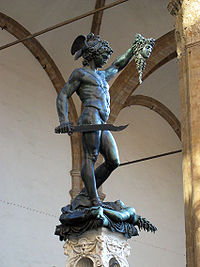
Don't be afraid of Medusa

If you are in Florence during this period, and if you are not easily frightened people, you may want to meet … Medusa (Greek: Μέδουσα (Médousa), namely the gorgon, the chthonic female and snake-haired monster who in Greek mythology had a singular property: gazing upon her would turn onlookers to stone! But don’t be afraid, in fact, again according to the myth, she was beheaded by the Perseus, who after using her head as a weapon for only three, or mostly four instances in his adventures, gave it as a gift to the goddess Athena to place on her shield.

Still worried? Don’t be, because I’m just talking about an annual exhibition of precious works usually kept in storage ... And this year’s event focuses precisely on Medusa, exploring the portrayal of the gorgon through centuries of art.

The exhibit features 40 artworks, including ceramics, drawings, paintings—among which is that by an unknown Flemish painter, attributed to Leonardo da Vinci for over a century—and jewellery, with a number of gems usually stored in Florence’s Archaeological Museum. As it was not enough the exhibit features several different editions of Dante’s Divine Comedy, with plates of Medusa who appears in Canto IX of the Inferno. On show from December 24 through January 31 in the Uffizi.

December 23, 2008

Merry Christmas!

Natività con San Giorgio e San Vincenzo Ferrer Filippo Lippi e collaboratori (1450 - 1475)

And now, folks, as every year since 2000 years,
it’s time to remind ourselves
what the spirit of Christmas is all about.
The following piece of music—a classic Christmas carol,
wonderfully performed by Enya—is just a vague idea,
but you might want to follow the suggestion …


MERRY CHRISTMAS TO YOU ALL!

BUON NATALE A TUTTI!