Showing posts with label UK politics. Show all posts

November 24, 2025

God Is Back


A significant and surprisingly broad phenomenon has emerged: a quiet revival of faith among young people in both the United States and the United Kingdom.

My latest on American Thinker.


In recent years, a significant and surprisingly broad phenomenon has emerged: a quiet revival of faith among young people in both the United States and the United Kingdom. At the same time, a parallel rediscovery of God is taking place among many leading intellectuals. Together, these two trends deserve careful attention  and serious reflection.

Let’s begin with the “ordinary people” before turning to the maîtres à penser.

England and Wales: Young People Are Returning to Church

According to The Quiet Revival report published by the Bible Society, the share of young people aged 18 to 24 who attend church at least once a month in England and Wales has risen from 4% in 2018 to 16% in 2024, with men driving much of this growth. Many of these young churchgoers are also gravitating toward Catholicism: among those aged 18-34 who are active in church life, over 40% identify as Catholic, surpassing Anglicans.

Paul Williams, CEO of the Bible Society, summarizes the findings this way:

“The Quiet Revival is a hugely significant report that should reshape perceptions of Christianity and religious practice in England and Wales. Far from sliding toward extinction, the Church is alive, growing, and making a difference for individuals and society.”

This favorable trend is also reflected in a rise in adult conversions and baptisms. Many parishes now report record numbers of adults entering the Catholic Church -- typically motivated by a search for authenticity, truth, and community.

A Similar Trend in the United States

The same dynamic is unfolding in the United States. According to Pew Research, about 1.5% of American Catholic adults today are converts. Many of these younger adults say they are seeking a “stable moral order” and a spiritual depth they no longer find in contemporary secular culture. For a growing number of them, the structure, ritual, and aesthetic beauty of Catholic liturgy are decisive factors.

In other words, a generation is rediscovering in God not only a transcendent ideal but also a concrete community and a form of stability that secular society struggles to provide.

Leadership Roundtable study notes that young adult Catholics in the U.S. are among the most engaged parishioners -- attending Mass, confession, and eucharistic adoration -- while also feeling tension between their personal dedication and the institutional fragility they perceive in parts of the Church.

This is not a series of isolated conversions. It is a demographic and cultural shift -- and a profound one.

…And the Intellectuals Are Returning to God

Alongside this youth-driven religious revival, a comparable phenomenon is unfolding among intellectuals.

For the past two decades, a large portion of the western cultural elite embraced the paradigm of the “New Atheism.” The formula seemed obvious: economic progress + science + technology = final emancipation from all religion.

But that season is over.

Philosophers, writers, commentators, and even high-profile figures in the tech world are now moving in the opposite direction: returning to God -- or at least to the religious dimension as an indispensable cultural foundation.

This time the trend does not originate with the masses, but with the people who shape ideas. And that matters: cultural currents often begin at the top and filter downward into public opinion.

Though the personal stories differ, they share a common thread: the realization that hyper-rationalism no longer explains the world -- and no longer helps people live well within it.

Here are some emblematic cases, drawing on an insightful Free Press article by Peter Savodnik.

Matthew Crawford: From Academic Agnosticism to the Anglican Church

Matthew Crawford -- long seen as a symbol of secular intellectual life -- found faith through a human encounter: meeting Marilyn Simon, a scholar and believer. His story is simple yet revealing. It wasn’t doctrine he lacked, but meaning. A higher moral order became, for him, a response to today’s radical individualism and fragmentation.

Paul Kingsnorth: The Environmental Novelist Who Found Orthodoxy

Once a leading figure in European environmentalism, Kingsnorth explored several spiritual paths before embracing Orthodox Christianity. His reasoning is partly sociopolitical: the ecological crisis, he argues, is at its core a spiritual one -- the result of a rupture between human beings and the natural world. Orthodoxy, with its mystical depth, offered him a restored sense of the sacred.

Ayaan Hirsi Ali: Faith as a Response to Inner Emptiness -- and to Islamism

A former Dutch MP, survivor of genital mutilation, and for years a fierce critic of political Islam, Ayaan Hirsi Ali converted to Christianity for two reasons:

• her personal battle with depression
• the West’s inability, in her view, to confront aggressive religious ideologies with purely secular tools

Her conversion is perhaps the most overtly political: she argues that a culturally disarmed Europe needs Christianity as an anchor of identity and resistance.

Richard Dawkins and “Cultural Christianity”

The father of New Atheism has not converted, but he has retreated. Dawkins now describes himself as a “cultural Christian,” openly worried that abandoning the Christian tradition will create a dangerous ideological and religious vacuum.

Jordan Hall: The Anti–Silicon Valley Conversion

A former tech pioneer, Jordan Hall discovered God not in some futuristic spiritual forum but in a small rural church. His diagnosis is sociological before it is mystical: the West is undergoing “cultural termination,” marked by demographic decline, loneliness, and digitized relationships. Religious community, he argues, provides something no technology can replace.

Conversions are Sweeping Through the Young

Across the U.S., conversions among young men are rising, traditional liturgies are making a comeback, and seminaries are seeing increased interest. In a period of economic insecurity, relational instability, and cultural uncertainty, religion reemerges as a form of social capital.

Not a Folkloric Revival -- and Not a Fashion Statement

The return to faith among both intellectuals and the young reflects a deep unease with a cultural model that has lost its normative power. For Europe -- and for the West more broadly -- where debates over identity, welfare, birth rates, and social cohesion are intensifying, these developments deserve close attention.

Religion may be returning not only as a legacy of the past, but as a resource for the future -- a striking challenge to the atheism and agnosticism that once appeared firmly in command.


September 17, 2025

Charlie Kirk, J.K. Rowling, and the Dark Forces Unleashed


I revisited the topic of an article I published yesterday in Italian on Money.it to write a post in English for my English-speaking friends and readers.


How a single act of violence has unleashed cultural, political, and ideological forces now entangling even J.K. Rowling


Charlie Kirk
Like the ancient myth of Pandora’s box, the assassination of Charlie Kirk has set loose a swarm of dark forces—ideological, political, and personal—that now entangle even figures far from the crime itself, among them J.K. Rowling, the author of the Harry Potter saga.

Rowling, for her part, has always been careful to emphasize that she supports the right of transgender people to live free from discrimination, harassment, and violence. Yet she has just as firmly insisted on the importance of preserving the reality of biological sex and of acknowledging the differences between men and women as fundamental to safeguarding women’s rights. This dual position—affirming dignity and equality for transgender individuals while rejecting the erasure of sex-based distinctions—has placed her at the very center of one of the most polarizing debates of our time. Unsurprisingly, her stance has drawn fierce accusations of transphobia from activists and significant segments of the media. But it has also earned her the backing of a broader movement—feminists, conservatives, free-speech advocates, and ordinary citizens alike—who argue that the ability to critically examine gender policies without being silenced or branded as hateful is itself a cornerstone of any free society.

J.K. Rowling
The controversy has left an indelible mark on Rowling’s public image. On one side, she has faced intense backlash—even from longtime admirers of the Harry Potter saga and members of the film’s cast—who accuse her of betraying the inclusive spirit they associate with her work. On the other, her refusal to recant has elevated her into a symbolic figure of resistance against what many view as a new ideological orthodoxy surrounding gender identity. To her critics, she has become a cautionary tale of privilege and prejudice; to her supporters, she represents courage, intellectual honesty, and the willingness to endure professional and personal costs for the sake of principle. In this sense, Rowling now embodies a paradox of modern public life: the more she is vilified in certain circles, the more she is venerated in others, a lightning rod not only for debates about gender but for broader questions of free speech, tolerance, and the limits of cultural conformity.

The latest development, reported by Alex Farber in the London Times, has added a disturbing new dimension. On Bluesky—the social media platform embraced by much of the progressive left as a “liberal” alternative to X after Elon Musk’s takeover of Twitter—several users celebrated Kirk’s death with grotesque enthusiasm and went so far as to suggest that J.K. Rowling should be “next.” In the fevered rhetoric of these online echo chambers, political opponents are not merely to be silenced but erased altogether. One chilling post read: “I’m glad that guy’s dead, but they’re really overdoing it with the whole ‘Oh, this is a dark day for America’ stuff about someone I’d never even heard of until he got shot. Can we get J.K. Rowling next? The U.K. would be heartbroken, but it’s for the greater good of trans people.” Such words, repellent in any context, reveal not only the brutalization of public discourse but also the extent to which violence has been normalized by the left as a legitimate tool of ideological struggle.

The lists of enemies drawn up in these digital forums are long and telling. Alongside Rowling, they include some of the most prominent figures in American conservatism—Donald J. Trump, Elon Musk, Matt Walsh, Michael Knowles, and Ben Shapiro, a close friend of Kirk, among others. To see such names casually grouped together in what amounts to a virtual proscription list speaks volumes about the climate of political hostility that now pervades sections of the online left. The spectacle is ignoble, yet not surprising: when the language of annihilation becomes commonplace, when opponents are caricatured as existential threats rather than fellow citizens, the step from rhetoric to justification of violence becomes perilously short. Bluesky, to its credit, eventually intervened, cautioning users against “glorifying violence.” But the very fact that such a warning was necessary illustrates how deeply the poison has seeped into the bloodstream of political discourse.

Rowling herself responded forcefully last Thursday on X, condemning the Bluesky commentators as “illiberal,” incapable of tolerating the free speech of their opponents, and warning that political violence is indistinguishable from terrorism. In a post that quickly circulated across platforms, she offered a taxonomy of extremism with characteristic clarity: “If you believe that free speech applies to you but not to your political opponents, you’re illiberal. If no evidence to the contrary can ever change your beliefs, you’re a fundamentalist. If you believe the state should punish people for opposing opinions, you’re a totalitarian. If you believe political opponents should be punished with violence or death, you’re a terrorist.” It was a sharp rebuke, but also a statement of principle: Rowling was reminding her detractors that the real test of liberty lies not in defending speech we welcome, but in tolerating speech we despise. Her intervention thus transformed a personal attack into a broader indictment of a political culture increasingly willing to sacrifice freedom on the altar of ideological purity.

Graham Linehan
Just days earlier, Rowling had already made headlines with a fierce attack on the British government after the arrest of Irish comedian Graham Linehan, accused of posting critical comments about transgender ideology. Linehan was detained at Heathrow Airport by no fewer than five armed officers. He later said he had been treated “like a terrorist,” locked in a cell, and even hospitalized due to stress. Authorities also barred him from using social media. “In a country where paedophiles escape sentencing, where knife crime is out of control, where women are assaulted and harassed every time they gather to speak, the state had mobilised five armed officers to arrest a comedy writer for this tweet (and no, I promise you, I am not making this up),” Linehan wrote on his Substack.

Rowling reacted with outrage: “What the fuck has the UK become? This is totalitarianism. Utterly deplorable,” she posted on X. For his part, Linehan argued the incident shows Britain has become “hostile to free speech and women,” while police “bow to pressure from violent, abusive men pretending to be women.” “I was arrested at an airport like a terrorist, locked in a cell like a criminal, taken to hospital because the stress nearly killed me, and banned from speaking online—all because I made jokes that upset some psychotic crossdressers,” he wrote on his Substack..

At this point, the soundest advice for Linehan, Rowling, and all those who refuse to march in lockstep with the orthodoxy broadcast by mainstream media would be to remain vigilant, to measure their public exposure, and, when possible, to avoid unnecessary risks. Such is the paradox of the “free” West—ostensibly the cradle of liberty and civil rights, yet increasingly a place where dissent must be whispered and conviction comes at a cost. Still, one suspects that such counsel will go largely unheeded. People who have already had the courage to alienate their peers, challenge the institutions of the state, and withstand the near-unanimous hostility of the press are not in the habit of retreating. They are, in the truest sense, figures of uncommon moral stature. They are heroes—deeply flawed perhaps, but heroic nonetheless—and as such they deserve to be honored, not posthumously with platitudes, but while they yet stand among us, bearing the weight of their convictions.


June 21, 2025

Northern Ireland in Flames


I revisited the topic of an article I published yesterday in Italian on Money.it to write a post for English-speaking readers.


Ballymena riots highlight deeper racial and social frictions in the UK

It started ten days ago in Ballymena, a town in County Antrim, Northern Ireland. Two 14‑year‑old boys, reportedly of Romanian origin, were charged with the attempted rape of a local teenage girl. The accusation quickly ignited four nights of rioting, with roughly 2,500 residents hurling Molotov cocktails, setting vehicles and buildings ablaze, and attacking neighborhoods inhabited by immigrants. Dozens of police officers were injured. From the very outset, authorities framed the events as racially motivated hate crimes.

For many Britons, the crisis brought to mind the Rotherham scandal — a dark chapter that came to light in 2011 following an investigation by The Times of London. Between 1997 and 2013, gangs comprised largely of Pakistani men subjected roughly 1,400 girls, mostly white and from disadvantaged areas, to systematic sexual abuse. The victims were groomed, drugged, raped, and forced into prostitution. The scandal exposed a catastrophic institutional failure, with police and social services ignoring credible reports for fear of being accused of racism and stoking ethnic tensions. In some instances, authorities even attempted to shift blame onto the victims, implying that they were “consenting.” Earlier this year, the case resurfaced when Elon Musk openly criticized the British government for its reluctance to fully investigate. Musk was quickly joined by conservative figures and Nigel Farage, while Labour leaders expressed discomfort, wary of what some framed as an “extreme right” campaign. Yet in the end, a review led by Baroness Casey was announced in January, and when it became clear that the report would recommend a formal national inquiry, Prime Minister Keir Starmer acted preemptively, approving it in recent days.

For many, the events in Ballymena carry echoes of the institutional failures exposed by Rotherham. As The Guardian observed, Ballymena reflects a familiar pattern: an influx of migrants, rising tensions with the local population, denial of racism, and an eventual spark that triggers indiscriminate violence. Yet this depiction overlooks another significant dynamic. In many communities across the UK — especially those far from wealthy neighborhoods — tensions arise precisely because migration is felt acutely, often concentrated in remote, deprived areas that are largely ignored by national discourse. Meanwhile, many Britons living in more privileged areas fail to comprehend these tensions simply because immigration has little direct impact on their daily lives.

The recent clashes are far from unprecedented. The Guardian recalled earlier outbreaks of race-related violence, from North Shields and Liverpool in 1919 — when a Black sailor drowned after being chased by a mob — to attacks on a Liverpool sailors’ dormitory in 1948 and a mixed residential complex in 1972. The housing crisis has long been a flashpoint, too: just last year, eight African families — half of them comprised of medical staff — were forced to flee a neighborhood in Antrim. Similar tensions surfaced in Nottingham and Notting Hill in 1958, while even Scotland and Wales have witnessed comparable incidents. In 1919, a rumor that a “foreigner” had assaulted a local woman ignited riots across South Wales, spreading from the valleys to Cardiff and its diverse Tiger Bay district.

More recently, in 2024, racial and religious tensions surged across the UK, with riots and attacks on mosques in Belfast, Bristol, London, and numerous other cities across the Midlands and North, including Blackpool, Hull, Leeds, Manchester, Middlesbrough, Stoke‑on‑Trent, and Sunderland. Home Secretary Yvette Cooper announced urgent security measures in response, stating: “In light of the disgraceful threats and attacks that local mosques have also faced in many communities, the government is providing rapid additional support through the Protective Security for Mosques Scheme, alongside the support from local police forces.” Meanwhile, Prime Minister Keir Starmer, freshly installed, was forced to convene the government’s top crisis committee, COBRA, as his Labour administration worked to regain control of the situation.

While the United States is often criticized for its struggles with racism and xenophobia, the United Kingdom is hardly in a better position — if anything, it has a long, deeply rooted history of racially charged violence that shows little sign of abating. What differentiates the US from the UK may be that, across the Atlantic, the MAGA movement have refused to turn a blind eye, allowing many Americans to feel less abandoned when grappling with a crisis of this magnitude. 

Something similar to what is happening in the United States is also taking place in Italy, where Giorgia Meloni’s government — despite countless challenges and setbacks, including judicial ones — is trying to give the public a sense that the migration crisis is, in some way, under control. At the very least, it aims to demonstrate the political will to limit, if not eradicate, illegal immigration and its impact on people’s daily lives. It is an immense task, undoubtedly, especially given that the European Union appears to be moving in a different direction. Recently, however, there have been signs of a shift in attitude, thanks in part to Giorgia Meloni’s persistence and tenacity. Only time will tell.


May 23, 2025

Which immigrants get the shaft in Starmer’s UK?


A big recent agreement between the U.K. and the E.U. showcases the serious problems plaguing Albion.
My latest on American Thinker, in which I explain how U.K. Prime Minister Keir Starmer executed two contradictory U-turns within.


This is a time of major shifts in the United Kingdom’s relationship with the rest of the world.  Following recent trade deals with the United States and India, significant changes are also taking shape in U.K.-E.U. relations.  In particular, the Common Understanding signed in London last Monday by British prime minister Keir Starmer, European Council president Antonio Costa, and European Commission president Ursula von der Leyen has sparked intense debate.  The shift, coming just nine years after the Brexit referendum, is a significant development on multiple fronts.

The agreement, described as a “wide-ranging reset,” covers security, defense spending, energy trade, pharmaceuticals, fishing, food exports, and — crucially — immigration and mobility, particularly for students.  While largely a statement of intent, leaders on both sides of the Channel have emphasized its importance.  Starmer called it “the dawn of a new era” in U.K.-E.U. relations and a “win-win deal,” while von der Leyen stated, “We are turning the page and opening a new chapter.”

Many of the issues addressed will require further negotiation, including the regulation of student and skilled worker visas.  Although restrictions are likely to slacken, the benefits may apply only to E.U. citizens.

This marks yet another pivot in the U.K.’s immigration policy — one that initially made legal migration harder, not illegal immigration.  Under the May 12 announcement, prospective students and workers faced stricter language requirements, while skilled job applicants needed a university degree.  Starmer justified these measures with familiar rhetoric: “taking back control of our borders” and “ending the failed experiment of open borders.”

Critics argued that the move was a thinly veiled attempt to counter the rising popularity of Nigel Farage’s populist Reform U.K., which dominated this month’s local elections, securing control of 10 out of 23 councils and winning 677 of 1,600 contested seats.  The government’s declining approval — following cuts to elderly benefits, tax hikes, and scandals over political donations — likely fueled the crackdown.

Starmer’s lofty rhetoric suggested a heavy reliance on emotional appeal.  “Nations depend on rules, fair rules,” he said.  “Sometimes they are written down, often they are not, but either way, they give shape to our values, guide us towards our rights, of course, but also our responsibilities, the obligations we owe to each other.”  “In a diverse nation, like ours, and I celebrate that,” he added, “these rules become even more important.  Without them, we risk becoming an island of strangers, not a nation that walks forward together.”

Nigel Farage blasted the plan, telling Sky News, “Starmer is in serious, serious trouble.  He lacks sincerity entirely.  He’s obsessed with power — not what to do with it.” Even within Starmer’s own Labor Party, dissent emerged.  Sarah Owen, M.P. for Luton North, argued,

“The best way to prevent the UK from becoming an ‘island of strangers’ is to invest in thriving communities — not pit people against each other.”

The business sector also raised alarms, warning that the restrictions could stifle economic growth, worsen the U.K.’s skills crisis, and exacerbate labor shortages in key industries — unless paired with an overhaul of vocational training.

The British Chambers of Commerce and Confederation of British Industry (CBI) echoed these concerns, noting that student visa limits could cripple university finances.  International students contribute £9.8 billion annually in tuition fees alone (per HESA, 2021/22), with their total economic impact exceeding £41.9 billion (Universities UK, 2023). Their spending on housing, transport, and services fuels local economies, making higher education a pillar of Britain’s global economic standing.

It must also be said that everything about London contradicts the prime minister’s rhetoric: the kindness and willingness to help foreign visitors — people who spontaneously stop to help you find your way, Tube staff who anticipate your questions before you even ask, and countless other signs of open-minded hospitality.  I say this from firsthand experience, having recently returned after years away.

Starmer likely conflated different types of immigration and their related challenges.  Or, as Farage suggests, it’s just intellectual dishonesty.

Here in Europe, we know all too well the damage caused by uncontrolled, chaotic migration — with waves of drifters, lacking skills or purpose, camping out in our historic city centers, in parking garages, under bridges, and in train stations.  But Starmer’s measures disproportionately — and needlessly — targeted a different kind of immigrant: the very people who helped make London a “capital of the world,” surpassing Paris, Rome, and Amsterdam, perhaps even outshining the Big Apple itself.  It’s a magnetism that gets under your skin and never lets go.

Did the government have a last-minute change of heart, or was this softening always part of the plan?  Only time will tell.  But as Shakespeare wrote, “all’s well that ends well.”  Or at least it seems that way for now.


February 24, 2025

Trump's Counterrevolution

Photo composite: Guardian Design/Getty Images/Rex/Shutterstock/AP/PA

Trump and Vance have done nothing less than expose the naked truth—the king has no clothes, dramatically and pathetically so.

Looking at what’s happening in the world these past months and weeks, it’s enough to leave anyone speechless for many reasons. First and foremost, there are the “Trump revolutions” – in both domestic and foreign policy – that are radically reshaping scenarios and narratives that once seemed solid and almost unchangeable.

Another reason for astonishment comes from Europe, meaning the European Union and the United Kingdom, due to the spectacle of impotence and indecision they’ve been displaying to the entire world regarding peace between Russia and Ukraine. Peace seemed distant and complicated by the intransigence of all parties involved: Putin’s Russia, Zelensky’s Ukraine, Joe Biden’s United States, the European Union, the United Kingdom, and NATO. Then Trump arrived, and almost miraculously, peace now seems just around the corner, or at the very least, much, much closer than it was just a few weeks ago.

Adding to this is the embarrassing inconsistency – dramatically and relentlessly highlighted by JD Vance in his “historic” speech in Munich – of the European Union in relation to its own founding values of democracy and freedom. It’s practically a dystopian scenario where the will of the people is crushed and mocked by an all-powerful bureaucracy completely aligned with international economic and financial elites.

Victor Davis Hanson
The same scenario, to be sure, that Biden’s America and his puppet masters have been presenting – an America that has forgotten its history, its “exceptionalism,” and the immortal principles on which it was founded. In this case as well, Trump’s arrival has shaken things up. A revolution, or rather, as the ever-sharp Victor Davis Hanson observes, a “Trump restoration” emphasizing it as a counterrevolution against the changes brought by the Obama and Biden administrations. “ We don’t really appreciate what we’ve been through with eight years of the Obama revolution and the four-year, more radical third term of Obama using or employing the wax effigy of Joe Biden,” says Hanson. It was a revolution that was a cultural, economic, political, social revolution, he continues. It was very similar to the French Revolution under the Robespierre brothers: “You should remember what they tried to do. They changed the days of the week. They renamed things. They tore down statues. They went after the churches.” Does this sound familiar? It was a revolutionary movement: “Movies were different, sports were different. Take a knee.” Then Donald Trump came in and… “It’s a return to normalcy. It’s a return to common sense. It only looks revolutionary to revolutionaries. But to the rest of the people, it is a counterrevolution to restore normalcy and bring the country from the far-left fringes back home again.”

Simon Jenkins


In foreign policy, the “restoration” is certainly no less remarkable. Let’s set aside the polemical tone of Trump’s statements, including some of his lexical choices—which could be debated at length. If we focus on substance, we can’t help but acknowledge the high level of realism, pragmatism, intellectual honesty, and common sense in what the President and his Vice President have proposed so far. So much so that even the left-leaning British Guardian, through one of its most prominent columnists—former Times of London editor Simon Jenkins—has had to recognize it. Read it and see for yourself: 

As for Ukraine, enough is enough. Putin is not going to invade the US, nor has he any intention of invading western Europe. If Europe wants to pretend otherwise, champion Vladimir Putin’s foes, sanction and enrage him, it can do so alone. […]
What Trump/Vance are now saying to western Europe is get serious. The cold war is over. You know Russia has no desire to occupy western Europe. This proclaimed threat is a fantasy got up by what a wise president, Dwight Eisenhower, called the US’s military-industrial complex, long practised at extracting profit from fear. If Keir Starmer really wants “to give priority to defence”, he can slash his own health and welfare budgets to pay for it. But is he really that threatened, or does it merely sound good?
Joe Biden was meticulous in the degree of help he extended to Kyiv. Now is the inevitable moment of extrication, but it will require a very difficult ceasefire to precede it. Without a substantial guarantee from Washington, it is hard to see anything other than eventual defeat for Kyiv. Ukraine could yet prove a rerun of the US in South Vietnam.
With a minimum of delicacy, Trump/Vance have decided to expose the mix of platitude, bluff and profiteering that underpinned much of the cold war. Nato’s victory in 1989 suggested the need for a shift to a more nuanced multipolar world, one that was never properly defined.
Trump/Vance are right that a realignment is badly needed. They have chosen the worst possible moment and the worst possible way to say it. We can be as rude to them as we like, but they will have US democracy on their side.

In short, according to one of Britain’s keener observers, Trump and Vance have done nothing less than expose the naked truth—the king has no clothes, dramatically and pathetically so. Of course, in other parts of the editorial, the tone is scornful (as expected!). And yet, the message is crystal clear—a lesson not just for “progressive” commentators on both sides of the Atlantic, but also for certain conservative pundits who have greeted the Trump administration’s moves with a degree of condescension, if not outright skepticism. If a President and his Vice manage to restore a measure of truth and common sense through their actions, sweeping away lies and hypocrisy, shouldn’t we at least acknowledge that we’ve all taken a huge step forward?

An Italian version of this article is being published in Atlantico magazine.


June 9, 2024

How the West Was Lost at Oxford University


My latest on American Thinker.
The British cultural establishment triumphantly welcomed a new history book according to which Western civilization has always been a bad idea... This unequivocally means that the capitulation of the British cultural establishment to “woke” culture — and other elite obsessions — is complete.


Once upon a time, we were told that the peoples of the Western world — which includes countries like Australia and New Zealand, although located in the Eastern Hemisphere — are heirs and trustees of Western civilization, imbalances and excesses included.  Often referred to simply as “the West,” Western civilization is a broad concept used to understand the cultural, social, political, and economic norms, traditions, values, and institutions that originated in or are associated with Europe.  It has its roots in Ancient Greece and Rome as well as in Christianity, humanism, the Renaissance, the Enlightenment, and the Industrial Revolution. It values rationalism, democracy, and individual freedoms and rights.

Later on, Marxist and otherwise far-left historians argued that the history of the West is marked by exploitation and conflict among different social classes, from feudal lords and serfs in the Middle Ages to capitalists and workers in the modern era.  Marxists, in particular, introduced the concept of cultural hegemony, formulated by Antonio Gramsci to describe ideological domination of the bourgeoisie over the proletariat.  In other words, according to this type of approach, the dominant cultural norms and values of Western civilization serve to maintain the power of the ruling class.

As of now, the left-wing narrative is that Western civilization is an illusion.  Postmodern and deconstructionist historians have claimed that the West is a late invention of the 18th-century philosopher. Skeptical of the grand narratives that have historically been used to describe Western civilization, such as progress, enlightenment, etc., they argue that these narratives often oversimplify complex histories and marginalize alternative perspectives.

It is in this context that the new book How the World Made the West, written by Josephine Quinn, professor of ancient history at Oxford University, needs to be read.  It’s aimed to bring to fulfillment the goal and the dream of legions of leftists the world over and from time immemorial. [...]  


February 27, 2023

People, Publishers Speaking Out Against 'Insane' Censorship of Roald Dahl


My latest on American Thinker.

This latest woke assault to common sense and freedom of expression might just be turning against those who launched it.

"Roald Dahl was no angel but this is absurd censorship.  Puffin Books and the Dahl estate should be ashamed," tweeted American-British-Indian novelist Salman Rushdie in response to  chief executive officer of free expression group PEN America Suzanne Nossel, who said the group is "alarmed"  at hundred of changes to venerated works by Roald Dahl "in a purported effort to scrub the books of that which might offend someone."

As the Daily Telegraph first reported, "language related to weight, mental health, violence, gender and race has been cut and rewritten."  For instance, the word "fat" has been cut from every new edition of relevant books, while the word "ugly" has also been culled.  As a result, Augustus Gloop in Charlie and the Chocolate Factory is now described as "enormous" (instead of "enormously fat"), while in The Twits, Mrs. Twit is no longer "ugly and beastly" but just "beastly."  In addition to numerous changes made to the original text, some passages not written by Dahl have been added.  In The Witches, a passage explaining that witches in the book are bald beneath their wigs now includes a line that reads: "There are plenty of other reasons why women might wear wigs and there is certainly nothing wrong with that." [...]  


February 7, 2022

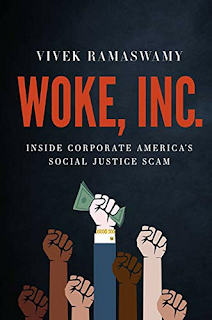
The Big Lie of Woke Capitalism

 My latest on American Thinker:


"There are at least three terms to describe the concept of stakeholder capitalism -- corporate wokeness, woke corporatism and woke capitalism. The last of the three was coined in 2015 by Ross Douthat when writing a piece for the New York Times. He defined it as how companies signal their support for progressive causes in order to maintain their influence in society. Since then the concept has become very popular in the U.S. and worldwide, corporations have gone political and seek, or at least profess to seek, change in the world.

On January 24, for one thing, former Unilever CEO Paul Polman wrote in a piece for the Financial Times that “Today, staff and customers believe you should... speak out on big, touchstone issues, from race to fake news and climate change.” In a historic moment of multiple and converging global challenges, he thinks, we have no other option but to embrace so-called stakeholder capitalism. After all, evidence is stacking up to show the “financial benefits to companies that consistently apply their principles and actively work to solve societal problems,” he argues. “Not everyone agrees, however,” he sadly but honestly acknowledges. In fact, if there is a big support for stakeholder capitalism among corporations, there’s also been a backlash from conservative voices, as we will see below. But let us dwell a little more on the supporters of stakeholder capitalism.

In his annual letter to BlackRock shareholders a few days ago, CEO Larry Fink argued that expectations of business leaders have changed dramatically in the last few years. Increased profits, happy shareholders, and more jobs are no longer what a chief executive is expected to deliver. For instance, most stakeholders -- from shareholders, to employees, to customers, to communities, and regulators -- “now expect companies to play a role in decarbonizing the global economy.” And “few things will impact capital allocation decisions -- and thereby the long-term value of your company -- more than how effectively you navigate the global energy transition in the years ahead.” This illustrates perfectly what stakeholder capitalism -- the new mantra of the Business Round Table as announced in August 2019 and endorsed by almost 200 CEOs of the largest corporations -- is all about..."


Read more: The Big Lie of Woke Capitalism


July 19, 2021

The Woke Are Coming to Britain


As a result of the rise of wokism, faith in the principles of economic freedom and meritocracy is at an all-time low in the UK... My latest on American Thinker

February 19, 2021

My New Book Is out and Available on Amazon!

Dear Readers,

Here we go again, a new book is born. A few weeks ago, when all the chapters were already written, I just had to write the Introduction to outline the purpose, goals, and contents of the book. Which, at least as regards the contents, was not an easy task at all, since this is a book that ranges across a vast array of topics and subjects. Yet I was well aware that the contents are not what matters most, to some extent they are just a chance and an opportunity. What matters most is what certain events, facts, issues, thoughts, and feelings can teach us about ourselves, life, and the world around us. I’d say that this book is a dialogue with myself about my understanding of and relationship with life itself. Existential, political, and philosophical issues—which are frequently recurrent in the book—are functional to wider self-knowledge and self-understanding. But this is not a philosophical book, despite the many philosophical issues that crowd its pages. Nor is it a political one, despite the seven subchapters devoted to the Trump era and its implications in the political, social, cultural, and economic life in the U.S. and elsewhere.

Let’s put it this way: to me, it is always like this in people’s lives, the idea is to always go forward, to progress toward an ever better condition. And it is right that it should be so. But reality rarely matches the initial vision exactly, and often it marches in the opposite direction. Contrary to popular belief, in our times many never stop unlearning, nor do they give up rising in the hierarchy of what is contrary to the Good, the Beautiful, the Just, or simply the Reasonable. Ours are times of intellectual chaos and moral relativism, if not nihilism, and everything seems on the verge of falling apart, as the events of the recent past in the U.S. and elsewhere, in case it was needed, have abundantly shown—by the way, while I was writing the Introduction, thousands of President Donald Trump’s ardent supporters violently were storming the U.S. Capitol building, prompting evacuations, injuries, and arrests...

The whole story of Covid-19 fits perfectly into this context, to the point of becoming, at least in my mind, an effective metaphor of the Zeitgeist, which is interwoven with individual and collective pursuits, aspirations, and ambitions that are so very often ill-conceived, short-sighted, and based on false premises. Yet, such an upside-down world is nevertheless our one and only world—and it is well worth fighting for, in spite of everything. In a small way and to some extent, Blessed Are the Free in Spirit. A Journal in Complicated Times is my contribution to the fight.

Like my previous book, Blessed Are the Contrarians. Diary of a Journey Through Interesting Times, this one is a kind of diary of a journey through our time—politics, culture, lifestyles, worldviews, etc.—and back home again, where “home” stands for a deep sentiment of belonging to our own free and indomitable spirit, which is much stronger than the spirit of our times, however powerful and attractive it may be. Moreover, in this book, as in Blessed Are the Contrarians, I have selected some of the articles posted on my blog over the last few years, those most suitable for this traditional mode of communication. In other words, Blessed Are the Free in Spirit is somehow none other than Part Two of Blessed Are the Contrarians. But with a couple of differences. The first being that in this book, the “journal” entries are arranged in chronological order (from most recent to oldest), as well as by subject matter. The second is that the author is no longer exactly the same person he was when the first book came out in 2012. This for the simple reason that time never passes in vain. As Heraclitus said, “You cannot step into the same river twice.” The water in the river is never the same, it is constantly moving, so the river is never the same river twice…

One word on the title of the book. A free-spirited person can be many different things—even (at least apparently) opposed to one another rather than harmonious or compatible—because their heart is their compass, and heart has no boundaries or rules imposed from outside. When they are religious, they tend to focus on the innermost teachings and truths of their religious faith rather than the “letter” of the Scriptures—and therefore they’re often, if not always, on the verge of heresy... They do not dwell on the past but resist a progress built on the destruction of traditions that go back many centuries and of the systematic denial of our history and civilization. They are fiercely independent, but can still develop a close emotional bond with those who provide for them and look to others for protection. They deeply care about their beliefs and what they feel strongly about but seem to not worry at all—except the bare minimum—about normal stuff like money, career, success, etc.

Free-spirited people are the salt of the earth, they are not restful persons. You never relax with these people. They are inspiring and thought-provoking, challenging and uplifting, men and women at their best. They are “contrarians” in the best sense of the word. And so they are somehow a step ahead of those to whom I dedicated my previous book. Some time ago, I stumbled upon an excellent definition of that blessed kind of person: “A free spirit is not bound by this, that, matter, materialism or opinion. They sing, dance, and flow on the wind—for they are at one with it. They are nothing and everything—void and expanse. Even space and time do not confine or define them. For they are pure energy itself” (Rasheed Ogunlaru).

With that being said, please note that free-spirited does not mean self-referential, solipsistic, or selfish. Quite the contrary. It’s because they are deeply in love with Life, Humanity, Poetry, Music, Dance, Theater, Writing and so many other things that Free-spirited people are what they are—if they flow on the wind it’s because they are at one with it! If they are self-confident it’s because they have faith in life! As the French say, tout se tient (everything fits). Freedom itself is not an absolute, not an either-or proposition, but a set of relations, possibilities mixed with actualities. Likewise, freedom of spirit, which is the quintessence of human nature, is basically the fruit of a compromise, a miracle of balance and elegance. Ultimately, free-spirited people cannot but be the result of a coincidentia oppositorum (the coincidence of opposites). As the most elegant of essayists and a living miracle of balance and intellectual like Michel de Montaigne once said, “One may be humble out of pride.” Which is certainly not a good thing, but what if we apply the same scheme in positive rather than in negative terms? Well, let’s say, for instance, that one may be cheerful/ironic out of seriousness, easy-going out of severity, naive out of sophistication, and so on. Hence Montaigne’s writing en chair et en os (“in the flesh”), as well as the imperceptibly subversive turns of his sentences and the slyly ironic tone that often creeps into his Essays. That’s what free-spirited people are made up of, and why they are the salt of the earth.

By invoking blessings on the Free in spirit, I’m trying to express the feeling I feel for them, my deep admiration and gratitude for their very special contribution to mankind and society. They are my North Star, my source of inspiration, and the reason why I am what I am. I would like to think that in whatever I write there is something the free-spirited writers and thinkers of the past centuries would approve of. Likewise, I hope what I write does not displease the free spirits of our day too much.

Now, for me, there’s nothing left to do but wish you happy reading and look forward to hearing from you with any questions or comments that you may have.


Blessed Are the Free in Spirit. A Journal in Complicated Times 
Paperback Ed. - ISBN-13 : 979-8702016979 - Publication date : February 5, 2021
Kindle Ed. - ASIN : B08W2DP9RC - Publication date : February 4, 2021