Showing posts with label books. Show all posts

June 9, 2024

How the West Was Lost at Oxford University


My latest on American Thinker.
The British cultural establishment triumphantly welcomed a new history book according to which Western civilization has always been a bad idea... This unequivocally means that the capitulation of the British cultural establishment to “woke” culture — and other elite obsessions — is complete.


Once upon a time, we were told that the peoples of the Western world — which includes countries like Australia and New Zealand, although located in the Eastern Hemisphere — are heirs and trustees of Western civilization, imbalances and excesses included.  Often referred to simply as “the West,” Western civilization is a broad concept used to understand the cultural, social, political, and economic norms, traditions, values, and institutions that originated in or are associated with Europe.  It has its roots in Ancient Greece and Rome as well as in Christianity, humanism, the Renaissance, the Enlightenment, and the Industrial Revolution. It values rationalism, democracy, and individual freedoms and rights.

Later on, Marxist and otherwise far-left historians argued that the history of the West is marked by exploitation and conflict among different social classes, from feudal lords and serfs in the Middle Ages to capitalists and workers in the modern era.  Marxists, in particular, introduced the concept of cultural hegemony, formulated by Antonio Gramsci to describe ideological domination of the bourgeoisie over the proletariat.  In other words, according to this type of approach, the dominant cultural norms and values of Western civilization serve to maintain the power of the ruling class.

As of now, the left-wing narrative is that Western civilization is an illusion.  Postmodern and deconstructionist historians have claimed that the West is a late invention of the 18th-century philosopher. Skeptical of the grand narratives that have historically been used to describe Western civilization, such as progress, enlightenment, etc., they argue that these narratives often oversimplify complex histories and marginalize alternative perspectives.

It is in this context that the new book How the World Made the West, written by Josephine Quinn, professor of ancient history at Oxford University, needs to be read.  It’s aimed to bring to fulfillment the goal and the dream of legions of leftists the world over and from time immemorial. [...]  


November 8, 2021

Will American Wokeness Destroy the Rest of the West?


It definitely seems that there's a sickness emanating from the United States that seeks to contaminate all of Western civilization. France in particular, believe it or not, is alarmed... 

March 20, 2021

Blessed Are the Free in Spirit: a Review by Walter Bernardone

Once upon a time, I was a blogger. Now I’m someone who has a blog somewhere but has no time to update it anymore. But once a blogger, always a blogger… yeah, as Samuel Robert Piccoli has brilliantly (albeit indirectly) shown throughout his new book, blogging is much more than simply writing, it’s a way of life. Most people think blogging is a Web site on which people publish periodic entries in reverse chronological order and allow readers to leave comments.

This is only partially true, however. As a matter of fact, blogging is defined more by a personal and opinionated writing style. The over-40’s know that blogs went largely unchallenged until Facebook reshaped consumer behavior with its all-purpose hub for posting everything social. Twitter also contributed to the upheaval. No longer did Internet users need a blog to connect with the rest of the world. They could instead post quick updates to link to articles that infuriated them, comment on news events, share photos or promote some cause, all the things a blog was intended to do. Yet the change is real, but not essential.

What I loved most about Blessed Are the Free in Spirit is that it is the quintessence of blogging, an example of blogging at its best.

Rob – as the author is best known in the blogosphere and social media – is also a philosopher and a man of letters, and this makes his writing even more fascinating. He can write about almost everything, as his book shows, without boring the reader. In short, he’s a great writer.

Walter Bernardone (GoodReads, March 16, 2021)

Blessed Are the Free in Spirit: a Review by Helen Butler

Rarely have I come across such an inspirational and enlightening book. Though simply and pleasantly written, Blessed Are the Free in Spirit: A Journal in Complicated times displays a critical spirit that is rare for our time of politically correct madness. This book challenges the reader without appearing to and without ever trying to preach to them, letting them make their own minds up about the many issues and topics the author touches upon, ranging from philosophy to literature, from politics to social media, from songs to seasons and places…

At the same time the book shows the importance to have a strong inner compass, and in so doing the author takes the reader’s consciousness to the highest level.

With that being said, if there is a flaw with this book, it is that it is not for everyone: it is not for small-minded people. It is not for people who cannot bear the freedom to be themselves and to take risks rather than just follow convention.

Politically speaking I’d say that this is a book for open-minded Conservatives and common-sense Liberals, or vice versa. Religiously speaking, in turn, this is a book for open-minded Christians and open-hearted secularists. And so on. Not by chance, as the author himself suggests in the Introduction, Blessed Are the Free in Spirit was conceived under the sign of Michel de Montaigne, who excelled in the art of looking at the things of this world without blinkers, prejudices, and preconceived notions. As S.R. Piccoli puts it, “the Lord of Montaigne was a skeptic, but of a very different sort from the one we are familiar with. He was not the kind of skeptic who basically believes in nothing, who refuses to take anything on faith, who takes issue with organized religion, and things like these. Yes, he was a man who doubted almost everything, but at the same time, he was a good Catholic, one who believed without reservation all that the church taught and prescribed. Strange enough, isn’t it? But strange as it might seem, to be honest that’s what I have always liked the most about him.”

To say that I like this book is an understatement, I love Blessed Are the Free in Spirit and strongly recommend it!

Helen Butler (GoodReads, March 13, 2021)

February 19, 2021

My New Book Is out and Available on Amazon!

Dear Readers,

Here we go again, a new book is born. A few weeks ago, when all the chapters were already written, I just had to write the Introduction to outline the purpose, goals, and contents of the book. Which, at least as regards the contents, was not an easy task at all, since this is a book that ranges across a vast array of topics and subjects. Yet I was well aware that the contents are not what matters most, to some extent they are just a chance and an opportunity. What matters most is what certain events, facts, issues, thoughts, and feelings can teach us about ourselves, life, and the world around us. I’d say that this book is a dialogue with myself about my understanding of and relationship with life itself. Existential, political, and philosophical issues—which are frequently recurrent in the book—are functional to wider self-knowledge and self-understanding. But this is not a philosophical book, despite the many philosophical issues that crowd its pages. Nor is it a political one, despite the seven subchapters devoted to the Trump era and its implications in the political, social, cultural, and economic life in the U.S. and elsewhere.

Let’s put it this way: to me, it is always like this in people’s lives, the idea is to always go forward, to progress toward an ever better condition. And it is right that it should be so. But reality rarely matches the initial vision exactly, and often it marches in the opposite direction. Contrary to popular belief, in our times many never stop unlearning, nor do they give up rising in the hierarchy of what is contrary to the Good, the Beautiful, the Just, or simply the Reasonable. Ours are times of intellectual chaos and moral relativism, if not nihilism, and everything seems on the verge of falling apart, as the events of the recent past in the U.S. and elsewhere, in case it was needed, have abundantly shown—by the way, while I was writing the Introduction, thousands of President Donald Trump’s ardent supporters violently were storming the U.S. Capitol building, prompting evacuations, injuries, and arrests...

The whole story of Covid-19 fits perfectly into this context, to the point of becoming, at least in my mind, an effective metaphor of the Zeitgeist, which is interwoven with individual and collective pursuits, aspirations, and ambitions that are so very often ill-conceived, short-sighted, and based on false premises. Yet, such an upside-down world is nevertheless our one and only world—and it is well worth fighting for, in spite of everything. In a small way and to some extent, Blessed Are the Free in Spirit. A Journal in Complicated Times is my contribution to the fight.

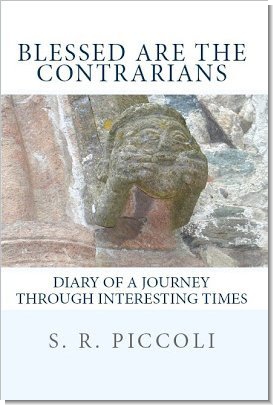
Like my previous book, Blessed Are the Contrarians. Diary of a Journey Through Interesting Times, this one is a kind of diary of a journey through our time—politics, culture, lifestyles, worldviews, etc.—and back home again, where “home” stands for a deep sentiment of belonging to our own free and indomitable spirit, which is much stronger than the spirit of our times, however powerful and attractive it may be. Moreover, in this book, as in Blessed Are the Contrarians, I have selected some of the articles posted on my blog over the last few years, those most suitable for this traditional mode of communication. In other words, Blessed Are the Free in Spirit is somehow none other than Part Two of Blessed Are the Contrarians. But with a couple of differences. The first being that in this book, the “journal” entries are arranged in chronological order (from most recent to oldest), as well as by subject matter. The second is that the author is no longer exactly the same person he was when the first book came out in 2012. This for the simple reason that time never passes in vain. As Heraclitus said, “You cannot step into the same river twice.” The water in the river is never the same, it is constantly moving, so the river is never the same river twice…

One word on the title of the book. A free-spirited person can be many different things—even (at least apparently) opposed to one another rather than harmonious or compatible—because their heart is their compass, and heart has no boundaries or rules imposed from outside. When they are religious, they tend to focus on the innermost teachings and truths of their religious faith rather than the “letter” of the Scriptures—and therefore they’re often, if not always, on the verge of heresy... They do not dwell on the past but resist a progress built on the destruction of traditions that go back many centuries and of the systematic denial of our history and civilization. They are fiercely independent, but can still develop a close emotional bond with those who provide for them and look to others for protection. They deeply care about their beliefs and what they feel strongly about but seem to not worry at all—except the bare minimum—about normal stuff like money, career, success, etc.

Free-spirited people are the salt of the earth, they are not restful persons. You never relax with these people. They are inspiring and thought-provoking, challenging and uplifting, men and women at their best. They are “contrarians” in the best sense of the word. And so they are somehow a step ahead of those to whom I dedicated my previous book. Some time ago, I stumbled upon an excellent definition of that blessed kind of person: “A free spirit is not bound by this, that, matter, materialism or opinion. They sing, dance, and flow on the wind—for they are at one with it. They are nothing and everything—void and expanse. Even space and time do not confine or define them. For they are pure energy itself” (Rasheed Ogunlaru).

With that being said, please note that free-spirited does not mean self-referential, solipsistic, or selfish. Quite the contrary. It’s because they are deeply in love with Life, Humanity, Poetry, Music, Dance, Theater, Writing and so many other things that Free-spirited people are what they are—if they flow on the wind it’s because they are at one with it! If they are self-confident it’s because they have faith in life! As the French say, tout se tient (everything fits). Freedom itself is not an absolute, not an either-or proposition, but a set of relations, possibilities mixed with actualities. Likewise, freedom of spirit, which is the quintessence of human nature, is basically the fruit of a compromise, a miracle of balance and elegance. Ultimately, free-spirited people cannot but be the result of a coincidentia oppositorum (the coincidence of opposites). As the most elegant of essayists and a living miracle of balance and intellectual like Michel de Montaigne once said, “One may be humble out of pride.” Which is certainly not a good thing, but what if we apply the same scheme in positive rather than in negative terms? Well, let’s say, for instance, that one may be cheerful/ironic out of seriousness, easy-going out of severity, naive out of sophistication, and so on. Hence Montaigne’s writing en chair et en os (“in the flesh”), as well as the imperceptibly subversive turns of his sentences and the slyly ironic tone that often creeps into his Essays. That’s what free-spirited people are made up of, and why they are the salt of the earth.

By invoking blessings on the Free in spirit, I’m trying to express the feeling I feel for them, my deep admiration and gratitude for their very special contribution to mankind and society. They are my North Star, my source of inspiration, and the reason why I am what I am. I would like to think that in whatever I write there is something the free-spirited writers and thinkers of the past centuries would approve of. Likewise, I hope what I write does not displease the free spirits of our day too much.

Now, for me, there’s nothing left to do but wish you happy reading and look forward to hearing from you with any questions or comments that you may have.


Blessed Are the Free in Spirit. A Journal in Complicated Times 
Paperback Ed. - ISBN-13 : 979-8702016979 - Publication date : February 5, 2021
Kindle Ed. - ASIN : B08W2DP9RC - Publication date : February 4, 2021 

September 26, 2020

The Purpose of Reading


There is a story on the internet and social media that talks about “the purpose of reading.” Nothing too original, nor particularly brilliant, at least in my opinion, but quite thought-provoking and, in its own way, insightful. Unfortunately, though, it is written in broken English—perhaps it’s a bad English translation of a story that was originally written in Chinese or another Far Eastern language... Thus I thought it was worth being rewritten in good English, so I asked an old friend of mine, Peter Weevers, who is a great storyteller, perfect for the job, to take over the task of doing justice to a beautiful story. And here is the excellent result: 
 

I’ve read lots of books, but most of them I’ve forgotten. What then is the purpose of reading them?” This was the question a pupil once asked his Master.
The Master didn’t answer at that time. After a few days, however, during a peaceful period when he and the young student were sitting by a river, he said he was thirsty and asked the boy to bring him some water using an old, dirty sieve that he found lying there on the ground.
The student was taken aback because he knew it wasn’t a reasonable request.
However, not wishing to displease his Master, he took the sieve and began to try to carry out this absurd task.
Every time he dipped the sieve into the river to scoop up some water to take to his Master, after only one step towards him there was not even a drop left in the sieve.
He kept trying several times but, as hard as he tried, even running as fast as he could from the riverbank to his Master, the water continued to pass through the mesh of the sieve and was all lost in the process. 
Finally exhausted, he sat down next to the Master and said: “I cannot bring any water with the sieve. Forgive me, Master, it’s impossible and I have failed in my task.”
“No,” answered the old man smiling, “you have not failed. 
Look at the sieve, now it shines, it’s clean, like new. The water, filtering through its mesh has thoroughly cleaned it.”
“When you read books,”  continued the old Master, “you are like a sieve and what you read is like the water of the river. It doesn’t matter if you can’t memorize all the words that flow through your mind, because books, with their ideas, emotions, feelings, knowledge, truths, that you read on their pages, will clean your mind and your spirit. They will renew you and make you a better person. 
This is also the purpose of the reading.” 

~ Anonymous


Music to my ears and those of the many whose memory leaves much to be desired! In any case, that’s exactly how it works, I get confirmation of this whenever I happen to think about something important or someone I care about. Books I thought I had forgotten—and suddenly they come to my mind, along with the gist of everything they taught me, showed me, suggested to me, and the ineffably good vibes they transmitted to me.

But the story also explains something that goes far beyond the books themselves: even books you may have totally forgotten about are essential and may continue operating inside us all in mysterious ways. French politician Edouard Herriot famously said that “culture is what remains when one has forgotten everything.” What is certain is that very few students could pass their final examinations even a year or two after leaving college or university. But the results in culture, in largeness of being, in purity of feeling, in nobility of character, still remain. In other words, culture is not so much a “thing” you own as a process and an attitude of mind—an attitude that is rooted mainly in our literary, philosophical, and religious readings. Hence, by the way, the importance of both increasing our reading and understanding ability on one hand, and of carefully selecting what we read on the other hand—classics are always the best choice, this goes without saying and it’s why I think I haven’t wasted a single minute of the time I’ve spent reading books!

August 17, 2019

R.I.P. Peter Fonda


If I hadn’t read Jack Kerouac’s On the Road—among many other novels set in the U.S.—and seen Peter Fonda’s Easy Rider, I probably wouldn’t have undertaken my pilgrimage to America in my early thirties and wouldn’t have fallen in love with her… I mean the real America, “the land of the free and the home of the brave,” not the country narrated by both Jack and Peter. You know, they call it heterogony of ends: while consciously pursuing your particular ends, you have unconsciously served wider ends, or if you prefer, I was like Columbus, who thinking he was going to China discovered a new world. Therefore, willing or unwilling, I owe them both a debt of gratitude. Kerouac died in 1969, the same year as Woodstock (!) and that Easy Rider came out. Maybe a coincidence, maybe not. And yesterday, exactly 50 years later, he died at the age of 79.

What about the movie? Well, since I’m not particularly adept at talking about films with the minimum competency requirements, it is my pleasure to give the floor to someone who knows more than I do. This is how Mark Bannerman concluded his article on ABC News (August 17, 2019):

Some 50 years on, there are those that see it as a curious film; a kind of period piece. For others it's the story that matters, a story that has crucial relevance today. Forget the bikes and the hippies and see it instead as an allegory of America. Two guys doing a questionable business deal, using it to fund their search for experience and meaning only to find the deal they did took them on a road leading nowhere.
In so many ways it challenges everything that America rests on.
Towards the end of the film Peter Fonda's character looks back on their journey and says simply: “We blew it.”
Asked about this just before his death, the actor said the line of script was intended for all generations, then added this pointed comment.
“Go look out the window and tell me we haven't blown it.”
Not my cup of tea, to be honest. But no hard feelings on my part. May the ground be light to you, Peter.

April 28, 2019

Why I Won't Delete My Social Media Accounts

A couple of days ago a good Facebook friend of mine asked me my thoughts on a couple of interviews released by Jaron Lanier. An American computer scientist who is considered by many to be one of the central figures in the history of immersive virtual reality, Lanier has now ascended to guru status in tech circles, issuing warnings about a digital world he helped make. In the interviews, like in his latest book—Ten Arguments for Deleting Your Social Media Accounts Right Now (2018)—he talks about Facebook, Twitter, YouTube, Google and how the tech and social media giants are using algorithms to record data about their users and to shape how we see the world and what we’re shown online. In particular, he contends that sites like Facebook and Twitter are dopamine farms that are reprogramming how you think and feel. He says they’re also causing political instability, and are changing the global economy for the worse.

At first, I thought I could write down a quick reply in the comment section, but then again I thought that the matter is too serious to be taken lightly, I mean I didn’t want to get off lightly. Therefore I realized it was worth writing a blog post at least. And here I am. Let me first say that I’m no expert on the subject here, even though last year, intrigued by a couple of reviews, I had a quick read of the above-mentioned book. (I also had the opportunity to read something about James Williams, yet another guru of computer science, a former Google product strategist who became a philosopher at the University of Oxford and whose research addresses the philosophy and ethics of attention and persuasion—in harsh opposition to the giant of the I-tech and on the same wavelength with Lanier, he argues that digital technologies privilege our impulses over our intentions, and are gradually diminishing our ability to engage with the issues we most care about.)

But let’s now get into some of the most fundamental and relevant concepts of Lanier’s thought. Take for instance the well-known concept of random reinforcement—addiction fed not by reward but by never knowing whether or when the reward will come. Well, Lanier puts it like this:

When the algorithm is feeding experiences to a person, it turns out that the randomness that lubricates algorithmic adaptation can also feed human addiction. The algorithm is trying to capture the perfect parameters for manipulating a brain, while the brain, in order to seek out deeper meaning, is changing in response to the algorithm’s experiments; it’s a cat-and-mouse game based on pure math. Because the stimuli from the algorithm don’t mean anything, because they genuinely are random, the brain isn’t responding to anything real, but to a fiction. That process—of becoming hooked on an elusive mirage—is addiction. As the algorithm tries to escape a rut, the human mind becomes stuck in one.

Roughly speaking, the reasons for freeing ourselves from social media include their tendency to trick us with illusions of popularity and success, to spend too much time isolating ourselves and disconnecting from the real world in order to maintain the perception of being connected, to twist our relationship with the truth, to rob us of our free will with relentless targeted ads, and to make politics terrifying. In other words, they bring out the worst in us. More specifically, here are “the ten arguments for deleting your social media accounts right now” (and the titles of the chapters of the book) in a nutshell:

1. You are losing your free will. Social media has become a space where everyone is posting for likes and comments…
  • Sean Parker, first president of Facebook: “We need to sort of give you a little dopamine hit every once in a while, because someone liked or commented on a photo or a post or whatever....It’s a social-validation feedback loop... exactly the kind of thing that a hacker like myself would come up with, because you’re exploiting a vulnerability in human psychology....The inventors, creators -- it’s me, it’s Mark [Zuckerberg], it’s Kevin Systrom on Instagram, it’s all of these people -- understood this consciously. And we did it anyway...it literally changes your relationship with society, with each other...It probably interferes with productivity in weird ways. God only knows what it’s doing to our children’s brains.”
  • Chamath Palihapitiya, former vice president of user growth at Facebook: “The short-term, dopamine-driven feedback loops we’ve created are destroying how society works.... No civil discourse, no cooperation; misinformation, mistruth. And it’s not an American problem -- this is not about Russian ads. This is a global problem... I feel tremendous guilt. I think we all knew in the back of our minds—even though we feigned this whole line of, like, there probably aren’t any bad unintended consequences. I think in the back, deep, deep recesses of, we kind of knew something bad could happen...So we are in a really bad state of affairs right now, in my opinion. It is eroding the core foundation of how people behave by and between each other. And I don’t have a good solution. My solution is I just don’t use these tools anymore. I haven’t for years.”

2. Quitting social media is the most finely targeted way to resist the insanity of our times. In this chapter, Lanier introduces an acronym under which all social media’s ills can be umbrellaed: “BUMMER” or “Behaviors of Users Modified, and Made into an Empire for Rent.” The Bummer machine is made up of six parts, indexed by the following mnemonic: A for Attention Acquisition leading to Asshole supremacy; B for Butting into everyone’s lives; C for Cramming content down people’s throats; D for Directing people’s behaviours in the sneakiest way possible; E for Earning money from letting the worst assholes secretly screw with everyone else; and F for Fake mobs and Faker society.
3. Social media is making you into an asshole. Meeting your inner troll, etc. This might be one of the most compelling reasons for either quitting or never joining social media.
4. Social media is undermining truth. Myths and lies spread across the internet like wildfire…
5. Social media is making what you say meaningless. Because it strips it of context.
6. Social media is destroying your capacity for empathy. “If you don’t see the dark ads, the ambient whispers, the cold-hearted memes and the ridicule-filled customized feed that someone else sees, that person will just seem crazy to you. And that is our new Bummer world. We seem crazy to each other because Bummer is robbing us of our theories of one another’s minds.” Hence the explosion of nastiness, a great blossoming of “assholes.”
7. Social media is making you unhappy. The author states that due to targeted advertisements, if you look up something unhappy you will start seeing ads similar to that search and will create an even greater sense of sadness…
8. Social media doesn’t want you to have economic dignity. The reason BUMMER is a huge issue is because the internet is free. Lanier thinks that if each user pays a small fee, advertisers will not be targeting audiences and people can live in greater harmony online…
9. Social media is making politics impossible. “There are so few independent news sites, and they’re precious … Our huge nation is only a few organizations away from having no independent newsrooms with resources and clout.“ But above all, BUMMER may have no party affiliation but, as stated before, is pro-asshole.
10. Social media hates your soul. A couple of quotes:
  • “Usually Google has had a way of coming up with the creepier statements, but Facebook has pulled ahead: A recent revision in its statement of purpose includes directives like assuring that ‘every single person has a sense of purpose and community’. A single company is going to see to it that every single person has a purpose, because it presumes that was lacking before. If that is not a new religion, I don’t know what is.”
  • “When you use BUMMER, you implicitly accept a new spiritual framework. It is like the EULA agreement—the user agreement—that you clicked “OK” on without reading. You have agreed to change something intimate about your relationship with your soul. If you use BUMMER, you have probably, to some degree, statistically speaking, effectively renounced what you might think is your religion, even if that religion is atheism. You have been inducted into a new spiritual framework.”


What shall I say about this book? Well, if I’m being honest, ever since I read Ten Arguments for Deleting Your Social Media Accounts Right Now the first definition that comes to my mind when I think of Lanier is exaggerated. Don’t get me wrong, I think the book is interesting and thought-provoking. Maybe nothing really new—these or similar ideas have been debated for some years now—but a good summary and exploration of the big personal and broader societal problems associated with social media. Despite his critical approach to the whole social media thing, however, Lanier has not lost hope. Speaking in general terms, that is, without specific reference to social networks, he thinks that “we can definitely make better interaction devices than we have.” As he told Wired in 2017, “there are lots of displays and sensors yet to be built. There’s so much to improve. But I love that. […] We’re in a perilous time. But I really believe in the human capacity for increased creativity and intelligence and wisdom, and I think if we present the tech in such a way that people have an ability to really see it and master it, they’ll rise to the occasion.”

As for social networks, he argues that If users rebel, Facebook, Twitter, etc. have an incentive to change for the better. “Whoever you are,” he explains in the book, “I hope you have options to explore what your life might be, especially if you are young. You need to make sure your own brain, and your own life, isn’t in a rut. Maybe you can go explore wilderness or learn a new skill. Take risks. But whatever form your self-exploration takes, do at least one thing: detach from the behavior-modification empires for a while—six months, say? Note that I didn’t name this book Arguments for Deleting Your Social media Accounts Right Now and Keeping Them Deleted Forever. After you experiment, you’ll know yourself better. Then decide.”

Put down this way, it would seem a rather moderate and balanced approach. But this is only one side of the story. The other is the depiction of a dark future and an even worse future based on the systematic amplification and exaggeration of issues that are real but not that dramatic. To say nothing about the contradiction in which the author finds himself: he explains how social media is making America tribal, but at the same time he goes out of his way to add extraneous content attacking Republicans. He attacks president Trump for his alleged addiction to tweeting, while ignoring those who gang up on him using bot networks and troll factories. Unfortunately, the obsession with politics turns an otherwise interesting book into a partisan attack. He starts his book nicely—with a metaphor comparing cats and dogs to social media users to show a divide between those who use social media and those who don’t—and he ends up just another unashamedly biased political commentator.

In any case, if we were to follow what seems to be the logic of his reasoning, we should also stop reading books and newspapers, watching television, using email, etc. In reality, every progress brings with it negative side effects, new challenges but also new opportunities. Every innovation carries both advantages and unpredictability, both desired and unintended collateral effects. Social media is just a tool, and like most tools, it can be used well or horribly or anywhere in between. It is not social media that “makes politics impossible,” nor is it politics that makes social media awful. Both social media and politics are tools. Paraphrasing the NRA saying (“It’s not guns that kill people it’s people that kill people”), it’s not social media that makes people into assh*les, it’s assh*les that make social media a sh*tty place.

June 5, 2016

My Books & the Historic Athenaeum Fund of Ca' Foscari University of Venice


Biblioteca Nazionale Marciana, Venice. Sansovinian Hall
I am pleased to inform the readers—especially those living or visiting the Venice area—that starting from June 2016 my books have been catalogued and incorporated into the collections of the Fondo Storico di Ateneo (Historic Athenaeum Fund) of Ca’ Foscari University of Venice—which is part of the Italian National Library Service (SBN) promoted by the Italian Ministry for Cultural Heritage and locally managed by the Biblioteca Nazionale Marciana. The books are available for consultation by scholars and students.

Here are the direct links to the books:

November 16, 2015

A Christian Story in the Spirit of C.S. Lewis

The story is set in a dystopian future in which humans have built walls and barricades to protect themselves from a world that has become a very dangerous place… A centuries-old wall stands over 30 meters high and 5 meters thick. It encircles the entire village, called the Wee, and keeps the demons out. Of course, at the same time, it locks people in. But one day the demons—not mere metaphors, but flesh and blood living entities—break through the village walls. A restless and somewhat impetuous sixteen-year-old girl named Fox Fire joins Cross Academy to be trained for the fight against the evil monsters. Things get more and more complicated when Fox Fire’s best friend KI—who had his parents killed by the demons several years before—becomes he himself demon possessed.

Pleasantly and colorfully written, Cross Academy is recommended if you like dark epic fantasy. But this book is more complex (structurally and thematically) than you’d think. In fact it is written by an American committed and devout Christian, Valicity Garris, in the spirit of C.S. Lewis. It’s a Christian story, though an unconventional one, which reminds us that “our struggle is not against flesh and blood, but against the rulers, against the authorities, against the powers of this dark world and against the spiritual forces of evil in the heavenly realms” (Ephesians 6:12).

November 10, 2015

A Powerful and Mesmerizing Story

This book was definitely worth my time and I am glad to have read it! Not that I’m a big reader of the fantasy fiction genre—even though perhaps Blood and Soul, by Allen G. Bagby, transcends its genre and seeks to understand the basis of human existence, and that’s also why I enjoyed the read so much, and once started reading I couldn’t put it down. Fascinating and complex characters, sparkling dialog, and intriguing plots combine to create a powerful and mesmerizing story that I highly recommend to all lovers of fantasy and high adventure.

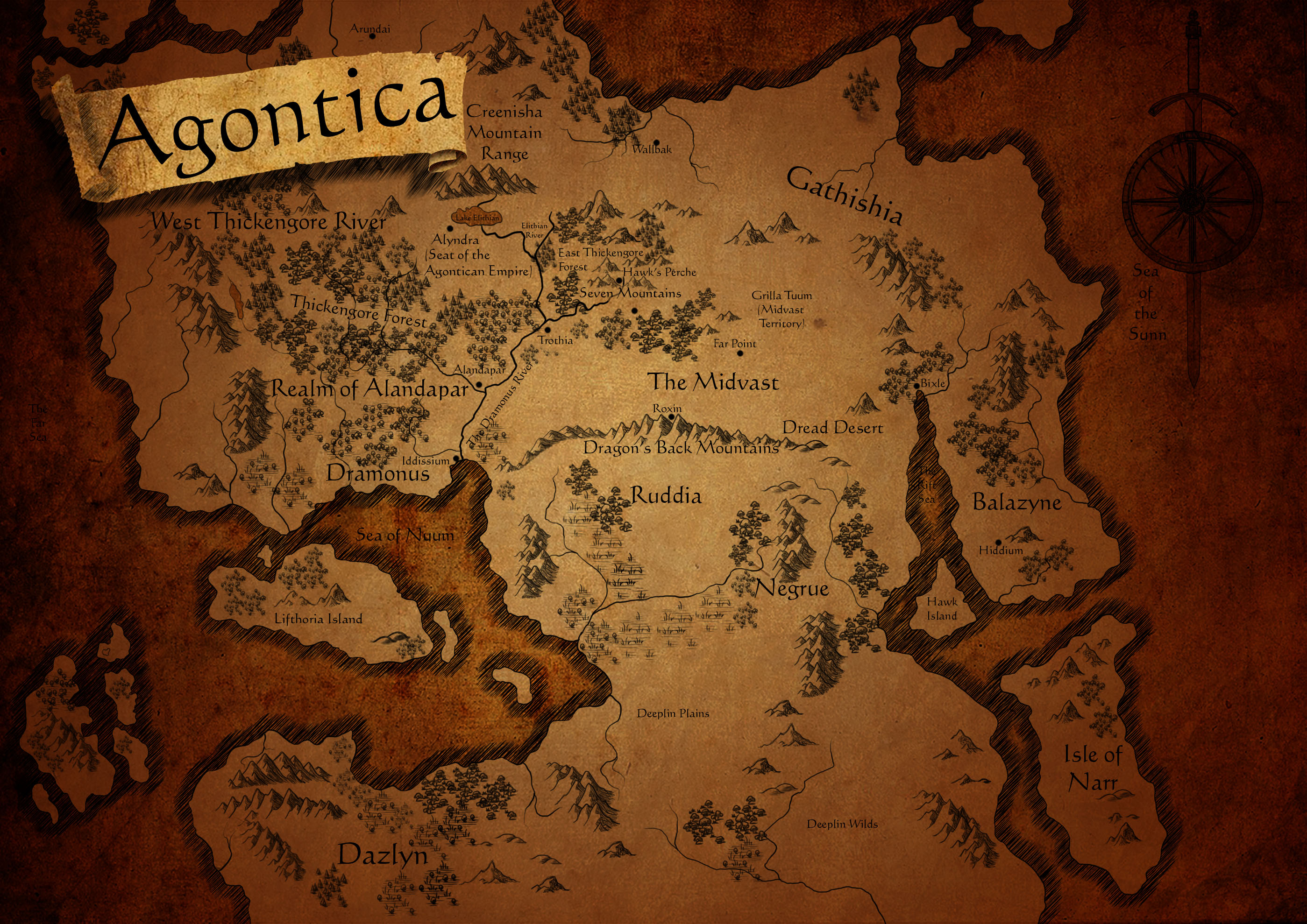
Set in a world similar to our Middle Ages, in a land called Agontica (a full-color map is available for download from the Author’s web-site), the story is a Hero’s Journey—a physical, emotional, mental, and spiritual one—with all the archetypal, symbolic elements: the Hero (the bastard Prince Ledarrin), the Antagonist (Mathagel), the Mentor, etc.

Simply put, the story has all the ingredients of a blockbuster epic: loyalty, intrigue, betrayal, war, survival, magic… At the same time, though, it is more than that: in this book you will also find history, theology, ethics, and politics. Which is something that adds a lot of value to the book and encourages the reader to think differently about life and the issues we deal with.

November 8, 2015

A Perfect Dystopia

In an Author’s note at the end of the book, Peter Meredith tells us that A Perfect America was inspired by two things. The first is the 2012 election—“a bit of a shock to many conservatives,” he recalls: “It seemed that a perfect storm had aligned against the president—terrible economic news, bad job reports four years running, skyrocketing debt, and poor performance in foreign policy—made it seem like the republican nominee would be a shoe-in.” But no, Romney lost to Obama. “It made me wonder,” Meredith continues, “if Romney couldn’t win in this situation when could another Republican ever win and what would happen if they never won again? I took the thought and ran with it. Though with history as a primer it didn't take much imagination. We don’t have to look past the Bolshevik revolution to see that a culture could be utterly destroyed and replaced with something almost exactly like what is described in A Perfect America. Scary indeed.“ Yep, scary! A perfect dystopia. Take a look at the Timeline of A Perfect State:

“2016— Defense of Marriage Act declared unconstitutional
[…]
2018—President offers blanket pardon to all illegal aliens. “No human is illegal!”
2019— Full Implementation of the Patient Protection and Affordable Care act
2020— Cost of Patient Protection and Affordable Care act greater than expected. Top Marginal Tax rate increased to 49%.Healthy Americans Law—among other things the law prohibits use of Transfats and restricts the amount of sugar in canned beverages and cereal.”

And so on, in a crescendo of liberal madness and Orwellian lunacy…, until

“2074— Private ownership of business declared illegal
2077— Freedom of Speech(Including freedom of the Press) is curtailed, determined to be of ―less importance‖ than the protection of the State and the Party.
2078—Fourth and fifth Amendments declared unconstitutional.
2080—Census shows steady population decline and continued negative population growth. New Population Laws are passed—cash rewards are given per child.
2081— Religion is declared illegal. Worship of God is considered subversive.
2082— The Greater Constitution of America ratified—this mainly dictates the rights of the State and the obligations of the citizenry.”

After all, as the good old Abe Lincoln once said “If destruction be our lot, we must ourselves be its author and finisher. As a nation of freemen, we must live through all time, or die by suicide.”

The second source of inspiration , says Meredith, is the Bible. But let’s postpone it for a while… The story is the following: in the year 2122, in the perfect state of America—in which the government owns everything and is everything, and religion, capitalism, homosexuality, and freedom of speech are illegal—Phil Tarsus is an Inquisitor, a man who is used to inflicting pain and causing terror, who makes a living rooting out and executing those people who have been charged with treason against the sanctity of the State. Yet, Stephen, a self-confessed gay sentenced to death by stoning, challenges him with strange, archaic concepts such as redemption and God…

Did you get it now? Phil Tarsus is nothing else but Saul of Tarsus, the Apostle who tortured and persecuted Christians—and was witness to the stoning of Saint Stephen, the first Christian martyr—until, on the road to Damascus, he experienced a vision of Jesus that forever changed his life. The 2012 election and the Bible. “Merge the two halves of the story and A Perfect America is born,” says Meredith.

All in all, therefore, the book provides the reader with both a warning and a sense of hope—there is always a way of escape. Even from the worst of all possible dystopias.

Thought-provoking, fast paced and well-plotted, this book is something I highly recommend for any lover of thriller novels and political fiction. Needless to say, a must-read for Conservatives and Libertarians.

November 5, 2015

Nehemiah: Becoming a Godly Leader -- A Review

Yet another great addition to The Bible Teacher’s Guide series by Gregory Brown. This time it’s the book of the Book of Nehemiah’s turn to be analyzed and studied in depth.

The Book of Nehemiah is somehow the second part of the Book of Ezra. Not by chance, as Brown himself reminds us, both the Septuagint (the Greek translation of the Old Testament) and the Latin Vulgate made them one book, calling Nehemiah “Second Ezra.” The two books tell us about the time when the Jews returned from Babylonia to their own country called Judah. The Book of Ezra—a priest and scribe—is about the first two groups of Jews who returned to Judah, and how they built their temple again. The Book of Nehemiah tells the story of a man whose name was Nehemiah—a high official at the Persian court, sent by God in order to carry out a special task, namely to help the Jews to build the walls round Jerusalem again, despite the opposition of Israel’s enemies. In turn, Artaxerxes, the king of Persia, appointed him as governor of Judah. The most important part of both Ezra’s and Nehemiah’s work, however, was showing the entire city that it should follow all of God’s laws.

Nehemiah was “a man of great integrity who feared the Lord,” and “a devout person of prayer.” He also had “a strong awareness of God’s sovereignty over all events,” as Brown points out in the Introduction. But mostly, Nehemiah and Ezra were “great leaders who God called to work together.” The first handled the practical aspects, the latter handled the spiritual. “As we consider them,” writes Brown, “we cannot but remember other great leaders who God called to work together throughout the narrative of Scripture. God called Moses and Aaron, David and Nathan, Hezekiah and Isaiah, Paul and Barnabas…”

This leads us to focus on the “background” and the “purpose” of the book of Nehemiah: God’s faithfulness to his promises—despite the fact that the people of Israel had disobeyed him and were exiled from the land, God remained faithful to his covenant with Abraham.

Among the major themes in the Book of Nehemiah are opposition (as soon as Nehemiah came to Jerusalem to rebuild the walls, those who were profiting from Israel’s misfortune began to antagonize and to mock both Nehemiah and the Israelites), prayer (as Nehemiah prays eleven times throughout the book), and leadership (Nehemiah motivated the Israelites to rebuild the wall that had been down for over 140 years, he “encouraged them to be faithful in the midst of persecution from without and turmoil from within”).

Along with the previous volumes of the series, Nehemiah: Becoming a Godly Leader is concise but thorough, scholarly enough for pastors but also simply as an expositional devotional, accessible to everyday Christians with thought-provoking and discussion-provoking questions. This book will be a very useful resource for all those committed to knowing, communicating, teaching, and living out the Word of God in every aspect of life—as men and women, fathers and mothers, sons and daughters, workers and community leaders. Highly recommended.

October 19, 2015

When a Book Meets Its Target Audience


It has been said that a book is not complete until it has been read. I would interpret that statement as a book is not complete until it has met its target audience, that is those to whom the book is primarily addressed. In the case of my book, Being Conservative from A to Z, as the Introduction reads, the target audience includes those “conservative-minded readers”—not scholars or experts in political philosophy—who “wish to acquaint themselves with conservative political thought and to get a critical and comparative perspective on what passes for political, social, economic, and cultural conservatism in their own time and place.” Allen Bagby, who has just reviewed the book—very kindly and generously, which I highly appreciate and value—on Amazon and Goodreads, seems to perfectly correspond to the description. This means that the book is a bit more complete…but I hope this is just the first step in the right direction.

October 14, 2015

First Peter: How to Live as Pilgrims in a Hostile World -- A Review

Peter was one of the original disciples who was called to follow Christ during his early ministry. He was eventually called to be one of the twelve Apostles, and as supported by a wide range of well documented evidence, he was also the head of them. “The Gospel writers,” writes Gregory Brown in his Bible Teacher’s Guide on First Peter, “focused on Peter throughout the narratives, as there is more material written about him than anybody else besides Christ. Also in the book of Acts, we see his importance in the establishment of the church. He leads the Apostles in the selection of the replacement for Judas (Acts 1) and he preaches several sermons that led to the salvation of thousands (Acts 2, 3 and 4).”

Peter writes this letter to Christians in order to comfort them—with the reality of their salvation—in the midst of intense persecution by the Roman Empire. He opens his letter with a greeting to “God’s elect” who are scattered in northern Asia Minor. He calls his fellow Christians a chosen people, a royal priesthood, a holy nation, a people of God’s own possession. Then he explains how God’s people should behave: they have to abstain from sin, live good lives before non-Christians, be respectful—all Christians should respect everyone, especially those in authority...

The message of the First Epistle of Peter—usually referred to simply as First Peter and often written 1 Peter—has been immensely comforting to Christians in Muslim and Communist societies where, as it is well known, they are undergoing constant persecution for their faith. “For them,” writes Brown, “this letter has been a manual on how to live as a Christian amidst persecution. Even in Western societies this letter is becoming more relevant.” At one time, he adds, “being a practicing Christian in society was not just tolerated but honored […] now with new ideas about marriage, the woman’s right to abort her children, and many other aspects of society, persecution is constantly growing.” How true!

Gregory Brown’s Bible Teacher’s Guide: First Peter: How to Live as Pilgrims in a Hostile World is a very useful resource for all those committed to teaching, communicating, pursuing, knowing and living out the truth of God’s word in its entirety as given to us in the Bible. It may be used very profitably by individual for personal devotions, by small bible study group leaders, and by pastors for sermon preparation. Highly recommended.

October 6, 2015

Interview


An interview of mine with ADELAIDE—Independent Quarterly Literary Magazine (New York). Probably the best interview I've ever had.
Hope you enjoy the read!


September 11, 2015

Blessed Are the Reviewers

I appreciate all feedback, from anyone, any type, any time, but it is such a blessing to receive such a wonderful review… Thank you, Kristin Spencer!

If you are interested in meeting many complex and influential contrarians, this is the book for you.
In addition to those points, it seems to me (an American expat living in Europe) that Piccoli is well traveled, and tries to understand other people and cultures on a complex level in stead of making assumptions based on his own familiar background. He describes himself as, European by birth, American by philosophy.” This characteristic is a rare thing to find in an author, and I appreciate it very much.
I should also note that any intellectual Christian will find this book immensely refreshing. I think Piccoli accomplishes in his book what Alfred Edersheim meant when he wrote of the parable of the talents, “It refers general to all that a man has, wherewith to serve Christ; for, all that the Christian has — his time, money, opportunities, talents, or learning (and not only ‘the Word’), is Christ’s, and is entrusted to us, not for custody, but to trade withal for the absent Master — to further the progress of His Kingdom.”

They’re Rugby Boys, Don’t You Know? -- A Review

“The things described here are the grateful response of a Christian who has been rescued from a life of sin and death and reconciled to God for a life of hope and an eternal future in heaven.” That’s what the Author says in the biographical note (“Natalie’s Personal Story”) at the end of her book. In fact, Natalie Vellacott believed God’s promise that, ‘All who call on the name of the Lord will be saved’. And “God, by His grace, planted true faith in my heart and I determined to live a new life before Him,” as she herself recalls a few lines above.

Miss Vellacott, a former English Police Sergeant turned missionary to the Philippines, describes in her book, They’re Rugby Boys, Don’t You Know? how she unexpectedly encountered and fell in love with a group of street teenage boys addicted to what the locals call “rugby”—a solvent used for repairing shoes in the Philippines which also has the effect, if inhaled, to temporarily ease hunger and depression, and is known to be one of the major causes of addiction to teenagers and even children. The book chronicles some of Natalie’s ups and downs, victories and frustrations of dealing with the “rugby boys,” the many mistakes she made and the many lessons she’s learned along the way. To her each one of the boys was worth God’s love and hers as well. “My biggest piece of advice,” she writes, “is ‘start small.’ One of the smallest things we did which had the biggest impact was to learn the names of the boys and to use them. Whoever God calls you to help, I encourage you to treat them as individuals and demonstrate through this that their lives are important. Constantly remind them that it is God who loves them and that this is the reason for your concern. Don’t expect dramatic change straight away, but; be Patient, Persevere, and Pray.”

They’re Rugby Boys is an inspiring read, it’s thought-provoking, emotional, and uplifting. I am very happy to have read it.

This book is not for profit and all royalties will be paid directly to “Olongapo Christian Help and Hope” for the ongoing support of the ministry.

September 4, 2015

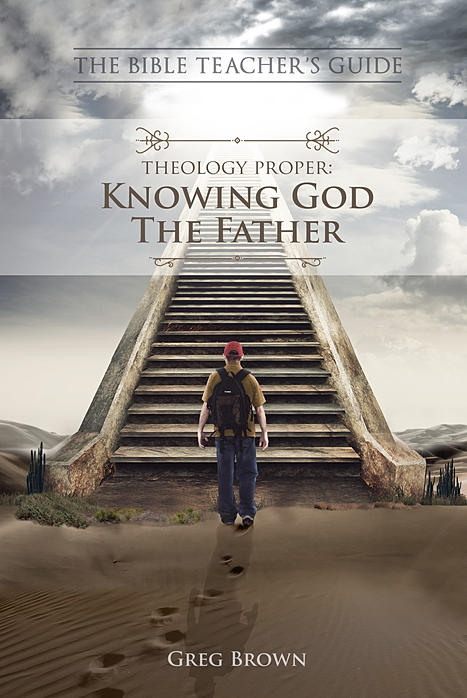
Theology Proper: Knowing God the Father -- A Review

Theology Proper is the sub-discipline of Systematic Theology which deals with the being, attributes and works of God, particularly God the Father. Romans 11:33 is perhaps the best summary verse for theology proper: “Oh, the depth of the riches of the wisdom and knowledge of God! How unsearchable his judgments, and his paths beyond tracing out!”

Greg Brown’s Bible Teacher’s Guide is a very useful resource for those believers who want to dig more deeply into the Word of God. Of course, as the Author warns in the Introduction of this valuable work, “before beginning we should consider the limitations of our study.” In fact, “no study of God can be considered comprehensive,” and this for three reasons: the first is a theoretical one (the limitation of the human mind), the second is a moral one (we each have been affected by the presence of sin), and the third is a “resource problem” (“God simply has not told us everything about himself. What he has told us we can know, but he has chosen in his sovereignty to not reveal everything”). That being said, there is so much to be explored, learned and understood...

After all, what is the highest good in life that anyone can pursue? What else but “the highest good out of which all good flows,” that is what in Latin is called summum bonum? As a matter of fact—and as this book wants to suggest—nothing on earth compares to the benefits of knowing God. One of those benefits being that if people don’t know God they can’t properly value human life:

Man is made in the image of God, and therefore, has value. I have value because in some way or another, even though I sin, I bear the image of God. Having God as my maker and having been created in his likeness, gives me innate value. Humanity has value. Depression often arises because of a lack of knowing God. One says, I am unattractive; I can’t do anything right; nobody loves me. These types of thoughts happen because we do not truly know our value as people made in the glory and image of God.

The Bible Teacher’s Guide: Theology Proper: Knowing God the Father is concise but thorough, scholarly enough for pastors but accessible to everyday Christians with thought-provoking and discussion-provoking questions. Pastor Gregory Brown has created a useful tool for studying and teaching God’s Word.

May 11, 2015

My Newly Redesigned Website Is Up!

Dear readers,

I’m very pleased to announce that my newly redesigned website, www.srpiccoli.eu (also www.aninfiniteidea.org), is now up and running! Any feedback is welcome and really appreciated!

The purpose of my new website is to provide general information about myself, my interests and background, as well as details about my books, including extracts, reviews, interviews, and more.

There you will also find a page of favorite quotations—some 120 at the moment, but the number is expected to rapidly increase—along with an introductory note titled “Why Quotations Matter.” Another page is that devoted to Web resources. Both of them, in my humble opinion, may contribute significantly to a better understanding of myself, even though they are first and foremost tools I use regularly to explore and catalogue my passions and interests.

I hope I did my best to help readers find what they may be looking for. Otherwise, please let me know. Paraphrasing a famous quote by Ralph Waldo Emerson, everything in life is an experiment. Therefore, the more you experiment, the more you fail, the more you learn. And the more you learn, the more you realize how little you know, and how much more there is to know and to learn, and how much better you can get if you really work at it. But I'm getting slightly off topic here... so let's get back on track! I'd just let you know that I really appreciate any and all feedback, positive, negative, humorous, or whatever.

I'll be waiting for you at the door. See you soon!