Showing posts with label anglosphere. Show all posts

June 21, 2025

Northern Ireland in Flames


I revisited the topic of an article I published yesterday in Italian on Money.it to write a post for English-speaking readers.


Ballymena riots highlight deeper racial and social frictions in the UK

It started ten days ago in Ballymena, a town in County Antrim, Northern Ireland. Two 14‑year‑old boys, reportedly of Romanian origin, were charged with the attempted rape of a local teenage girl. The accusation quickly ignited four nights of rioting, with roughly 2,500 residents hurling Molotov cocktails, setting vehicles and buildings ablaze, and attacking neighborhoods inhabited by immigrants. Dozens of police officers were injured. From the very outset, authorities framed the events as racially motivated hate crimes.

For many Britons, the crisis brought to mind the Rotherham scandal — a dark chapter that came to light in 2011 following an investigation by The Times of London. Between 1997 and 2013, gangs comprised largely of Pakistani men subjected roughly 1,400 girls, mostly white and from disadvantaged areas, to systematic sexual abuse. The victims were groomed, drugged, raped, and forced into prostitution. The scandal exposed a catastrophic institutional failure, with police and social services ignoring credible reports for fear of being accused of racism and stoking ethnic tensions. In some instances, authorities even attempted to shift blame onto the victims, implying that they were “consenting.” Earlier this year, the case resurfaced when Elon Musk openly criticized the British government for its reluctance to fully investigate. Musk was quickly joined by conservative figures and Nigel Farage, while Labour leaders expressed discomfort, wary of what some framed as an “extreme right” campaign. Yet in the end, a review led by Baroness Casey was announced in January, and when it became clear that the report would recommend a formal national inquiry, Prime Minister Keir Starmer acted preemptively, approving it in recent days.

For many, the events in Ballymena carry echoes of the institutional failures exposed by Rotherham. As The Guardian observed, Ballymena reflects a familiar pattern: an influx of migrants, rising tensions with the local population, denial of racism, and an eventual spark that triggers indiscriminate violence. Yet this depiction overlooks another significant dynamic. In many communities across the UK — especially those far from wealthy neighborhoods — tensions arise precisely because migration is felt acutely, often concentrated in remote, deprived areas that are largely ignored by national discourse. Meanwhile, many Britons living in more privileged areas fail to comprehend these tensions simply because immigration has little direct impact on their daily lives.

The recent clashes are far from unprecedented. The Guardian recalled earlier outbreaks of race-related violence, from North Shields and Liverpool in 1919 — when a Black sailor drowned after being chased by a mob — to attacks on a Liverpool sailors’ dormitory in 1948 and a mixed residential complex in 1972. The housing crisis has long been a flashpoint, too: just last year, eight African families — half of them comprised of medical staff — were forced to flee a neighborhood in Antrim. Similar tensions surfaced in Nottingham and Notting Hill in 1958, while even Scotland and Wales have witnessed comparable incidents. In 1919, a rumor that a “foreigner” had assaulted a local woman ignited riots across South Wales, spreading from the valleys to Cardiff and its diverse Tiger Bay district.

More recently, in 2024, racial and religious tensions surged across the UK, with riots and attacks on mosques in Belfast, Bristol, London, and numerous other cities across the Midlands and North, including Blackpool, Hull, Leeds, Manchester, Middlesbrough, Stoke‑on‑Trent, and Sunderland. Home Secretary Yvette Cooper announced urgent security measures in response, stating: “In light of the disgraceful threats and attacks that local mosques have also faced in many communities, the government is providing rapid additional support through the Protective Security for Mosques Scheme, alongside the support from local police forces.” Meanwhile, Prime Minister Keir Starmer, freshly installed, was forced to convene the government’s top crisis committee, COBRA, as his Labour administration worked to regain control of the situation.

While the United States is often criticized for its struggles with racism and xenophobia, the United Kingdom is hardly in a better position — if anything, it has a long, deeply rooted history of racially charged violence that shows little sign of abating. What differentiates the US from the UK may be that, across the Atlantic, the MAGA movement have refused to turn a blind eye, allowing many Americans to feel less abandoned when grappling with a crisis of this magnitude. 

Something similar to what is happening in the United States is also taking place in Italy, where Giorgia Meloni’s government — despite countless challenges and setbacks, including judicial ones — is trying to give the public a sense that the migration crisis is, in some way, under control. At the very least, it aims to demonstrate the political will to limit, if not eradicate, illegal immigration and its impact on people’s daily lives. It is an immense task, undoubtedly, especially given that the European Union appears to be moving in a different direction. Recently, however, there have been signs of a shift in attitude, thanks in part to Giorgia Meloni’s persistence and tenacity. Only time will tell.


June 9, 2024

How the West Was Lost at Oxford University


My latest on American Thinker.
The British cultural establishment triumphantly welcomed a new history book according to which Western civilization has always been a bad idea... This unequivocally means that the capitulation of the British cultural establishment to “woke” culture — and other elite obsessions — is complete.


Once upon a time, we were told that the peoples of the Western world — which includes countries like Australia and New Zealand, although located in the Eastern Hemisphere — are heirs and trustees of Western civilization, imbalances and excesses included.  Often referred to simply as “the West,” Western civilization is a broad concept used to understand the cultural, social, political, and economic norms, traditions, values, and institutions that originated in or are associated with Europe.  It has its roots in Ancient Greece and Rome as well as in Christianity, humanism, the Renaissance, the Enlightenment, and the Industrial Revolution. It values rationalism, democracy, and individual freedoms and rights.

Later on, Marxist and otherwise far-left historians argued that the history of the West is marked by exploitation and conflict among different social classes, from feudal lords and serfs in the Middle Ages to capitalists and workers in the modern era.  Marxists, in particular, introduced the concept of cultural hegemony, formulated by Antonio Gramsci to describe ideological domination of the bourgeoisie over the proletariat.  In other words, according to this type of approach, the dominant cultural norms and values of Western civilization serve to maintain the power of the ruling class.

As of now, the left-wing narrative is that Western civilization is an illusion.  Postmodern and deconstructionist historians have claimed that the West is a late invention of the 18th-century philosopher. Skeptical of the grand narratives that have historically been used to describe Western civilization, such as progress, enlightenment, etc., they argue that these narratives often oversimplify complex histories and marginalize alternative perspectives.

It is in this context that the new book How the World Made the West, written by Josephine Quinn, professor of ancient history at Oxford University, needs to be read.  It’s aimed to bring to fulfillment the goal and the dream of legions of leftists the world over and from time immemorial. [...]  


October 31, 2020

R.I.P. Sir Sean Connery


Sean Connery was born into a working-class Edinburgh family. And this, perhaps paradoxically, is the key reason why, at least in my view, he was perfect in the roles of kings (e.g. King Arthur in First Knight and Richard the Lionheart in Robin Hood: Prince of Thieves), intellectuals (e.g. Brother William of Baskerville in The Name of the Rose and Professor Henry Jones in Indiana Jones and the Last Crusade), “masters & commanders” (e.g. Juan Sánchez Villa-Lobos Ramírez in Highlander and Captain Marko Ramius in The Hunt for Red October). 

In other words, he was the living proof that true aristocracy, in all of its variants, is exclusively a matter of personality. 

Rest in Peace, Sir Sean.

December 6, 2009

Beyond any reasonable doubt?


As (almost) everyone already knows, Amanda Knox, the 22-year-old American college student who had been accused of murdering her British roommate Meredith Kercher in 2007 in the medieval town of Perugia, Italy, was found guilty of the crime in question and sentenced to 26 years in prison by an Italian jury. The trial took nearly a year. The court also convicted Knox’s co-defendant and former boyfriend, Italian Raffaele Sollecito (25 years sentence). A third man, Rudy Guede, had already been convicted and sentenced to 30 years.

Though I must admit that I didn’t follow the trial that closely, I feel like saying something about what I consider to be the most important aspect of the whole thing, with all due respect for the strictly human aspects of the story. In fact, as the New York Times puts it, “for many in Britain and the United States, what was on trial here was Italian justice.” “I have serious questions about the Italian justice,” Senator Maria Cantwell, Democrat of Washington, said in a statement after the verdict. “The prosecution did not present enough evidence for an impartial jury to conclude beyond a reasonable doubt that Ms. Knox was guilty,” she added.

According to Pulitzer Prize-winner Timothy Egan, Amanda has spent two years in prison because of her inappropriate behaviour, such as kissing her boyfriend after Meredith’s body was found or doing cartwheels in the police station, but there is no proof against her. And a couple of days before the verdict he wrote, “As with the American system, the Italian jury will be asked to find guilt beyond a reasonable doubt this week. […] If they simply apply the standard that the law calls for, the verdict will be obvious.”

“Beyond a reasonable doubt,” that’s the main problem with Italian justice, in my humble opinion.

But there is something else. Peter Popham in November 24, 2009, Independent:

One of the great virtues of the British judicial system is that, whatever ideas a detective or prosecutor may have about a case, he is not allowed to voice them until the case comes to court. And a very good thing too...


This is the plain truth.

…They manage these things differently in Italy, where prosecutors regularly leak their theories to the newspapers, often in extraordinary detail. Reporters compete for the juiciest tit-bits. As a result, by the time the trial comes around, the public already know what they think about a case, and why. This makes miscarriages of justice horribly likely.


True, sadly true. And that’s another major problem.

But never forget that this is the same “justice” which has been holding the whole political system in check in this country since about 20 years, amidst much international fanfare and celebration. Not that I want to accuse the New York Times & Co. of anything, but …

June 27, 2008

Shakespeare fills us with wonder

Shakespeare fills us with wonder the first time we approach him. We go away, & work, & think, for years, & and come again, he astonishes us anew. Then having drank deeply & saturated us with his genius, we lose sight of it for another period of years. By & by we return, & there he stands immeasurable as at first. We have grown wiser, but only that we should see him wiser than ever. He resembles a high mountain which the traveller sees the morning & thinks he shall quickly near it & pass it & leave it behind. But he journeys all day till noon, till night. There still is the dim mountain close by him, having scarce altered its bearings since the morning light.


—Ralph Waldo Emerson [from his journals, Nov. 10-11, 1838], in EMERSON IN HIS JOURNALS, selected and edited by Joel Porte, Harvard University Press, Cambridge (Massachsetts) - London (England), 1982.

May 26, 2008

Why Western civilization is worth fighting for

Man of Roma, in a stimulating comment to my previous post—and eventually in a post on his own blog—asked whether our set of Western values, paraphrasing a speech by former British Prime Minister Tony Blair, “is really much more ‘robust, true, principled and appealing’ that it is so clear that it can beat theirs” (the values of the Islamic world). Here goes my answer.


Your post introduces different levels of issues, although very synthetically formulated. It would be an interesting and stimulating intellectual challenge, but a much too arduous task for me, to accept the challenge, that is to wrestle with the entire constellation of complex, unresolved issues: cultural, religious, ethical, political …

That is why I’ll limit myself to deal with what seems to me the most fundamental (level of) issue, that is to say “Which are our Western values?” And, consequently, why Western civilization is worth fighting for?

First and foremost, since I know that you consider yourself as belonging to the left, I’ll quote from a Johann Hari's interview with the former leftist Christopher Hitchens (The Independent, September 2004) and from a blog post by Professor Norman Geras: “The United States—said Hitchens—was attacked by theocratic fascists who represent all the most reactionary elements on earth. They stand for liquidating everything the left has fought for: women's rights, democracy[.] And how did much of the left respond? By affecting a kind of neutrality between America and the theocratic fascists.”

Norm, in turn, pointed out that, in his view, the most important thing one needs to know about someone today in forming a judgement about the character of their political outlook isn't whether or not they are of the left, or consider themselves as belonging to the left …

Rather more significant is to know what their all-round relationship is to certain values that have always been central to the historical project of the left: democratic and egalitarian values; a decent conception of justice (such as aims to achieve for everyone the possibility of a secure and fulfilled existence); and the protection of individual human beings from the more egregious types of assault to which they are subject when such values are denied or cast aside. Christopher Hitchens's present choice is not my own. I remain attached to the idea of arguing for these values within the left. A left which showed no respect for them wouldn't be worth belonging to. But all the same, I appreciate and feel the difficulty of accepting a common political identity with the contemporary apologists for terrorism, the mumblers and rootcausers, the people seemingly capable of understanding everything except the need for drawing a clear line between those who uphold the politics of democracy and those dedicated to their destruction. The left today has no reason for self-congratulation. This is a loose movement which is able (and has seen fit) - from the Falklands to Iraq - to mobilize always hundreds, and sometimes thousands and tens of thousands, to oppose conflicts fought by the Western democracies against the ugliest of tyrannies and/or reactionary social and political forces, but musters nothing comparable, or indeed just nothing, against a global campaign of terrorist murder; or, equally, against genocidal processes as these periodically unfold in one country after another, destroying the fabric of entire communities and uncountable numbers of lives. It is a milieu in which anti-Americanism is rampant, and one whose chosen monsters today are the elected political leaders of two of the world's great democracies, rather than any of the many more suitable targets for hatred and contempt one might have anticipated from a left moved by authentically democratic impulses; in which, in the face of an anti-Semitism now resurgent across Europe - within short memory of the time that continent was turned into a slaughterhouse and graveyard for the Jewish people - the voices addressing themselves to the phenomenon, as a danger which the left ought to meet and fight, are scarce; and in which, worse still, the state of the Jewish people, born out of the ashes of that terrible catastrophe, is now widely treated as a pariah to be calumniated, isolated, boycotted and - for a significant body of left opinion - destroyed.


And this is how Norm drew the moral line between, so to speak, “right” and “wrong,” or as I’d rather say, with reference to our discussion, between Western values and (non-Western) disvalues:

With those, both within the left and without it, who fight for democratic principles, practices and institutions and the fundamental rights of human beings; against those, whatever their political colour, who always have a reason, or a tactful silence, to offer on behalf of the forces fighting against these things; as well as against these oppressive and murderous forces.


Yet, in my view, the above is only one among the many possible ways to bring the argument to the point to which Norm has brought it. To make an example, Bernard Lewis—a towering figure among experts on the culture and religion of the Muslim world—took another cultural path. In his What Went Wrong book, Lewis has shown what made Islam so different from other monotheistic religions, particularly from a political and cultural point of view. For centuries, he says, the Islamic world was in the forefront of human achievement—the foremost military and economic power, the leader in the arts and sciences of civilization, etc.—while Christian Europe was sunk in the darkness of barbarism. And then everything changed. What went wrong? Lewis offers no easy answers, but he points out the lack of secularism and its roots at the core of Islam itself.

Secularism in the modern political meaning—the idea that religion and political authority, church and state are different, and can or should be separated—is, in a profound sense, Christian. Its origins may be traced in the teaching of Christ, confirmed by the experience of the first Christians; its later development was shaped and, in a sense, imposed by the subsequent history of Christendom.
[…]
In imperial Rome Caesar was God, reasserting a doctrine that goes back to the god-kings of remote antiquity. Among the Jews, for whose beliefs Josephus coined the term “theocracy,” God was Caesar. For the Muslims, too, God was the supreme sovereign, and the caliph was his vice-gerent, “his shadow on earth.” Only in Christendom did God and Caesar coesixt in the state, albeit with considerable development, variety, and sometimes conflict in the relations between them.


Of course there has been the conversion of Constantine, says Lewis, and the establishment of Christianity as the state religion initiated “a double change; the Christianization of Rome and—some would add—the Romanization of Christ,” but “by this time the Christian faith and the Christian church were centuries old, with their character sharply defined and indelibly marked by the experience of the founding generations.” While Muhammad was, so to speak, “his own Constantine. […]”

Now, being a believer (Christian Catholic), I am not that fanatic of secularism, but … I am also happy (and proud) to live in a society where the principle of the separation between state and church—founded on the Word of God (“Give to Caesar what is Caesar's and to God what is God's”)—is so important. I think this is a good reason, among many others, why Western civilization is worth fighting for.

May 15, 2008

Philosophy matters

St. Thomas Aquinas,Intelligence is not a matter of democracy (while democracy is most likely a matter of intelligence, but this is another story). In the days of Socrates, Plato, Aristotle, and the Sophists, the art of subjectifying truth—in which the latters were masters—played an important role in Athenian democracy’s growth (i.e. by involving a tolerance of the beliefs of others), but nevertheless the difference between fallacious, deceptive reasoning and true reasoning was since then very clear. That is why intelligence is not a matter of democracy, that is to say it is no question about how many people think something is true or false, what matters is if something is true or false with reference to the notions of true and false. Here, of course, we are talking about the principle of non contradiction, that is that fundamental principle of thought, which two great philosophers, Aristotle and Thomas Aquinas, taught us to recognize, and which is so basic that it can be successfully argued for merely by showing that any opponents of the principle must be using it—and thus be committed to it—themselves.


That is why … philosophy matters. And that is also why I wholeheartedly agree with Norm and his answer to the following question: “Does philosophy have anything to say that is of relevance to the way non-philosophers think about the world?”

March 10, 2008

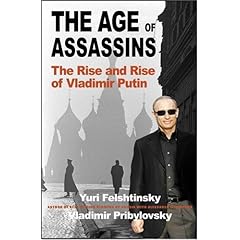
Is Vladimir Putin a despot?

The Russian leader’s career since 1975 is the subject of The Age of Assassins: the Rise and Rise of Vladimir Putin, a new book by Yuri Felshtinsky and Vladimir Pribylovsky. But the book is, of course, also a history of Russia over the past 17 years. Furthermore, Felshtinsky and Pribylovsky try to to draw parallels between the Putin phenomenon and … some other familiar, old phenomena such as Stalin, Hitler, Mussolini, Mao Zedong. We want to know, they say, whether Putin is a despot or not, whether the world will see a new cold—or perhaps even nuclear—war.

From Oleg Gordievsky’s review in The Times of Friday, March 7, 2008:

The authors state that it should have become obvious by now that Russia's Government “would henceforth be run and be controlled by people who hated America and Western Europe, who had no experience in building anything, who acted in secrecy while belonging to an organisation of which - as with the Gestapo in Nazi Germany - not a single good word can be said in its defence”. It is difficult to disagree with this judgment.


Hat tip: David McDuff (A Step At A Time)

May 11, 2007

But he didn't pass by

[UPDATED]

After Tony Blair’s resignation speech—delivered on May 10 to party activists in his Sedgefield constituency—I must confess that, among the dozens of comments I have come across on the subject, I have especially loved the sobriety with which my favourite British blogger has expressed his point of view. He simply quoted this passage from the speech “against a whole heap of the commentary” on Blair’s depart (though pointing out that, unlike me, he doesn’t get the ‘belief’ stuff …):

In Sierra Leone and to stop ethnic cleansing in Kosovo, I took the decision to make our country one that intervened, that did not pass by, or keep out of the thick of it.

Then came the utterly unanticipated and dramatic. September 11th 2001 and the death of 3,000 or more on the streets of New York.

I decided we should stand shoulder to shoulder with our oldest ally. I did so out of belief.

So Afghanistan and then Iraq, the latter, bitterly controversial.

Removing Saddam and his sons from power, as with removing the Taliban, was over with relative ease. But the blowback since, from global terrorism and those elements that support it, has been fierce and unrelenting and costly. For many, it simply isn't and can't be worth it.

For me, I think we must see it through. They, the terrorists, who threaten us here and round the world, will never give up if we give up.


UPDATE - Sat, May 13, 2007 - 10:30 pm
There is a full version video in two parts of the speech at You Tube: part one, part two.

April 16, 2007

Thinking Blogger Award

Through the 2996 list, namely the directory of the bloggers who created a tribute for the victims of 9-11-01, this blog has been nominated for a “Thinking Blogger Award.”

This is all new to me and I greatly appreciate the pleasant surprise. I really think that helping people think is one of the main benefits of blogging.


As part of the acceptance I’m supposed to tag five other blogs for the award. So, here are the five I'm tagging as Thinking Bloggers—or, as I would put it, bloggers that make me think—and passing on the award. In no particular order:

> Italian Bloggers For Giuliani 2008 (in Italian)
> Random Dreamer
> Free Thoughts
> 1972 (in Italian)
> The Right Nation

Nominee instructions:
To nominees: Should you choose to participate, please make sure you pass this list of rules to the blogs you are tagging. The participation rules are simple: 1) If, and only if, you get tagged, write a post with links to 5 blogs that make you think; 2) Link to
this post so that people can easily find the origin of the meme; 3) Optional: Proudly display the 'Thinking Blogger Award' with a link to the post that you write.
Enjoy!

March 7, 2007

Celtic Woman

Celtic Woman are four Irish female vocalists—Chloe, Lisa, Méav and Orla—and a terrific fiddle player—Mairead—who have created a wonderful musical experience. Since their March 2005 debut in the U.S. they have become one of the most popular Celtic music groups performing today. In their repertoire are contemporary hits (“Beyond the Sea,” “The Prayer,” “Scarborough Fair,” “Over the Rainbow”), classical favourites (“Lascia Ch’io Pianga,” “Vivaldi’s Rain”), and Irish standards (“Dúlaman,” “At the Ceili,” “Caledonia,” “Mo Ghile Mear”).

I must confess I was astonished when I first came across, a few months ago, this ensemble of beautiful, young women and angelic voices. It was indeed a very emotional discovery, and not only because Celtic music is one of my favourite musical genres (I am a long time lover of Enya’s music, for example). So I’ve got to thank Beth, at Blue Star Chronicles, for letting me know about this video, in which Celtic Woman is performing The Sky and the Dawn and the Sun in a live concert filmed at Slane Castle, the home of Lord Henry Mount Charles, in County Meath, Ireland (December 2, 2006). Enjoy the listening … and watching experience!


February 9, 2007

What are we afraid to do?


Always do what you are afraid to do.
Ralph Waldo Emerson

Is it because Ralph Waldo Emerson—among my intellectual heroes—is my favorite that I absolutely love the above quoted sentence, or is it because of the sentence that the great American poet and essayist is my favorite intellectual hero? It’s a tough question, really. Well, perhaps a moot question, and anyway it might not be a major problem for most people ...

The real problem, instead, is perhaps that we are afraid of a lot of things. At least until we get involved with them. As a matter of fact, when this happens, when circumstances put someone in a condition to do something, things might seem to become less dramatic. And you might also realize that if you run away because you are afraid to do something, you pass opportunity by.

Better still, the problem could be described more accurately as laziness than as fear, so that most times we are afraid more of what we are too lazy to do than what we are too cowardly to face.

That is why, in my opinion, the best mental attitude is that which consists in forcing our natural laziness, that is what most of the times make cowards of us all, even and especially when things seem to be going against us.

January 17, 2007

Obama's choice


Barack Hussein Obama is the fifth African American Senator in U.S. history and the only African American presently serving in the U.S. Senate. The son of Barack Hussein Obama, Sr. of Alego, a village in Nyanza Province, Kenya, and Ann Dunham of Wichita, Kansas, he grew up in his mother's white American middle class family. Obama and his wife, Michelle, live on Chicago ’s South Side, where they—and their two daughters, Malia, 8 and Sasha—attend Trinity United Church of Christ.

According to recent opinion polls he is the second most popular choice among Democratic voters for their party's nomination in the 2008 U.S. presidential election, behind Hillary Clinton, and just yesterday he took his first step toward launching a Presidential campaign by announcing an “exploratory committee.”

Gene, at Harry’s Place, has asked a good question (he also linked to this well-krafted video, which could be of some help to those who might want to try and answer this question):

can a man of mixed race […] with only two years in the Senate […] whose middle name is Hussein and whose last name rhymes with Osama, be elected President of
the United States?

January 10, 2007

The radical loser

Hans Magnus Enzensberger—one of modern Germany's most interesting and celebrated writers—looks at the kind of ideological trigger required to ignite the “radical loser”—whether amok killer, murderer or terrorist—and make him explode. In an article which originally appeared in German in Der Spiegel on November 7, 2005 and now available in English translation.

The loser may accept his fate and resign himself; the victim may demand satisfaction; the defeated may begin preparing for the next round. But the radical loser isolates himself, becomes invisible, guards his delusion, saves his energy, and waits for his hour to come.
[…]

The project of the radical loser, as currently seen in Iraq and Afghanistan, consists of organizing the suicide of an entire civilisation. But the likelihood of their succeeding in an unlimited generalization of their death cult is negligible. Their attacks represent a permanent background risk, like ordinary everyday deaths by accident on the streets, to which we have become accustomed.

In a global society that constantly produces new losers, this is
something we will have to live with.
[Read the rest]


[This post was first published at windrosehotel.splinder.com on December 12, 2005]

December 18, 2006

Yet another 'star rating' system

Do you remember the demonstration staged by Iranian students one week ago, on Monday, December 11, against President Mahmamoud Ahmadinejad? Yes, when they lightened a firecracker and burned the head of state's photograph calling him a dictator as he himself was speaking at Amir Kabir Technical University in Tehran. Well, as a result, about seventy students have been “awarded” through the new "star rating" system which has been recently adopted by University authorities for politically-active students. However, as The Telegraph reported,

the star system has become a badge of honour among those who have acquired them on their records. Students have likened it to the German Nazi-era practice of making Jews wear the Star of David.


Read the rest to learn more.

This while early returns are showing hard-line President Mahmoud Ahmadinejad's conservative opponents leading in elections for local councils, and former Iranian president Hashemi Rafsanjani is leading the race for a seat on a powerful clerical body.

Tech Tags:

November 23, 2006

Thanksgiving Day

Today is Thanksgiving Day in the United States. As for me, I wanted to give God a special THANK YOU ... for having given us all that Beautiful America! So I found this very valuable tribute:

November 11, 2006

What's Left? (2)

Oliver Kamm isn’t the only one who has had a preview of Nick Cohen’s new book, What's Left? How the Liberals Lost their Way, due to be published in February. Norm also has had the opportunity to read the book in draft, and here are the two excerpts he has selected to share with his readers:

The anti-war movement disgraced itself not because it was against the war in Iraq, but because it could not oppose the counter-revolution once the war was over. A principled Left that still had life in it and a liberalism that meant what it said might have remained ferociously critical of the American and British governments while offering support to Iraqis who wanted the freedoms they enjoyed. It is a generalisation to say that everyone refused to commit; the best of the old Left in the trade unions and Parliamentary Labour Party supported an anti-fascist struggle regardless of whether they were for or against the war, and American Democrats went to fight in Iraq and returned to fight the Republicans.
But... no one who looked at the liberal-left from the outside could pretend that such principled stands were commonplace.

[…]

If the new left of the 21st century is to be a liberal-left worth having, then it must learn from the best of the old traditions. First, it must understand that we are lucky people who have won life's lottery. An accident of birth has given us freedom and the wealth that comes with it. We don't have an obligation to overturn tyranny by military force. But we have no right to turn our backs on those who want the freedoms we take for granted. We have no good cause to scoff at them and make excuses for the men who would keep the knife pressed to their throats. The best reason for offering them support is that we can. We have the freedom to vote, to lobby, to protest, to write and to speak, and there is no point in having freedom unless you use it to a good purpose.


November 7, 2006

What's Left?

British journalist Nick Cohen’s new book, What's Left? How the Liberals Lost their Way, will be published by 4th Estate in February, 2007, but Oliver Kamm has had a preview, and he says it's excellent, “and you should pre-order it now.” As the synopsis by Amazon.co.uk says, the book dissects the agonies, idiocies and compromises of mainstream liberal thought, or, as Oliver Kamm puts it, the scandal of “how segments of the Left, in their willingness to discern progressive qualities in the most reactionary causes, went over to the other side of the political divide.”

Besides, this book reminds me of a very interesting seminar held in Rome on May 31, 2006, to discuss the reasons why the Left has forgotten its own principles. The speakers were Paul Berman, Christopher Hitchens, John Lloyd, Piero Fassino (general secretary of the Democrats of the Left), and Adriano Sofri (former leader of the far Left Lotta Continua). An account of the seminar was given by a special correspondent for normblog—final comment included.

Nick Cohen—a columnist for the Observer and New Statesman—comes from the Left, and when, at the age of 13, he found out that his kind and thoughtful English teacher voted Conservative, he nearly fell off his chair: 'To be good, you had to be on the Left.' Today—as the abstract suggests—he's no less confused:


When he looks around him, in the aftermath of the invasion of Iraq, he sees a community of Left-leaning liberals standing on their heads. Why is it that apologies for a militant Islam that stands for everything the liberal-Left is against come from a section of the Left? After the American and British wars in Bosnia and Kosovo against Slobodan Milosevic's ethnic cleansers, why were men and women of the Left denying the existence of Serb concentration camps? Why is Palestine a cause for the liberal-Left, but not, for instance, China, the Sudan, Zimbabwe or North Korea? Why can't those who say they support the Palestinian cause tell you what type of Palestine they would like to see? After the 9/11 attacks on New York and Washington why were you as likely to read that a sinister conspiracy of Jews controlled American or British foreign policy in a liberal literary journal as in a neo-Nazi rag? It's easy to know what the Left is fighting against - the evils of Bush and corporations - but what and, more to the point, who are they fighting for? As he tours the follies of the Left, Nick Cohen asks us to reconsider what it means to be liberal in this confused and topsy-turvy time. With the angry satire of Swift, he reclaims the values of democracy and solidarity that united the movement against fascism, and asks: What's Left?

Hat tip: Harry’s Place


October 25, 2006

Murder in the Himalayas


Buddhist monk Thubten Tsering was one of the 75 Tibetan who, on September 30, were making a secret trek across the border into Nepal, moving in single file across a mountain slope near the 19,000-foot-high Nanpa La Pass, when Chinese border guards opened fire. “There was no warning of any kind, […] the bullets were so close I could hear them whizzing past. We scattered and ran,” he told reporters in Delhi on Sunday.”

Now that the accounts of survivors, now safely in India, can be pieced together with those of the mountaineers who witnessed the shooting and with the video footage taken by a Romanian cameraman who was at advance base camp on Mount Cho Oyo at the time, the full story of what happened that day in the Himalayas has emerged. Read The Independent article here for details.

September 27, 2006

Somewhere in Britain

You may say I am a nostalgic guy, but, after reading Tony Blair’s final conference speech, I cannot help thinking that, as Guardian columnist Martin Kettle puts it,

[h]e may be the past, and it may, as he said, be time to go (body language experts said this was the only insincerely delivered line in the whole text). But this was Blair at his absolute best, vindicating his long reign as Labour's leader. It was so good that it made you ask yourself whether this party isn't out of its mind to be getting rid of him.
[…]
What this party owes to that man is beyond calculation. Labour has been in power for 10 years because of many things - Tory failure, the New Labour internal revolution, a strong economy and many more. But it needs to be said quite simply that without Blair none of it would have happened. It needed a new kind of Labour leader who could speak to the whole nation to make it all come together and to make it sing. And Blair did it - yes, with help and, sure, with colleagues - but in the end this was his doing and only Iraq wrecked it.

Anyway, since I am not a Labour member, nor am I a British citizen—though I consider myself a friend of Britain—it is not up to me to express statements such as the following:

Gordie's oh-so-pedestrian speech is blown out of the water by Cherie saying what everyone knew anyway, followed by a simply superb speech by Our Gorious Leader. What a load of hypocritical tossers (pardon my language but it's what they are) those Labour members are. They've spent the past decade bitching about Blair, and now that he's off into the sunset they cheer him to the rafters.

But how about if it is Stephen Pollard who speaks?

Tech Tags: