“ I remember a concert performance of the music of Johann Sebastian Bach—in Munich in Bavaria —conducted by Leonard Bernstein. At the conclusion of the final selection, one of the Cantate, I felt—not through reasoning, but in the depths of my heart—that what I had just heard had spoken truth to me, truth about the supreme composer, and it moved me to give thanks to God. Seated next to me was the Lutheran bishop of Munich. I spontaneously said to him: Whoever has listened to this understands that faith is true—and the beauty that irresistibly expresses the presence of God’s truth. ”
~ Benedict XVI, speaking at the audience last Wednesday (August 31, 2011) with the pilgrims and faithful gathered in the small square of Castel Gandolfo.
Well, it is not the first time that Pope Benedict has called art and music “the greatest apologetic for our faith.” This time, however, His Holiness added the above personal recollection. And I hope you will appreciate to know that the Cantata of Bach that so profoundly touched the heart of the future pope was the one that bears the catalog number BWV 140, which was composed by JSB for the Mass of the twenty-seventh Sunday after the feast of the Holy Trinity, the last Sunday before Advent in the Lutheran liturgical year (via Sandro Magister). Here it is, accompanied with beautiful pictures of the Lake District in England:
Jeff
Bridges and Maggie Gyllenhaal in CRAZY HEART (Photo by Lorey Sebastian)
“Your vision will become clear only when you can look into your own heart. Who looks outside, dreams; who looks inside, awakens.” Thus wrote Carl Gustav Jung, the great Swiss psychiatrist who founded the so-called analytical school of psychology, and, luckily for us religious and non-materialistic people, broadened Sigmund Freud’s psychoanalytical approach. Who knows whether he ever came across that famous passage from Saint Augustine’s De Vera Religione which roughly translates as “Do not wish to go outside, return into yourself. Truth dwells in the inner man.” Be it as it may, one thing is almost certain: both Ryan Bingham and T-Bone Burnett, who wrote “The Weary Kind,” the beautiful country song from the film Crazy Heart, may not have read either the famous psychiatrist or the great Father of the Church, and yet they seem to have learned well the great lesson of both Augustine of Hippo and Carl Jung. Yes, just “Pick up your crazy heart and give it one more try,” that’s all you need to do.
“ There aren’t all that many places in the world where law enforcement officers would move against a powerful millionaire based on the word of a poor, immigrant chambermaid. In fewer places still would the people who cuffed the suspect admit mistakes and later ask that charges be dropped. ”
~ The Washington Post, Editorial (August 27, 2011)
Theodore Roosevelt
26th President of the United States
“ It seems to me that, for the nation as for the individual, what is most important is to insist on the vital need of combining certain sets of qualities, which separately are common enough, and, alas, useless enough. Practical efficiency is common, and lofty idealism not uncommon; it is the combination which is necessary, and the combination is rare. Love of peace is common among weak, short-sighted, timid, and lazy persons; and on the other hand courage is found among many men of evil temper and bad character. Neither quality shall by itself avail. Justice among the nations of mankind, and the uplifting of humanity, can be brought about only by those strong and daring men who with wisdom love peace, but who love righteousness more than peace. ”
This is more or less what I was trying to think while sitting beside a restless sea on a cloudy but pleasant August afternoon…
“ Not with doubting, but with assured consciousness, do I love Thee, Lord. Thou hast stricken my heart with Thy word, and I loved Thee. Yea also heaven and earth, and all that therein is, behold on every side they bid me love Thee; nor cease to say so unto all, that they may be without excuse. But more deeply wilt Thou have mercy on whom Thou wilt have mercy, and wilt have compassion on whom Thou hast had compassion: [Rom. i. 20; ix. 15] else in deaf ears do the heaven and the earth speak Thy praises. But what do I love, when I love Thee? not beauty of bodies, nor the fair harmony of time, nor the brightness of the light, so gladsome to our eyes, nor sweet melodies of varied songs, nor the fragrant smell of flowers, and ointments, and spices, not manna and honey, not limbs acceptable to embracements of flesh. None of these I love, when I love my God; and yet I love a kind of light, and melody, and fragrance, and meat, and embracement when I love my God, the light, melody, fragrance, meat, embracement of my inner man: where there shineth unto my soul what space cannot contain and there soundeth what time beareth not away, and there smelleth what breathing disperseth not, and there tasteth what eating diminisheth not, and there clingeth what satiety divorceth not. This is it which I love when I love my God.
And what is this? I asked the earth, and it answered me, ‘I am not He;’ and whatsoever are in it confessed the same. I asked the sea and the deeps, and the living creeping things, and they answered, ‘We are not Thy God, seek above us.’ I asked the moving air; and the whole air with his inhabitants answered, ‘Anaximenes was deceived, I am not God.’ I asked the heavens, sun, moon, stars, ‘Nor (say they) are we the God whom thou seekest.’ And I replied unto all the things which encompass the door of my flesh: ‘Ye have told me of my God, that ye are not He; tell me something of Him.’ And they cried out with a loud voice, ‘He made us.’ My questioning them, was my thoughts on them: and their form of beauty gave the answer. And I turned myself unto myself, and said to myself, ‘Who art thou?’ And I answered, ‘A man.’ And behold, in me there present themselves to me soul, and body, one without, the other within. By which of these ought I to seek my God? I had sought Him in the body from earth to heaven, so far as I could send messengers, the beams of mine eyes. But the better is the inner, for to it as presiding and judging, all the bodily messengers reported the answers of heaven and earth, and all things therein, who said, ‘We are not God, but He made us.’ These things did my inner man know by the ministry of the outer: I the inner knew them; I, the mind, through the senses of my body. I asked the whole frame of the world about my God; and it answered me, ‘I am not He, but He made me.’ ”
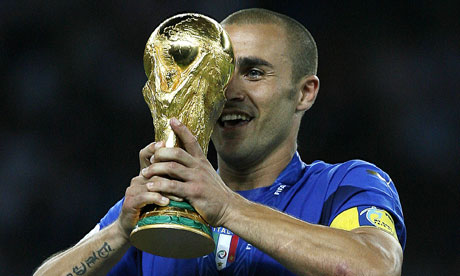
Soccer legend and Italy’s 2006 World Cup winning captain Fabio Cannavaro retires after persistent knee injuries. The photo of him holding the trophy aloft became the defining image of the 2006 tournament.
My summer readings’ list includes re-reading Henry James’ Italian Hours, published almost exactly one hundred years ago, in 1909. It’s a classic collection of essays, three of which are about Venice—James had visited Venice for short periods in 1869 and 1872 but his first extended stay in the city took place in 1881—and the novelist’s “special relationship” to this wonderful city. As his biographer Leon Edel has written, “Venice was one of the greatest topographical love affairs of James’s life.” Apart from his hints to the “misery” of Venetian people in those times—a lot of water has passed under the bridge since then, though changes are not always for the best…—what he wrote is surprisingly topical, and amazingly true. Take this statement for instance:
Venetian life, in the large old sense, has long since come to an end, and the essential present character of the most melancholy of cities resides simply in its being the most beautiful of tombs. Nowhere else has the past been laid to rest with such tenderness, such a sadness of resignation and remembrance. [“The Grand Canal”]
However, if what he loves most about Italy, as he wrote in another essay in the same collection (“Florentine Notes” Part I), is “the faculty of making much of common things and converting small occasions into great pleasures,” this is true a fortiori in the case of Venice. And that seems to be the leitmotif of the essays on Venice. The following two excerpts are fairly representative of the whole:
[Venice] is a city in which, I suspect, there is very little strenuous thinking, and yet it is a city in which there must be almost as much happiness as misery. The misery of Venice stands there for all the world to see; it is part of the spectacle--a thoroughgoing devotee of local colour might consistently say it is part of the pleasure. The Venetian people have little to call their own--little more than the bare privilege of leading their lives in the most beautiful of towns. Their habitations are decayed; their taxes heavy; their pockets light; their opportunities few. One receives an impression, however, that life presents itself to them with attractions not accounted for in this meagre train of advantages, and that they are on better terms with it than many people who have made a better bargain. They lie in the sunshine; they dabble in the sea; they wear bright rags; they fall into attitudes and harmonies; they assist at an eternal conversazione. It is not easy to say that one would have them other than they are, and it certainly would make an immense difference should they be better fed. The number of persons in Venice who evidently never have enough to eat is painfully large; but it would be more painful if we did not equally perceive that the rich Venetian temperament may bloom upon a dog's allowance. Nature has been kind to it, and sunshine and leisure and conversation and beautiful views form the greater part of its sustenance. It takes a great deal to make a successful American, but to make a happy Venetian takes only a handful of quick sensibility. The Italian people have at once the good and the evil fortune to be conscious of few wants; so that if the civilisation of a society is measured by the number of its needs, as seems to be the common opinion to-day, it is to be feared that the children of the lagoon would make but a poor figure in a set of comparative tables. Not their misery, doubtless, but the way they elude their misery, is what pleases the sentimental tourist, who is gratified by the sight of a beautiful race that lives by the aid of its imagination. The way to enjoy Venice is to follow the example of these people and make the most of simple pleasures. Almost all the pleasures of the place are simple; this may be maintained even under the imputation of ingenious paradox. There is no simpler pleasure than looking at a fine Titian, unless it be looking at a fine Tintoret or strolling into St. Mark's,--abominable the way one falls into the habit,--and resting one's light-wearied eyes upon the windowless gloom; or than floating in a gondola or than hanging over a balcony or than taking one's coffee at Florian's. It is of such superficial pastimes that a Venetian day is composed, and the pleasure of the matter is in the emotions to which they minister. These are fortunately of the finest-- otherwise Venice would be insufferably dull. Reading Ruskin is good; reading the old records is perhaps better; but the best thing of all is simply staying on. The only way to care for Venice as she deserves it is to give her a chance to touch you often--to linger and remain and return. [“Venice” Part I]
There is something strange and fascinating in this mysterious impersonality of the gondola. It has an identity when you are in it, but, thanks to their all being of the same size, shape and colour, and of the same deportment and gait, it has none, or as little as possible, as you see it pass before you. From my windows on the Riva there was always the same silhouette--the long, black, slender skiff, lifting its head and throwing it back a little, moving yet seeming not to move, with the grotesquely- graceful figure on the poop. This figure inclines, as may be, more to the graceful or to the grotesque--standing in the "second position" of the dancing-master, but indulging from the waist upward in a freedom of movement which that functionary would deprecate. One may say as a general thing that there is something rather awkward in the movement even of the most graceful gondolier, and something graceful in the movement of the most awkward. In the graceful men of course the grace predominates, and nothing can be finer than the large, firm way in which, from their point of vantage, they throw themselves over their tremendous oar. It has the boldness of a plunging bird and the regularity of a pendulum. Sometimes, as you see this movement in profile, in a gondola that passes you--see, as you recline on your own low cushions, the arching body of the gondolier lifted up against the sky--it has a kind of nobleness which suggests an image on a Greek frieze. [“Venice” Part IV]
In the first three months of the year, Italy’s economy—the third-largest economy in Europe—expanded 0.1%, while the euro-zone as a whole grew 0.8%. That’s the real issue, not Italy’s public debt, which is projected to peak at 120 per cent of GDP this year. In fact, many analysts say Italy should be more worried about its long-term prosperity than its solvency. Hence the government’s three-year austerity plan (see here and here), presented by Economy Minister Giulio Tremonti yesterday. The plan—€52 billion (about $74 billion) in fiscal savings—is designed to reduce the budget deficit to 3.9 per cent of gross domestic product this year and gradually to zero by 2014, but also and especially to reignite Italy’s feeble economy with measures including tax breaks for young entrepreneurs and longer store opening-hours on weekends, and to boost Italian productivity, which is among the lowest in Europe. Will it work? Well, ask credit rating agencies, if you still trust them, otherwise, follow your nose—that’s my favorite option right now, though not entirely disinterested, I must admit…
"It would reduce the whole instrument to a single phrase, that of instituting a Congress with power to do whatever would be for the good of the United States; and as they would be the sole judges of the good or evil, it would be also a power to do whatever evil they please. Certainly no such universal power was meant to be given them. [The Constitution] was intended to lace them up straightly within the enumerated powers and those without which, as means, these powers could not be carried into effect." ~~Thomas Jefferson, Opinion on a National Bank, 1791
This weekend we celebrate the independence of America, specifically marking it by the signing of the Declaration of Independence. Lip service is given to it by many, but what emanates from it is the U S Constitution. For the five to six thousand years of civilization before 1776, humankind's evolution was slow and horrible. Not much was accomplished under the tyranny of kings and emperors. Since the creation of the U S Constitution, we have accomplished more, in technology, wealth, religion and liberty than the whole of history before. The Constitution is under direct and deadly attack by the Left; yet they will pretend to celebrate freedom from tyranny this weekend with the rest of us that truly embrace liberty.
During the healthcare debate in 2009, then House Speaker Nancy Pelosi was asked by a reporter where in the Constitution it authorized Congress to mandate that citizens buy health insurance, her response was “Are you serious?” Democrat from South Carolina Rep. James Clyburn: “There’s nothing in the Constitution that says that the federal government has anything to do with most of the stuff we do.”
Democrat Congressman Phil Hare on the Constitution
In the past couple years Conservatives have tried to pass a rule that any legislation brought up has to state where in the Constitution it allows them to pass that law. It’s been rejected every time by Democrats and RINO’s (Republican In Name Only).
“Time” magazine had a cover story asking about the Constitution, “Does It Still Matter?” (Rob posted about this in the entry below.) Time's managing editor, Richard Stengel: "To me the Constitution is a guardrail. It's for when we are going off the road and it gets us back on. It's not a traffic cop that keeps us going down the center." Interpreted this is that the Constitution means whatever the Left wants it to mean. Jefferson: "a mere thing of wax in the hands of the judiciary which they may twist and shape into any form they please."
Which is just what the Left wants. They can’t gain full power if they obey the “enumerated rights” specified in the document. Jefferson again: "Our peculiar security is in possession of a written Constitution. Let us not make it a blank paper by construction. ... If it is, then we have no Constitution. ... [T]o consider the judges as the ultimate arbiters of all constitutional questions ... would place us under the despotism of an oligarchy. ... In questions of power, then, let no more be heard of confidence in man, but bind him down from mischief by the chains of the Constitution."
Stengal makes this incredible observation: "If the Constitution was intended to limit the federal government, it sure doesn't say so. Article I, Section 8, the longest section of the longest article of the Constitution, is a drumroll of congressional power." I don’t know what he’s reading, but that article states specifically what the government is allowed to do, and is allowed to do no more. The Left, enemies of the Constitution, attacks it by ignoring what it says, and then says it says something else. James Madison: "The powers delegated by the proposed Constitution to the federal government are few and defined. Those which are to remain in the State governments are numerous and indefinite. The former will be exercised principally on external objects, as war, peace, negotiation, and foreign commerce; with which last the power of taxation will, for the most part, be connected. The powers reserved to the several states will extend to all the objects which, in the ordinary course of affairs, concern the lives, liberties, and properties of the people, and the internal order, improvement and prosperity of the State."
Obama ran on the notion that he was going to “fundamentally transform” America. That can only be done by ignoring the Constitution, which he swore to uphold when he took the oath: "I do solemnly swear (or affirm) that I will faithfully execute the Office of President of the United States, and will to the best of my Ability, preserve, protect and defend the Constitution of the United States." He has ignored the law. He declared a moratorium on offshore drilling after the oil spill and kept it in effect. Several courts have said this is unconstitutional, so he instructed his energy czar to not issue any permits to drill. Several courts have said Obamacare in unconstitutional because it forces citizens to buy a product provided by the private business sector. He’s not put that legislation on hold until the issue is brought before the Supreme Court, he keeps enforcing it. He’s gone to war (Libya) without Congressional approval. Just some examples. We essentially have an anti-Constitutional, lawless president, supported by a Media and political party that states the Constitution is nonbinding and meaningless.
Another attack on the Constitution was made by Leftist Washington Post writer Ezra Klein: “The issue with the Constitution is not that people don’t read the text and think their following. The issue with the Constitution is that the text is confusing because it was written more than a hundred years ago and what people believes it says differs from person to person.” The Constitution of course was written over two hundred years ago.
His statement means to, proving absurdity by showing absurdity, is that we can’t understand anything written by Adam Smith, Shakespeare, Tolstoy, Dickens, Emerson…you get the picture. Klein interpreted means that stupid Conservatives don’t understand that Constitution is designed to implement a SocialistState.
This 4th of July, our Independence Day, as much as I’ll celebrate our freedom, I’ll worry over how far down the road we are to the shredding of the Constitution and becoming Obama’s and the Democrat Party’s vision of a “transformed” America. The move toward Statism has been slow, taking a couple hundred years, but Leftists are poised to kill liberty by the last triumphal act of shredding the Constitution. This is the last thing they need to impose their rule. I suppose then we can rename Independence Day, Government Day.
When the bullet that began the American Revolution was fired at Concord, historians called the event “the shot heard round the world.” Autocratic rulers heard that shot, and things that had not been questioned for millennia were now open to challenge.
Today, many among “the intelligentsia,” as well as “political messiahs,” are doubtful about the American exceptionalism. They ask whether the United States has really been “exceptional.” You couldn’t be more exceptional in the 18th century, they say, than to create the Constitution of the United States—by opening with the momentous words, “We the people...” Hence articles such as the cover story in the July 4th issue of Time magazine, “a long and rambling essay” in which Time magazine editor Richard Stengel “manages to create a toxic blend of the irrelevant and the erroneous,” as Thomas Sowell rightly puts it. Stengel asks of the Constitution: “Does it still matter?” Simply, Sowell answers back, “if it doesn’t, then your Freedom doesn’t matter.” A must read as we approach another July 4th celebration.
Dark clouds are gathering over pro-democracy leader Aung San Suu Kyi. Burma’s government has warned the Nobel peace prize laureate—who has remained in Rangoon since her release from house arrest, but she has said she soon plans to travel to the countryside to meet her supporters—to halt all political activities. The warning is extended to Aung San Suu Kyi’s party, the NLD (National League for Democracy). As is usually the case, let’s hope for the best but prepare for the worst.
I’ve just received an email from Catherine Elson informing me about an article, titled “Top 15 Blogs on Religious Studies,” she just posted on The Divining Blog. I’m glad to pass the information along. Catherine firstly reminds readers that religious studies—which differ from theology in that they are usually conducted by a third party, while theologists are usually a believer in the religion they are studying—combine the varying religions to see the effects on the mind, lifestyle and beliefs. “Learn about religious studies at these top blogs and websites on the subject,” she says. “Regardless of your own religious background, learning about others will help you gain a more thorough understanding of the world and often, your own beliefs.”
What would you do if someone tried to kill you by shooting a kind of rocket at you? Of course I wish you not to face a similar situation, but then again, as you know, everything is possible in life. Therefore it’s important to be ready! That’s why, in my opinion, you should consider the kind of reaction shown in the video below (don’t try to do this at home!), provided that you have a .357 Magnum Smith & Wesson revolver, and that you are a veteran shooter... From the movie RED :
Country music scholar Bill C. Malone writes, “For the two or three minutes consumed by a song, Jones immerses himself so completely in its lyrics, and in the mood it conveys, that the listener can scarcely avoid becoming similarly involved.” Never has anything more true been said regarding country music legend George Jones. Yet, however true this may be, what makes Jones the best living country music singer is, of course, his distinctive voice and phrasing. Once, when the great Johnny Cash was asked who his favorite singer was he replied, “You mean besides George Jones?” To say nothing about the fact that Frank Sinatra once called George Jones “the second best white male singer”—not too hard to guess who was the best in his opinion…
But if Jones is the king of country singers, 12-time Grammy Award winner Emmylou Harris—the greatest female singer since Ella Fitzgerald, according to Sir David Frederick Attenborough—is the reigning queen of American roots music. She is probably the female voice by which all others are measured. As Elvis Costello puts it, “Emmylou Harris is the greatest harmony singer on the face of the earth. There’s no question about that. She’s also a great solo singer and a great songwriter as well. (…) Emmylou has this great sense of poise, grace. These are the words that come to mind when you think of her singing.”
Two great country music artists… But I’m not going to write an essay on George’s and Emmylou’s immense musical talent, the above was only intended as a brief introduction to the video below: George Jones & Emmylou Harris singing “Here We Are,” a song written by Rodney Crowell. Enjoy it!
Everything in life is temporary. Everything has an end. Winter ends, snow melts, spring ends… But, as the old proverb goes, every end is a new beginning, and when spring ends summer starts. Or, if you prefer, as T.S. Eliot put it, “What we call the beginning is often the end. And to make an end is to make a beginning. The end is where we start from” (this is also wonderfully expressed in “East Coker,” the second of Four Quartets). Why am I telling you this? Well, I’m referring to someone both you and I know and who is about to make a big change in his life—he’s almost retired from his previous career as a teacher…—and thought we could wish him a happy ending and a bright new beginning. May God always guide and bless him!
Mount Athos is not for everyone, at least it isn’t for women—the last authorized female pilgrim set foot there sixteen centuries ago, and her name was Galla Placidia, the daughter of Theodosius, the Christian emperor of Rome (and Constantinople), but as soon as she entered one of Athos’s monasteries, an icon of the Virgin ordered her: “Halt!” and enjoined her to leave the mountain…
Yet, Mount Athos is a truly holy land that inspires fear of God, a place of free spirits and great charismatics, a place without time, unless it is that of the angelic spheres. On Athos “logos is wed to praxis,” word to deeds, says Eliseos, the igoumenos:
The monk has to show that the truths are reality. He has to live the Gospel in a perfect way. This is why his presence in the world is essential. Saint John Climakos wrote: “Angels are light for monks, monks are light for men.”
Yesterday, here in Italy, was the festival of the Republic, but the Italian Prime minister had few reasons to celebrate after his ruling center-right coalition was resoundingly beaten in runoff administrative elections last Monday. He lost Milan (44.9 percent to 55.1 percent), his home town, the city where he built his economic empire and where his political career started, and in Naples Luigi De Magistris—a former magistrate who was struck by politics on the way to Damascus—beat Berlusconi-backed Gianni Lettieri (65.3 percent to 34.7 percent). As it was not enough the center-left opposition’s candidates also won runoff votes in the northern cities of Mantua, Trieste, Gallarate and Novara, as well as Cagliari, the capital of Sardinia. In other words, a complete disaster. And, Ok, maybe it’s over for Berlusconi, the big loser, the bunga-bunga man, and so on.
But then again, as I pointed out a couple of weeks ago after the (equally catastrophic) first electoral round, both the results in Naples and in Milan, as well as those in Bologna, Turin, and many other places, show that the center left is in no better shape than the center right. One example for all: the results of Beppe Grillo’s Five Star Movement (almost 10% in Bologna, 10% in Ravenna, 15% in Rimini, 5% in Turin, 8% in Savona, and so on), whose goal is to demolish the credibility of the whole Italian political, economic and financial establishment, which, of course, according to Grillo (and many others), includes the Democratic Party, i.e. the biggest and most influential opposition party, and the heir of the defunct PCI (Partito Comunista Italiano). And, actually, this is how Grillo himself described in his blog what happened in Milan, Italy’s finance and business capital:
The System has won. The one that makes you come out into the street because it’s you that’s won, but in the end it’s always the system that wins. It transforms the voters into fans content that finally it’s the Left that’s won or alternatively it’s the Right that’s won. Someone said of the PDminusL that “It’s easy to win with the candidates of the others”. OK, but who are the others? Pisapia, who is De Benedetti’s lawyer and the bearer of the PDminusL’s membership card number ONE (that has for the Swiss engineer the same magical effects as Uncle Scrooge’s mythical coin), Fassino a deputy in Rome and the mayor of Turin who wants the militarisation of the Val di Susa? Vendola who builds incinerators together with Ms Marcegaglia, has earmarked 120 million euro of public money from the region of Apulia to Don Verzé’s San Raffaele foundation; Don Verzé the spiritual father of Berlusconi and he is keeping the management of water in private hands? The system has liquidated Berlusconi and it has to present new faces so as not to be swept away. If they’re old, they pass them off as new. If Pisapia at least puts a stop to the monstrous construction of EXPO 2015 together with that of City Life, closes down the incinerators, cuts the salaries of the town cabinet members by 75%, I will change my mind. Do you think he will do that?
On reading the newspapers it seems that the 5 Star MoVement has been deleted from politics, swept away by the new that is coming in. It’s the PDminusL that’s won, the same one that guaranteed for Berlusconi “a life that is never late”, that has allowed in the Fiscal Shield, that voted for the Great Pardon, that did not make it possible to group together the local elections and the referendum (one vote would have been enough, but absences included 10 PDminusL people, including Fassino, and 2 IDV, do you think it was just by chance?),that gifted three public national frequencies to Berlusconi asking in exchange just one per cent of the turnover, that did not do a law on the conflict of interests when it was in government and did not even modify Calderoli’s “legge porcata” {filthy law}.
The Confindustria is looking for new ways of maintaining its parasites. It woke up after Fukushima, when it understood that the cake of about 30 billion for nuclear power stations was vanishing, before that it was expecting the juicy bone and was keeping quiet. The Confindustria, together with the parties, will do everything possible to cause the failure of the referenda that would take away from it the management of water for ever. No one is talking about the referenda any more. Everyone’s out in the street celebrating. Everything changes so that nothing changes. They will never give up (but is it in their interests?). Neither will we.
Well, Ok, he’s a comedian, not a normal politician, he’s a mad man and whatever you want, but there is little doubt that Grillo is right when he argues that they are cheating. Sometimes the truth, in politics, can make the difference.
Girolamo Savonarola's monument, Ferrara (Italy)
After all, it’s an old trick of the post-communist left to brand all of their political opponents—even the most upright of them—as “right wing extremists” and deeply dishonest people, and, at the same time, to strenuously defend their own “business agents” and to consider all of them as “honorable, ethical and virtuous people,” no matter what they really are. What I really like about Grillo, even though I often don’t agree with him, is that he doesn’t care whether you are right or left-wing, he only tries to fight political corruption (or what he regards as such) in whatever form and wherever it comes from. He may sounds more like a modern Savonarola (with Savonarola’s fanaticism but without his Christian faith) than a political leader, the opposite of a detached analyst, but he’s not a liar and a hypocrite. And he’s certainly honest.
On the other hand, if it is true that, as Stefano Folli put it in the economic daily newspaper Il Sole 24 Ore, the electoral results “opened up the question of the leadership of the center-right,” it is also true that, as some other commentators cautioned, local wins would not automatically translate into an electoral victory at a national level. And this for many reasons. One is that the center-left coalition will have to face the challenge presented by Beppe Grillo’s Five Star Movement. And as the recent elections have shown, nothing is impossible here, in the Bel Paese.
This Monday is a national day of remembrance for US military Soldiers, Marines, Airmen and Sailors that have given their lives in defense of this country and freedom. Memorial Day should have a sense of the sacred, but for most it’s the weekend of barbeques and beer, the weekend that officially kicks off summer, and the weekend of sales. I don’t know how many man in the street interviews I’ve seen that the interviewee has no idea what this holiday is about. This day, not to be chauvinist, is a day that anyone living in a free country should observe and honor the US Military.
The day itself started out as a commemoration of those that died in our Civil War, and was call ‘Decoration Day’. Since then over a million American servicemen have paid for defending freedom with their lives.
The kind of men these are was best summed up by General Douglas MacArthur at an address he gave in 1962 at the U.S. Military Academy:
"Their story is known to all of you. It is the story of the American man at arms. My estimate of him was formed on the battlefields many, many years ago and has never changed. I regarded him then, as I regard him now, as one of the world's noblest figures -- not only as one of the finest military characters, but also as one of the most stainless. His name and fame are the birthright of every American citizen. In his youth and strength, his love and loyalty, he gave all that mortality can give. He needs no eulogy from me, or from any other man. He has written his own history and written it in red on his enemy's breast."
"In twenty campaigns, on a hundred battlefields, around a thousand campfires, I have witnessed that enduring fortitude, that patriotic self-abnegation and that invincible determination which have carved his statue in the hearts of his people. From one end of the world to the other, he has drained deep the chalice of courage. As I listened to those songs in memory's eye, I could see those staggering columns of the First World War, bending under soggy packs on many a weary march, from dripping dusk to drizzling dawn, slogging ankle deep through mire of shell-pocked roads; to form grimly for the attack, blue-lipped, covered with sludge and mud, chilled by the wind and rain, driving home to their objective, and for many, to the judgment seat of God. I do not know the dignity of their birth, but I do know the glory of their death. They died unquestioning, uncomplaining, with faith in their hearts, and on their lips the hope that we would go on to victory. Always for them: duty, honor, country. Always their blood, and sweat, and tears, as they saw the way and the light."
These are exceptional people, I knew them when I served, and saw them killed in firefights, and wept at their funerals. In those years we had the draft, and draftees served with the same commitment as those that volunteered. Now our military is all volunteers and are making the same incredible sacrifices. It deeply saddens me that so many in this country do not honor them, and so many, including our president, have contempt for them. (One piece of evidence, among many, of that statement about our president, is his refusal, so far, to participate in the traditional presidential Memorial Day ceremonies.)
Ronald Reagan on this day in 1962:
"I have no illusions about what little I can add now to the silent testimony of those who gave their lives willingly for their country. Words are even more feeble on this Memorial Day, for the sight before us is that of a strong and good nation that stands in silence and remembers those who were loved and who, in return, loved their countrymen enough to die for them. Yet, we must try to honor them not for their sakes alone, but for our own. And if words cannot repay the debt we owe these men, surely with our actions we must strive to keep faith with them and with the vision that led them to battle and to final sacrifice."
"Our first obligation to them and ourselves is plain enough: The United States and the freedom for which it stands, the freedom for which they died, must endure and prosper. Their lives remind us that freedom is not bought cheaply. It has a cost; it imposes a burden. And just as they whom we commemorate were willing to sacrifice, so too must we -- in a less final, less heroic way -- be willing to give of ourselves. It is this, beyond the controversy and the congressional debate, beyond the blizzard of budget numbers and the complexity of modern weapons systems, that motivates us in our search for security and peace. ... The willingness of some to give their lives so that others might live never fails to evoke in us a sense of wonder and mystery. One gets that feeling here on this hallowed ground, and I have known that same poignant feeling as I looked out across the rows of white crosses and Stars of David in Europe, in the Philippines, and the military cemeteries here in our own land. Each one marks the resting place of an American hero and, in my lifetime, the heroes of World War I, the Doughboys, the GI's of World War II or Korea or Vietnam. They span several generations of young Americans, all different and yet all alike, like the markers above their resting places, all alike in a truly meaningful way."
"As we honor their memory today, let us pledge that their lives, their sacrifices, their valor shall be justified and remembered for as long as God gives life to this nation. ... I can't claim to know the words of all the national anthems in the world, but I don't know of any other that ends with a question and a challenge as ours does: 'O! say does that star-spangled banner yet wave, O'er the land of the free and the home of the brave?' That is what we must all ask."
This day, for me, I honor not only those million plus servicemen that have fallen protecting our freedoms, not only of America, but every nation now free, but the personal loss of those I knew, that fell.
"Greater love has no one than this: to lay down one's life for one's friends."
John 15:12-14
We ask for the prayers, love and support of every American Serviceman now serving anywhere in the world, as well their families.
“ O God, who never cease to bestow the glory of holiness on the faithful servants you raise up for yourself, graciously grant that the Holy Spirit may kindle in us that fire with which he wonderfully filled the heart of Saint Philip Neri. ”
[Original Latin text: Deus, qui fideles tibi servos sanctitatis gloria sublimare non desistis, concede propitius, ut illo nos igne Spiritus Sanctus inflammet, quo beati Philippi cor mirabiliter penetravit.]
~ Missale Romanum 1975 editio typica altera (Via Fr. Z's Blog)
Giovanni Battista Tiepolo, The Virgin Appearing to St Philip Neri Museo Diocesano, Camerino
Saint Philip Neri was the gracious, cheerful Rome’s apostle of the sixteenth century, but at the same time he is one of the glories of Florence, where he was born of an illustrious Christian family, in 1515. His peculiar charisma was a burning love of God, a love that imperceptibly communicated itself to all about him and that made him one of the most beloved saints in Christendom. I have to say I have always loved him since I was a little boy in Rome (where I grew up), because my Religion teacher, an old cheerful man, Father Contenti (which in Italian means “happy” in plural…), would often tell us kids stories and anecdotes about him—some of my most cherished memories ever!
What is not commonly known is that he was also a very good friend, admirer, counselor, and confessor for many years of Giovanni Pierluigi da Palestrina, the greatest composer of liturgical music of all time—it was in his arms that the great composer breathed his last. That’s why I think a good way to celebrate him is to listen to this sublime Alma Redemptoris Mater mottetto:




 , published almost exactly one hundred years ago, in 1909. It’s a classic collection of essays, three of which are about Venice—James had visited Venice for short periods in 1869 and 1872 but his first extended stay in the city took place in 1881—and the novelist’s “special relationship” to this wonderful city. As his biographer Leon Edel has written, “Venice was one of the greatest topographical love affairs of James’s life.” Apart from his hints to the “misery” of Venetian people in those times—a lot of water has passed under the bridge since then, though changes are not always for the best…—what he wrote is surprisingly topical, and amazingly true. Take this statement for instance:


