December 3, 2008

Dealing firmly with China

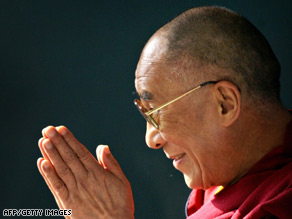
The Dalai Lama is in Europe. On Monday, during his visit to Prague—where he met his long-time friend Vaclav Havel, the former Czech President, as well as Prime Minister Mirek Topolanek—, he called on the world to stand firm when dealing with China. “I’m always telling my friends that a good, a close relationship with a huge country like China is very essential, and not only for the economy,” he said. “But in the meantime, there are principles, like freedom of expression, human rights, democracy... for which you have to stand firm. Genuine friendship leaves a space to be firm, and at the end the other does appreciate (that),” he added.

His Holiness will address the European Parliament in Brussels on December 4 and will have a meeting with French President Sarkozy on December 6 in Gdansk, Poland.

Well, what would be an appropriate outcome of this European tour? What about if “the European Union designate as soon as possible a high profile European Emissary to help resolve the issue of Tibet and put an end to tensions between China and Europe around Tibetan issues?” That is what the International Campaign for Tibet (ICT) asks the European Union to do.

It would be a miracle if that were to happen, but, well, who knows?

November 30, 2008

'O Come, O Come Emmanuel'

Today is the first Sunday of Advent. To live it properly, I thought the listening of the wonderful hymn “O Come, O Come Emmanuel,” sang by Aled Jones with backing vocals of Libera, might be helpful. I wish you a blessed Advent season!

November 29, 2008

The genius of Arturo Benedetti Michelangeli

Michelangeli was known for his note-perfect performances. “His fingers can no more hit a wrong note or smudge a passage than a bullet can be veered off course once it has been fired,” wrote of him the music critic Harold Schonberg. In this post is explained how his style is classical in the sense of Classicism, and in a way that is more than emblematic.

Why more than emblematic? Because Michelangeli (together with Maurizio Pollini) is further evidence of a sort of anti-romanticism present in the Italian culture and due, not many doubts about it, to the Italian classical heritage and its influence in all fields.

Ave, Caesar

If you are interested in ancient Roman history and you are in Rome during this time (or plan, as I do, to visit there soon), then I think you shouldn’t reasonably miss “Julius Caesar - Man, Feats and Myth” (Giulio Cesare. L'uomo, le imprese, il mito), the first ever exhibition to focus entirely on ancient Rome’s most famous political and military leader.

The exhibition, which is being held at the Chiostro del Bramante, started on Friday, October 24, 2008, through Saturday, May 3, 2009. It examines the historic aspects of Caesar’s rule, as well as the political and cultural atmosphere of his time, his astonishing military campaigns, his magnificent literary works, his climb to power and his brutal murder in the Roman Senate.

The exhibition—in my view the event of the year in the Italian capital—collects archaeological documents of the utmost importance, coming from the most prestigious Italian and foreign museums, and paintings by masters such as Rubens, Guercino, Pietro da Cortona and Guido Reni. Massive canvases of Caesar by Giambattista Tiepolo, sold to the Russian tsar in the early nineteenth century, have also returned to Italy for the occasion (and for the first time in 200 years).

Caesar, as the organizers explain, was “an exceptional character, a man of letters, historian, general and statesman of extraordinary far-sightedness.” It was he himself who “started even during his lifetime, to create his own myth.” In fact,

he presented himself as a descendant of Venus, thus tying himself to the original myth of the city of Rome itself, dating back, according to ancient tradition, to Aeneas himself, son of Venus, who supposedly landed at the Tyrrhenian shores of Latium at the end of his long wanderings, being exiled from Troy, as marvellously narrated in the Virgilian Aeneid.

Hence the exhibition’s guiding philosophy.

The final section looks at the depiction of Caesar in the world of cinema. The palace that houses the exhibit was designed by Donato Bramante in the 15th century and is attached to the church of Santa Maria della Pace along Via Della Pace close to piazza Navona.

P.S. Since it happens that just in these days I’m reading, Idi di Marzo (The Ides of March), the latest book by Valerio Massimo Manfredi (unfortunately for my English-speaking readers the English version is yet to be released), I can’t help confessing that this is one of those moments where I feel sorry that I live so far away from Rome …

Come nevica sul Pd ...

Ma che diavolo hanno da criticare quelli che le misure del governo a favore dei più poveri proprio non le hanno mandate giù? Non lo dico io, anche se potrei benissimo associarmi, ed anzi mi associo senz’altro, non lo dico io, dicevo, ma Lucia Annunziata. Una contestazione da sinistra della contestazione di sinistra di provvedimenti presi dalla destra. Non è un gioco di parole, magari lo fosse, è molto di più, è un altro sintomo che qualcosa si è rotto: diciamo il rapporto, il contatto con la realtà. E quindi, per dirla come la Annunziata, anche “il senso del denaro” se n’è andato in vacanza. Per quelli di sinistra, naturalmente, ché la gente comune il valore e il senso dei soldi li ha molto ben presenti. Su questo non ci piove, anzi, date le condizioni meteo, non ci nevica.

November 28, 2008

Sex spells trouble, my friends ...


Sexual pressure, sexual desire, actually I think is short period satisfaction and often, that leads to more complication.
[…]
Naturally as a human being ... some kind of desire for sex comes, but then you use human intelligence to make comprehension that those couples always full of trouble. And in some cases there is suicide, murder cases.

Don’t worry, my dear secularist readers, it was not the Pope who said this. It was Tenzin Gyatso, 14th Dalai Lama.

November 27, 2008

Happy Thanksgiving!

Today is Thanksgiving Day in the United States. As for me, I would like to give thanks to the Lord for many things, one of which is … Columbus, that is for letting him be born, and for letting him think that, after all, it was time to discover a new World!

But now, for the sake of true Country Music connoisseurs, I’ll call upon Johnny Cash to speak. Let’s listen to Man in Black singing a rare song called “Thanksgiving Prayer” (words and music by Johnny himself and Josef Anderson). He sang it on the Dr. Quinn Medicine Woman Show several years ago. Enjoy it, and have a wonderful Thanksgiving!

November 26, 2008

Once upon a time ... La Dolce Vita

I can’t honestly say that La Dolce Vita is one of my favourite movies, nor that it is my favourite Federico Fellini’s masterpiece (I prefer I Vitelloni, La Strada, and above all Amarcord), but I understand and respect the reasons why millions of people from all over the world tend to consider it as one of the best films ever. In any case, there is no doubt that La Dolce Vita is a cult movie which represents a watershed moment in the history of both cinema and custom.

That is why, since its half-century mark—Fellini conceived the film in November 1958, shot in 1959 and premiered in early 1960—is approaching, Rimini, the director’s hometown, is pulling out the stops to give the movie a two-year-long international birthday bash. The celebrations will eventually extend to Los Angeles in 2009 (the Academy of Motion Picture Arts and Sciences will hold an exhibition in Beverly Hills from January 24 to April 19 on Fellini’s “Book of my Dreams”).

All this, the Guardian writes today,

is a world away from the furore when the film was finally released in 1960 - when Fellini was spat on "in the name of the fatherland" at the Milan premiere, challenged to a duel by an outraged Roman, accused of inciting vice and immorality by the Vatican newspaper and saw fights break out in the audience after showings.

But the film was not even universally admired by liberal critics:

An early Guardian review observed that the film lasts three hours, "of which two are superfluous", before offering the withering judgment that "even the best sequences rise no higher than the level of good journalism".

Light years away, actually. Another major British newspaper, the Independent, tells the story of how it all started, namely when an American billionaire decided to cheer up a penniless young Venetian countess by bankrolling a birthday party for her in a trattoria in Trastevere. It was then that on the dance floor the then almost-unknown Anita Ekberg started pulling down her suspenders …

November 25, 2008

A 'Machiavellian' perspective on the Tibetan issue?

“We are in a democratic system, but the opinion of the majority may not be the right one,” said Lhadon Thethorg, a delegate (and New York president of Students for a Free Tibet) on the final day of the meeting between the Tibetan exile leaders which took place last week in Dharamshala. In fact nearly 600 delegates voted to continue to follow the Dalai Lama’s “Middle Way” strategy. However, Lhadon Thethorg added, “whether for the ‘Middle Way’ or independence for Tibet, people are calling for more vigorous action.”

Dolma Gyari, deputy speaker of the Tibetan parliament-in-exile, in turn, said that “if China does not respond positively to our initiative, there is no other options left for us than to go for independence.” Yet, the Dalai Lama doesn’t seem too hopeful about the “positivity” of the Chinese approach towards the Tibetan issue: “My trust in Chinese officials has become thinner and thinner,” he said Sunday, addressing the delegates after they wrapped up the gathering. So what? Is he in doubt about his own “Middle Way” path itself, which seeks genuine autonomy through negotiations with the Chinese leadership? Yes and no, I’d say. No, because the alternative approach (to seek the path of negotiation over the way of violence) would lead nowhere. Yes, because of the undoubted failure of the negotiations which have been held so far. Is this contradictory? Yes, if we mean this in a logical sense, no, if we consider the true nature of the issue, or, to say it with Machiavelli’s words, if we go directly to “the effectual truth of the thing than to the imagination of it.”

But there is a different way to approach the issue: instead of wondering, as many people do, whether or not the Dalai Lama’s “Middle Way” is the best path, we might wonder whether or not Chinese views and policies on Tibet are actually wise and thoughtful. As a matter of fact, the Chinese are assisting the calls for Tibetan independence, and, as this leading article in yesterday’s Independent says, they are “encouraging radicalism as a way of splitting the Dalai Lama from his adherents and then waiting for him to reach an isolated death.”

But …

[t]his is a dangerous policy. Marginalising moderation, as we know from the Islamic world, only plays into the hands of the extremists, of which there are an increasing number amongst young Tibetans. The call for independence, as opposed to autonomy, will grow louder. Beijing should heed the Dalai Lama’s call for the “middle way” before it finds that events have moved beyond its control.

I find this perspective to be a good starting point for further discussions.

November 22, 2008

Tibet exiles back Dalai Lama's 'Middle Way'

At last the nearly 600 Tibetan exile leaders who have been meeting in the Northern India hill town of Dharamsala this week to debate a potential new approach to Tibet’s struggle for freedom have voted to continue to follow the Dalai Lama’s “Middle Way” strategy.

This was generally considered the most likely—and reasonable, in my opinion—outcome of the gathering, but there has been a small minority who called for Tibetan independence instead of the “genuine autonomy” which His Holiness has been seeking for decades. “The majority of the people have spoken and have requested his holiness the Dalai Lama to continue with his Middle Way approach,” said spokesman Tenzin Taklha, according to whom “the Tibetans demonstrated that the Dalai Lama was their undisputed leader.” The Tibetan parliament, which convenes in March, must approve the agreements reached in the meeting, said former prime minister of Tibet’s government-in-exile Tenzin Tethong.

Yet, in the face of that “moderate” outcome Chinese authorities and government will likely remain deaf. “The Dalai Lama’s so-called ‘middle way’ is a naked expression of ‘Tibet independence’ aimed at nakedly spreading the despicable plot of opposing the tide of history,” said last Friday an editorial in the official Tibet Daily newspaper. That is why the delegates also recommended that Tibetan leaders stop sending delegates to meet with Chinese officials “until we are convinced China is serious about negotiating and so far China is not serious,” as a participant at the meeting refers.

Which means, to speak the way the ancient Romans used to, it will take place the day of the Greek calendae—and let's keep in mind the Greek calendar did not have calendae!

November 21, 2008

Fuga dal Pd (updated)

C’è chi dice no. E se ne va (dalla Direzione nazionale del Partito democratico), non senza aver prima esposto dettagliatamente, in una lettera aperta a Walter Veltroni pubblicata oggi in prima pagina dal Riformista, le motivazioni che hanno “suggerito” questa decisione. E’ Irene Tinagli, che insegna alla Carnegie Mellon University di Pittsburgh ed è esperta di politiche pubbliche per l'innovazione, la creatività e lo sviluppo economico. Inoltre lavora come consulente per il Dipartimento Affari Economici e Sociali dell'Onu e per la Commissione europea. Il suo ultimo libro—informa Il Riformista—è Talento da svendere, uscito quest’anno per i tipi di Einaudi.

[Continua qui, come al solito. Attenzione, c'è un aggiornamento: da leggere assolutamente, su Wittgenstein.]

Dharamsala notebook


The BBC's Chris Morris reports on the atmosphere at the “special meeting” that is taking place this week in Dharamsala to discuss the future of Tibet (see my previous post).

November 20, 2008

Rethinking freedom struggle


Nearly 600 Tibetan exiles began a week-long meeting Monday in Dharamsala—the Northern India hill town which is home of the 73-year-old Dalai Lama and Tibet’s government in exile—for a very special and unprecedented meeting to discuss Tibet’s future.

His Holiness called for this gathering two months ago, when he began to realize that his attempts to secure greater autonomy for his country through negotiation with the Chinese government were fated to fail. Which actually happened, and in fact he publicly admitted earlier this month in Japan, that his “middle path” approach of seeking dialogue with the Chinese leadership in search of a “genuine” autonomy (not “independence”) for Tibet had been exhausted and that there was now “no other alternative than to ask people” about how to proceed.

Though the meeting will have no policy-making power, since any recommendations would require the approval of the exiled Tibetan parliament, according to many exiles and observers this is definitely a moment of historic importance: time are ripe for change, they say, but, apart from the most radical Tibetan activist groups, nobody knows which alternative approach could produce better results at not-too-great a cost. And maybe that is also why the Dalai Lama himself has decided not to attend the meeting. “His Holiness wants to give Tibetan people the opportunity to express their views. He is neutral,” said Lodi Gyari, special envoy of the Dalai Lama, at a press conference on Sunday in Dharamsala.

Neutral? Who could have imagined that the Tibetan spiritual leader would have thrown in the sponge? But is this what he really wants? I am neither very convinced about that, nor am I persuaded that, as my friend Enzo writes in today’s Il Foglio newspaper and in his blog (in Italian), “the era and the epic of the Dalai Lama as a political leader have come to their terminus.”

Yet, I agree with Enzo when he recalls and stresses what Thupten Samphel, spokesman for the Tibetan government-in-exile, said in response to Qin Gang's—China's Foreign Ministry spokesman—warning ( “any attempt to separate Tibet from Chinese territory will be doomed”): “This meeting is not about taking Tibet away from China,” he said, “it’s about restoring the human rights of Tibetan people living in Tibet.”

No doubt that any attempt to take Tibet away from China would lead nowhere, while focusing on the issue of “human rights of Tibetan people living in Tibet” sounds much more realistic (and “noble”).

One more thing: Thubten Samphel also noted that the Dalai Lama had said last month that his “trust in the Chinese government was diminishing. But he never said he had given up on talks.” That’s quite another matter.

November 19, 2008

Veltroni? Niente da aggiungere

Ne farei volentieri a meno, sono sincero, ma avere un blog politico comporta anche il dovere di occuparsi di questioni e situazioni politicamente sgradevoli, persino tediose, e dei personaggi che ne sono protagonisti (ai quali, pur con tutta la buona volontà, non ci si può riferire in termini più benevoli di quelli impiegati un momento fa). E dunque parliamo delle recenti vicende del Pd e del suo capo. O meglio dell’editoriale di Ernesto Galli della Loggia sul Corriere di ieri e della risposta di Walter Veltroni su quello di oggi.
[continua qui]

November 16, 2008

'Let Eluana Englaro live!'

After the ruling by Italy's top appeals court allowing Eluana Englaro’s family to halt the treatment that is keeping her alive, the nuns of the Misericordine Order, under whose care Eluana has been surviving for 14 years, have launched a moving appeal to save her life. In a letter published in yesterday’s Avvenire, the daily newspaper of the Italian Bishops Conference, they said:

Our hope, and that of many like us, is that the death by hunger and thirst of Eluana, and others in her condition, will not be carried out. That is why, once again, we maintain our availability, today and into the future, to continue to serve Eluana. If there are those who consider her dead, let Eluana remain with us who feel she is alive. We don’t ask anything but the silence and the liberty to love and to devote ourselves to those who are weak, poor and little in return.

A crystal clear example, in my view, of what Catholic faith and, I dare to say, Catholic moral theology are all about. [See also here]

As for the Catholic hierarchy, Archbishop Salvatore Fisichella, head of the Vatican’s Pontifical Academy for Life, described allowing Eluana Englaro to die as an “immense crime” and a “civil and moral defeat.” Eluana, he said, would die an “atrocious death” by being deprived of water and nutrition. A step on the road to legal euthanasia, in his view. But he added that he had “profound respect” for Eluana’s father (“I pray for him”), and that “no one who has not had a similar experience can possibly judge her family, or indeed other families dealing with similar cases.”

Another example, but this time of a comprehensive, well-balanced approach to this kind of case. Both the nuns and Archbishop Fisichella, in my own humble opinion, have been equal to their task.

November 14, 2008

Italy's Terri Schiavo case

The Corte di Cassazione, Italy's top appeals court, removed today the last legal obstacle in a landmark “right-to-die” case which has fiercely divided opinion in Italy, by authorizing the father of 37-year-old Eluana Englaro to remove the feeding tube which has kept his comatose daughter alive for nearly seventeen years.

The Englaro case has been compared to that of Terri Schiavo, the American woman who spent 15 years in a vegetative state and was allowed to die in March 2006 against the wishes of her parents after a long court battle.

In fact, Terri Schiavo’s brother, Bobby Schindler, told LifeNews.com he strongly disagrees with the court. “Today’s ruling,” he said, “will clear the way for Eluana to experience a barbaric and inhumane death by starvation and dehydration.” He is also worried that the kind of “bioethics” that prompted courts in the United States to allow his sister’s former husband to kill her is making its way across the globe. “This court’s ruling seems to indicate that American ‘medical ethics’ are spreading like a virus among the international community, threatening countless numbers of elderly, ailing and disabled persons in an increasing and alarming way,” Schindler noted.

Perhaps Schindler undervalues the high “progressive” standards achieved in some European countries. Nevertheless I think he is basically right.

Free Nay Phone Latt !

As it is well known Burma’s military government exercises strict control over all public media. That’s why dissidents often use the Internet—where controls are, at least up to a certain point, less stringent—to circulate information. But this time there was no escape for Nay Phone Latt, a 28-year-old blogger, whom a court in military-ruled Myanmar sentenced to more than 20 years in jail last Monday for his Internet activities.

Nay Phone Latt, who is also a former member of detained democracy leader Aung San Suu Kyi's opposition party, used his blog, written in the Burma language, as a forum to discuss the difficulties of daily life, such as the regular power outages and the rising cost of living. The blog was banned by Burma's military regime, and Nay Phone Latt was arrested in January this year during a round-up of activists linked to the massive anti-junta protests in September 2007.

The sentence, say Reporters Without Borders, consisted of two years for violating article 505 (b) of the Criminal Code (which punishes defamation of the state), three years and six months for violating article 32 (b) of the Video Act and 15 years for violating article 33 (a) of the Electronic Act.

Reporters Without Borders and the Burma Media Association say that this shocking sentence “is meant to terrify those who go online in an attempt to elude the dictatorship’s ubiquitous control of news and information.” The two organizations called for bloggers around the world to post a photo of Nay Phone Latt on their webpages and write to Burma’s embassies to press for the young man’s immediate release. Hence this post, with which I willingly accept the call and ask my few but loyal readers to spread the word … [Hat tip: Nora]

The American Dream makes converts ...

“And now we may let Obama let us down. When was the last time someone deceived us?” wrote prominent Italian columnist Adriano Sofri a couple of days ago in la Repubblica newspaper (in Italian, via Luca).

That is likely the way many European leftists look at Barack Obama.
“There is a lesson,” says the Italian intellectual,

in the fact that the three contemporary personalities who more confidently dealt with the dream had African ancestors: Martin Luther King, Nelson Mandela, and now Barack Obama.

Well, isn’t Obama King’s dream realized? Perhaps more pragmatically, as Sofri puts it, he is the man who

describes America as the ‘Dream’ Corporation in which every American must hold a stock of shares. In his best speeches, the redistribution of the American Dream went along with the redistribution of the wealth.

And hence his huge margin victory. I would just ask Sofri and the other European leftists one question: should Obama be successful in achieving his aims, do you think you will be ready to be converted to the American Dream? [Italian version]

November 12, 2008

Anch'io ci credo, direttore, però ...

“Io ci credo” (all’Italia), scrive il direttore del Giornale a quelli che fanno parte della community de ilGiornale.it—come lo scrivente, che per informarsi via Web sottoscrive tutto ciò che di decente e serio, in Italia e soprattutto fuori, si renda disponibile a titolo gratuito …—, invitando tutti a fare altrettanto e a testimoniarlo qui.

E allora eccomi: anch’io ci credo, credo che gli italiani siano migliori di quanto non pensino e non appaiano alla luce di quel che si legge sui giornali o si sente e si vede nei telegiornali, e che dunque possiamo farcela, e che probabilmente ce la faremo. Ma questa fiducia, come suggerisce il “probabilmente,” non è incondizionata ... [continua qui]

Once upon a time in San Ginesio ...

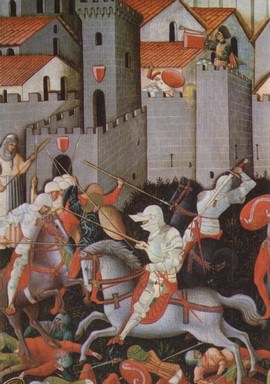
San Ginesio’s Battle, Tavola XV CenturyEvery two years a fabulous battle re-enactment takes place in a lovely hilltop town called San Ginesio, in the Le Marche region, Central Italy. The event is known as “La Festa della Fornarina” (“The Little Baker’s Festival”).

Please follow this link if you are interested in knowing what the Festa is all about, and what else is to be found in that picturesque Italian town.

It all began when, back in the late Middle ages (on November 30, 1377), while the people of San Ginesio were soundly sleeping, their enemies from the near town of Fermo, sneaked up in the dead of night and attacked San Ginesio …