January 5, 2009

Best European Blog

The 2008 Weblog Awards


I got the news a couple of days ago that my blog had been named as one of ten finalists for the Best European Blog (Non UK) category in the 2008 Weblog Awards.

This was totally unexpected but highly welcomed! In fact, the Weblog Awards are the world’s largest blog competition, with over 500,000 votes cast in the 2007 edition for finalists in 45 categories, and in the past I have perused them over the years to discover some great blogs to add to my blog reader. So I am both stunned and honored to be considered worthy of inclusion in the list of finalists for the Best European Blog.

There is a small window of opportunity for readers to vote for their favorite nominees (January 5th through the 12th). I have added a direct-link badge in the right sidebar to make it easier for you to vote.

Voting rules:

  1. You may vote once every 24 hours in each poll.
  2. After voting in an individual poll you will be locked out from voting again in that poll (on the computer you voted from) for 24 hours.
  3. Each poll has its own separate 24 hour lockout control. Voting in, for example, Best European Blog will not lock you out of voting in other categories.

Needless to say, I would be very grateful and honored if you would consider voting for me ...

January 4, 2009

Moral clarity in Gaza


Pulitzer Prize-winning columnist Charles Krauthammer in yesterday’s Washington Post:

Some geopolitical conflicts are morally complicated. The Israel-Gaza war is not. It possesses a moral clarity not only rare but excruciating.

Israel is so scrupulous about civilian life that, risking the element of surprise, it contacts enemy non combatants in advance to warn them of approaching danger. Hamas, which started this conflict with unrelenting rocket and mortar attacks on unarmed Israelis -- 6,464 launched from Gaza in the past three years -- deliberately places its weapons in and near the homes of its own people.

This has two purposes. First, counting on the moral scrupulousness of Israel, Hamas figures civilian proximity might help protect at least part of its arsenal. Second, knowing that Israelis have new precision weapons that may allow them to attack nonetheless, Hamas hopes that inevitable collateral damage -- or, if it is really fortunate, an errant Israeli bomb -- will kill large numbers of its own people for which, of course, the world will blame Israel. [...]

The full article is worth reading from beginning to end.

January 3, 2009

Mysterious Italy!

It’s a commonplace that Italy is a beautiful but strange, unmanageable, unreliable country, and that it was just its own oddness that recently led—after a spectacular post-war growth record—to a gradual impoverishment.Italy and its economy are like the Titanic hitting the iceberg,” said once Gianni De Michelis, deputy prime minister in 1988 and 1989. An he was right, at least in part.

That is also why the kind of news we are getting these days on the economic front have the power to overtake us, I mean news such as this. So we learn that the GDP (gross domestic product) per average Briton, which was $45,970 in 2007, is expected to slump to just $35,243 this year, “lower than even Italy”—as the Telegraph puts it—on $37,866 the fifth-placed economy. And Britain falls into sixth place for the first time since 1996. Ok, this is because of the plunging value of the sterling, but

[e]ven stripping out effects of the currency, all economists predict that Britain will be hit hard this year, with forecasting house IHS Global Insight predicting the economy would shrink by an alarming 2.7 per cent, causing the country to suffer from the deepest recession since the Second World War.

Who would have ever predicted this? Certainly not the British newspapers (er, no, actually …) neither the Italian ones, to speak frankly, nor the Italian bloggers. Mysterious Italy!


P.S. I would like to say “we Italians got it right this time,” but the truth is that, this time, the Brits got it wrong. So sorry my British friends …

January 2, 2009

Canova and Neoclassicism

A. Canova, Love and Psiche, Louvre, Paris
It is not just because Antonio Canova was born in a small village located a few miles from the North-Eastern Italian town where I live that I feel the need to write this post, but rather because he is the greatest Italian sculptor of modern times, the artist who in 1802, by special request of Napoleon I, went to Paris and modeled a colossal figure of the emperor, which on the fall of the emperor himself was presented by Louis XVIII to the British government, which in turn gave it to the Duke of Wellington—sic transit gloria mundi … but Canova’s time of glory was destined to last far longer than that of Napoleon! In 1818 he was also commissioned to make a heroic statue of George Washington for the State House, Raleigh, N.C., while his “Bust of Napoleon” is in the Corcoran Gallery, Washington, and other masterpieces are in the Vatican and in the Louvre Museum.

Ok, I don’t want to indulge in unnecessary vaunting (and parochialism), nor do I want to beat about the bush … the reason of this post is an upcoming exhibition in the North-Central Italian city of Forlì, starting from January 25 through June 21. The exhibit will be focused on the ties between Antonio Canova and international neoclassical art. Don’t miss it, if you can help it. Read here to understand why.

January 1, 2009

Time to pay the bills

“Europe was created by history. America was created by philosophy,” once said Margaret Thatcher. Maybe that’s what the difference between Europe and America is all about. But what the “American Philosophy”—or better still, if you prefer, the American Spirit—is all about? As a European by birth and an “American by philosophy,” I’d have some ideas about how to answer, but this piece by David Ignatius, focused on the ongoing financial crisis and government bailout, can be helpful to get a down-to-earth picture of the whole thing in a socio-economic perspective, which at the moment is almost certainly the most topical one.

December 31, 2008

Happy New Year!

If the new year comes a second later

Are you eager to put 2008 behind you? I mean, are you, for example, a Wall Street analyst, a stockbroker, a financial reporter, or still worse, are you people who lost a fortune trusting the above mentioned “experts?” Well, tonight you have to hold your good-byes for just a moment, one second, to be precise. In fact, the international authorities—the International Earth Rotation and Reference Systems Service (IERS), namely the world’s official timekeepers—will add a single second to our lives to keep our clocks in sync with solar time used by astronomers.

It will be the 24th “leap second” since 1972. That’s because, “sometimes, the Earth’s rotation on its axis can take longer or shorter than 24 hours, depending on factors such as the breaking action of tides, snow or the lack of it at the polar ice caps, solar wind, space dust and magnetic storms.”

So, please hold on, and pray the new year brings a better economy. When economics fails, prayer can step in and do the work …

December 30, 2008

David Grossman’s proposal to Israel

In two posts about the Israeli assault on Gaza, Norman Geras gives a convincing answer to those who prompted the charge that Israel’s use of force is “disproportionate,” and agrees with what David Grossman has proposed to Israel. In turn, I definitely agree with Norm. “After its severe strike on Gaza,” says Grossman,

Israel would do well to stop, turn to Hamas’ leaders and say: Until Saturday Israel held its fire in the face of thousands of Qassams from the Gaza Strip. Now you know how harsh its response can be. So as not to add to the death and destruction we will now hold our fire unilaterally and completely for the next 48 hours. Even if you fire at Israel, we will not respond with renewed fighting. We will grit our teeth, as we did all through the recent period, and we will not be dragged into replying with force.
Moreover, we invite interested countries, neighbors near and far, to mediate between us and you to bring back the cease-fire. If you hold your fire, we will not renew ours. If you continue firing while we are practicing restraint, we will respond at the end of this 48 hours, but even then we will keep the door open to negotiations to renew the cease-fire, and even on a general and expanded agreement.
That is what Israel should do now. Is it possible, or are we too imprisoned in the familiar ceremony of war?

December 28, 2008

Il partito degli ex-onesti sulla via di Canossa

Ancora una volta Angelo Panebianco ci risparmia la fatica di trovare un senso a ciò che sta succedendo all’interno del Pd, e nella fattispecie in relazione alle note vicende giudiziarie. Infatti basta leggere l’editoriale di oggi sul Corriere per chiarirsi le idee. Una radiografia precisa e impietosa da cui emergono i travagli e le contraddizioni in materia di «giustizialismo» di quella che fu la sinistra non più comunista e che ora, dopo aver inglobato quella che fu la sinistra catto-comunista della Dc (poi scioltasi nella Margherita), si chiama Partito democratico.

Panebianco spiega anche perché, malgrado le “svolte” violantesche e veltroniane, non ci saranno cambiamenti significativi nell’atteggiamento di fondo di quel partito nei confronti della questione giustizia. Alla base, dice il professore, ci sono “tre dogmi” pressoché insuperabili …

A quanto così efficacemente sintetizzato e spiegato non occorre aggiungere nulla. A margine, tuttavia, si potrebbero dire un mucchio di cose, la maggior parte delle quali, però, sarebbero ovvietà e banalità. Ad esempio questa: qualcuno si era illuso, o aveva fatto finta di credere, o aveva fatto di tutto per convincersi e convincere l’opinione pubblica che ci fosse, oppure che fosse concepibile o plausibile un “partito degli onesti,” alleato di ferro di pubblici ministeri sempre e comunque al di sopra di ogni sospetto, paladini del Bene contro il Male. Panebianco attribuisce questa illusione non solo alla dirigenza, ma anche a buona parte dei militanti e degli elettori del Pd, e credo che abbia ragione. Ebbene, la nemesi è qui, sotto gli occhi di tutti: il teorema è saltato, la favola degli “onesti” è finita, così come quella dei pm senza macchia, giacché ora anche gli “ex-onesti”—se mi si passa la licenza poetica—se la prendono con loro, al pari dei “mascalzoni”—altra licenza poetica—di sempre, le cui sfuriate anti-magistratura-politicizzata erano considerate per definizione troppo “interessate” per essere prese sul serio.

E, attenzione, la favola degli onesti non vale più neppure per il partito di Di Pietro, che sembrava il grande beneficiario dello scempio del Pd. Ora, anche lui deve beccarsi la sua parte di insinuazioni e/o insulti (ci ha pensato quel linguacciuto di Gasparri). Con questo non voglio dire che anche l’ex pm è coinvolto nel malaffare, ci mancherebbe, si è garantisti per qualcosa! No, mi limito ad applicare lo schema dipietrino (implicito o esplicito): se sei sospettato, anche solo di striscio, certamente la tua credibilità è intaccata, ergo devi farti da parte, e comunque non costituisci più “l’alternativa” a un sistema di corruzione e malaffare. Questo devono aspettarsi i seguaci di Antonio Di Pietro e i suoi paladini nel mondo dell’informazione-spettacolo, sempre che facciano (e abbiano fatto)  sul serio e non per finta. Viceversa, anche loro stanno nel mazzo, “come tutti gli altri” (altro schema dipietrino, travagliesco, ecc.).

Tutto questo Panebianco non l’ha detto, e ha fatto bene, perché appunto sono ovvietà, se non banalità, e lui non ci tiene a fare di queste sparate. Mentre qui, su un blog, certe cose si possono anche dire, magari premettendo che, appunto, sono osservazioni scontate, e dunque in qualche misura banali. Il punto, però, è se siamo tutti convinti che questi discorsi siano scontati, che certe cose, al punto a cui siamo arrivati, siano talmente ovvie che non occorra neanche dirle (ma trarne le consuguenze, questo sì, almeno si spera). Qui avrei qualche dubbio: andare a Canossa è uno sport faticoso! Di qui questo post “quasi” banale, di cui chiedo scusa ai lettori più sofisticati ed esigenti.

December 27, 2008

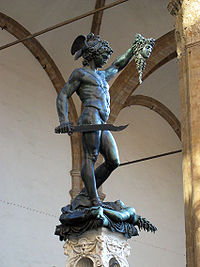
Don't be afraid of Medusa

If you are in Florence during this period, and if you are not easily frightened people, you may want to meet … Medusa (Greek: Μέδουσα (Médousa), namely the gorgon, the chthonic female and snake-haired monster who in Greek mythology had a singular property: gazing upon her would turn onlookers to stone! But don’t be afraid, in fact, again according to the myth, she was beheaded by the Perseus, who after using her head as a weapon for only three, or mostly four instances in his adventures, gave it as a gift to the goddess Athena to place on her shield.

Still worried? Don’t be, because I’m just talking about an annual exhibition of precious works usually kept in storage ... And this year’s event focuses precisely on Medusa, exploring the portrayal of the gorgon through centuries of art.

The exhibit features 40 artworks, including ceramics, drawings, paintings—among which is that by an unknown Flemish painter, attributed to Leonardo da Vinci for over a century—and jewellery, with a number of gems usually stored in Florence’s Archaeological Museum. As it was not enough the exhibit features several different editions of Dante’s Divine Comedy, with plates of Medusa who appears in Canto IX of the Inferno. On show from December 24 through January 31 in the Uffizi.

December 23, 2008

Merry Christmas!

Natività con San Giorgio e San Vincenzo Ferrer Filippo Lippi e collaboratori (1450 - 1475)

And now, folks, as every year since 2000 years,
it’s time to remind ourselves
what the spirit of Christmas is all about.
The following piece of music—a classic Christmas carol,
wonderfully performed by Enya—is just a vague idea,
but you might want to follow the suggestion …


MERRY CHRISTMAS TO YOU ALL!

BUON NATALE A TUTTI!


December 21, 2008

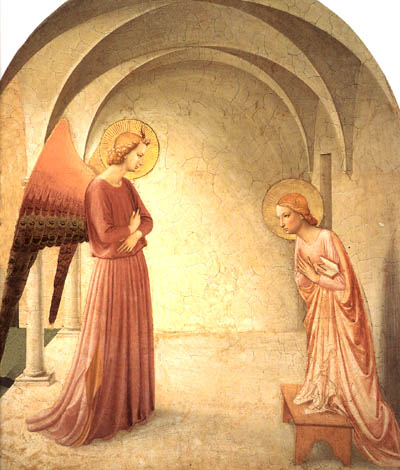
Annunciation

Beato Angelico - Annunciazione
Today, Christians throughout the world observe the Fourth Sunday of Advent, in which Western churches light the fourth and last Advent candle in symbolic preparation for the birth of the Lord. In today’s Gospel (Luke 1:26-38) the angel Gabriel appears to Mary and tells her that it is God’s wish that she bear the Messiah. It is such a well-known passage that there would be no need for me to fully quote it, but I don’t want to miss the opportunity to further spread this wonderful Word of God (in the classic King James version):

And in the sixth month the angel Gabriel was sent from God unto a city of Galilee, named Nazareth, To a virgin espoused to a man whose name was Joseph, of the house of David; and the virgin's name was Mary.
And the angel came in unto her, and said, Hail, thou that art highly favoured, the Lord is with thee: blessed art thou among women.
And when she saw him, she was troubled at his saying, and cast in her mind what manner of salutation this should be.
And the angel said unto her, Fear not, Mary: for thou hast found favour with God.
And, behold, thou shalt conceive in thy womb, and bring forth a son, and shalt call his name JESUS.
He shall be great, and shall be called the Son of the Highest: and the Lord God shall give unto him the throne of his father David: And he shall reign over the house of Jacob for ever; and of his kingdom there shall be no end.
Then said Mary unto the angel, How shall this be, seeing I know not a man?
And the angel answered and said unto her, The Holy Ghost shall come upon thee, and the power of the Highest shall overshadow thee: therefore also that holy thing which shall be born of thee shall be called the Son of God.
And, behold, thy cousin Elisabeth, she hath also conceived a son in her old age: and this is the sixth month with her, who was called barren.
For with God nothing shall be impossible.
And Mary said, Behold the handmaid of the Lord; be it unto me according to thy word. And the angel departed from her.

I have hardly ever read/heard such a marvelous story. I have no adequate words to express my admiration and gratitude to the Lord, nor do I think there are any. Perhaps only music can be equal to the task, and that’s why I’ll call upon music to “speak” …

In the video the splendid and famous “Ave Maria” by Charles Gounod (based from Johann Sebastian Bach’s prelude #1 in C major) performed by Deanna Durbin and the Vienna Boys Choir (Wiener Sängerknaben). This touching performance—from the movie Mad About Music—was filmed in the fall of 1937, when Durbin was 15-year-old. A piece of history in itself.

December 19, 2008

Gladiators are back!

Gladiators will return to the Colosseum … though only in mock fights. The events will take place to mark the 2,000th anniversary of the birth of Emperor Vespasian, who began the construction of the structure. Originally known as the Amphitheatrum Flavium, the Colosseum is the largest amphitheater ever built in the Roman empire. Its plan is a vast ellipse, with tiers of seating for 50,000 spectators, measuring externally 188 m x 156 m (615 ft x 510 ft). The modern-day gladiators could be drawn from Rome’s “gladiator school,” whose 200 members spend their weekends dressed in sandals and breast plates and learning ancient fighting techniques.

Italy's Terri Schiavo case - 2

Italy's Health Minister Maurizio Sacconi When one month ago the Corte di Cassazione, Italy's top appeals court, authorized the father of 37-year-old Eluana Englaro to remove the feeding tube which had kept his comatose daughter alive for nearly seventeen years, the last legal obstacle in a landmark “right-to-die” case—it has been also called ‘Italy’s Terri Schiavo case’—seemed to have been removed once and for all. Not only had a step on the road to legal euthanasia been taken, Eluana would also have died an atrocious death by being deprived of water and nutrition.

Archbishop Salvatore Fisichella, head of the Vatican’s Pontifical Academy for Life, described allowing Eluana Englaro to die as an “immense crime” and a “civil and moral defeat.” And he was absolutely right, according to both Catholics and pro-life lay politicians and opinion leaders.

At that point, what remained to be done was to find a hospital or a clinic willing to grant Eluana Englaro its “help.” And that’s what happened a few days ago, when a public-funded Udine clinic offered to help end Eluana’s life. A team of 20-25 professionals from outside the clinic, said Director Claudio Riccobon, were willing to look after Eluana on an unpaid voluntary basis.

But that was not going to be the last word: the transfer was halted at the last minute a couple of days ago, after Health Minister Maurizio Sacconi issued an official guideline stating that the suspension of treatment for patients in a vegetative state in public health institutions is “illegal.” It was actually a courageous move on his part, which was hailed with satisfaction by Catholics and pro-life citizens, but provoked immediate and indignant protests by the counterpart. In turn, the president emeritus of Italy’s Constitutional Court, Antonio Baldassare, told newspaper Corriere della Sera that Sacconi’s guideline ”is valid for everyone except Eluana” because the Cassation Court had issued a specific ruling on Eluana Englaro’s case.

So it seems that we are still facing a controversial juridical issue. But that of Eluana Englaro is not just a purely juridical case. It’s a matter of life or death for Eluana, and, I would add, for civilization itself. That is why I think Maurizio Sacconi is doing a great job.

[Previous posts on Eluana Englaro's case: 'Let Eluana Englaro live!' and Italy's Terri Schiavo case]

An Italian revolution

“A true revolution is taking place, with the population on its side and the conservatives against,” says Renato Brunetta, Italy’s minister for public administration. A “revolution” in which the “conservatives” are not the nobles, as during the French one, but the unions, and whose goal is to restructure the civil service, primarily by cracking down on fannulloni, slackers, and emphasising meritocracy, productivity and transparency. “Why were civil servants twice as ill as the private sector?” he asks. Perhaps because they work too hard, a cynic “conservative” might answer. Don’t listen to him, would say Brunetta, he’s a damn dirty liar …

December 17, 2008

Time’s Person of the Year: Barack Obama


President-elect Barack Obama is Time’s Person of the Year for 2008. Why? “For having the confidence to sketch that kind of future in this gloomy hour:”

“Two years from now, I want the American people to be able to say, ‘Government’s not perfect; there are some things Obama does that get on my nerves. But you know what? I feel like the government’s working for me. I feel like it’s accountable. I feel like it’s transparent. I feel that I am well informed about what government actions are being taken. I feel that this is a President and an Administration that admits when it makes mistakes and adapts itself to new information.’”

And also “for showing the competence that makes Americans hopeful that he will pull it off.”

“Can he really achieve all that?” asks Time Magazine. “Plenty of voters will be happy if he aces only Item 1 on his list.”

Perhaps this is not what as many people throughout the US (and even more throughout the world) would hope for. This might be not enough. Nor might be the achievement of all of the other above mentioned goals. Unfortunately, it’s not just a matter of “perception,” even though there is no doubt that psychology matters in politics. But good luck all the same.

Journalistic courtesy

I wonder what would the mainstream international newspapers have written had this happened to the ruling Italian center-right coalition. Well, I can’t say it with certainty, but my guess is that they would have written some very different articles … hey, wait a moment, different from what? Actually, now that I think about it, they didn’t write anything at all … Never mind, let’s come back to the point: what would they have written? But, to put things in chronological order, what actually happened?

It happened that Berlusconi's People of Freedom (PDL) party won by large margin regional elections in Abruzzo. But, what is more, at least in my personal opinion, Abruzzo is the central Italian region where the previous center-left Democratic Party (PD) governor had to step down following an alleged public health scam. Furthermore, Abruzzo is where there are 40 suspects in the investigation by the Pescara Public Prosecutor's office, on the alleged bribes for public contracts, which brought about the arrest of Mayor, Luciano D'alfonso, who is also the regional secretary of the PD.

Then again what would the Guardian, the Independent, the New York Times, and other liberal newspapers have written had that (something analogue) happened to the conservative coalition? Obviously I can’t say it with certainty, but I might have an idea of the amount of coverage and of the arguments which might have been advanced. Never mind though—different political views, different standards of journalistic courtesy …

December 14, 2008

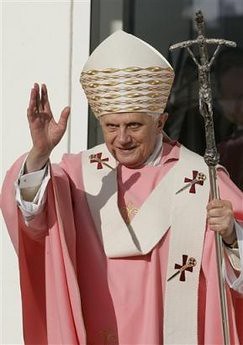
Gaudete Sunday

Advent, the preparation season for Christmas, is basically a penitential period. Yet, in the Latin Church tradition the third Sunday of Advent—that is today—is also called “Gaudete Sunday,” from the Latin word for “rejoice,” thus corresponding with “Laetare” (another Latin word for “rejoice”) or Mid-Lent Sunday. On the third Sunday of Advent, as on Laetare Sunday, the organ and flowers, forbidden during the rest of the season, are permitted to be used, as well as rose-coloured vestments are allowed instead of purple. Which means that, beyond penitence, there is an indescribable joy—we believe that Joy is coming to us from God.

That is why a Christian should be joyful, and this joy should express itself in corresponding forms of behavior. Yet, so many Christians—and unfortunately even priests and bishops—look almost always grim and unhappy. There is no light in their eyes, no joy on their faces, no warmth or enthusiasm in their words. They are just like any other people and one can hardly recognise them as Christians, that is to say those who have been born again in the family of God (John 3:3)! How is it possible? I don’t know the answer. Do you?

To conclude, I would like to give an idea of what, in my humblest opinion, that Christian joy might look like. I mean, I thought that the following video could be somehow connected to the spirit of Gaudete Sunday: Johnny Cash & June Carter performing in Johnny's 1980 Christmas show. June plays the autoharp and banjo and then Johnny and June sing a duet. Again, in my view this is the kind of “joyful Christian” we are all called to be.

Affascinati da Gesù

Antonio Socci è bravissimo, lo sappiamo: scrive e ragiona bene (polemista eccezionale), racconta in modo coinvolgente, insomma ti prende, non è uno che passa inosservato. E tuttavia, a volte, la sua verve polemica e il suo latente “fondamentalismo” (uso il termine con “licenza poetica” …) risultano un po’ indigesti anche a coloro i quali, sui contenuti, non avrebbero nulla da obiettare. Detto questo, credo di far cosa gradita a parecchi lettori di wrh rinviandoli alla lettura di questo scritto, apparso nella più recente uscita della Newsletter del Nostro, che io ricevo regolarmente via email essendo abbonato. L’argomento è “Affascinati da Gesù,” dove la fascinazione riguarda i “laici,” gente come Pansa, che cita don Giussani, e, udite udite, Scalfari …

December 12, 2008

New Michelangelo's masterpiece on show

Yet another good news for art connoisseurs today! A wooden crucifix recently attributed to the young Michelangelo—the carving has been tentatively dated to 1495, when the artist was 20, by the experts—was on display in Rome yesterday, at the Italian Embassy to the Holy See, after being purchased (3.2 million euros) by the Italian State from a Turin arts dealer. It will also be in exhibition at the Italian Parliament on December 23 before finding a permanent home in one of Florence’s main museums.

“Among the elements that it shows is an almost perfect anatomical knowledge of the human body. Its structure, muscles, tendons, skin compose a harmonious and strong image,” said Cristina Acidini, head of the Polo Museale Fiorentino or Florentine Museums group. And not by chance, since the artist “very often used to flay dead bodies in order to discover the secrets of anatomy,” as the Florentine painter and writer Giorgio Vasari, a contemporary of Michelangelo, once wrote. [UPDATE Dec. 23: see here]