October 24, 2008

Leggo Saviano

Si tiene oggi, a Napoli (al Pan, via dei Mille, ore 16:00) una lettura pubblica di Gomorra, il magnifico libro di Roberto Saviano. L’incontro è stato convocato da due associazioni, “Decidiamo insieme” e “Napolipuntoacapo,” con il supporto logistico e organizzativo della Regione Campania e del Comune di Napoli.

L’evento, spiega Claudio Velardi, “non sarà in alcun senso etichettabile, e sarà solo il primo momento di una mobilitazione più larga, che dovrà da subito coinvolgere i quartieri più periferici e le organizzazioni da anni impegnati sul territorio nella lotta per la legalità e contro la camorra.” Per l’occasione è stato aperto anche un blog: Leggo Saviano. Auguri sinceri per una buona riuscita dell'iniziativa.

America docet

Su Sarah Palin si sono dette e scritte molte cose. Un florilegio unico nel suo genere ed una pietra miliare—molto più nel male che nel bene—nella storia delle campagne elettorali americane. E tuttavia è lei, proprio lei, il fenomeno più interessante—più in positivo, stavolta, e per più di un aspetto, che in negativo—e il segno di una svolta che definire epocale non sarebbe esagerato. Leggere cosa scrive Christian Rocca sul Foglio per credere.

Per parte sua, Barack Obama, primo candidato di colore alla presidenza degli Stati Uniti, nonché quasi certo trionfatore della lunghissima corsa elettorale, potrebbe a buon diritto ritenersi defraudato di qualcosa: di essere «il primo», la novità assoluta, e roba del genere.

In entrambi i casi, comunque, ancora una volta l’America è salita in cattedra. Non occorre essere né un simpatizzante di Mr. Obama, né un fan di Mrs. Palin per prendere atto di questa verità. This is America, folks.

October 23, 2008

My name is Maximus ...

“My name is Maximus Decimus Meridius, Commander of the Armies of the North, General of the Felix Legions, loyal servant to the true emperor, Marcus Aurelius. Father to a murdered son, husband to a murdered wife. And I will have my vengeance, in this life or the next.”

Is there anyone who doesn’t remember the expression on Russell Crowe's face while pronouncing those words (see the video below)?

Well, not only did Maximus have his vengeance in the movie, he also took his revenge in the real world. In fact his tomb has been found in Rome some days ago! Or better still the tomb which has been found is that of the Ancient Roman aristocrat who inspired Russell Crowe’s character in the film Gladiator. And his real name wasn’t Maximus Decimus Meridius, but Marcus Nonius Macrinus, a proconsul who achieved major victories for Marcus Aurelius, emperor from 161 AD to his death in 180 AD, in the wars against Germanic tribes in northern Europe.

Furthermore, fortunately the real Roman hero doesn’t seem to have ever been sold into slavery. He came from Brescia in northern Italy—almost a next-door neighbour of mine!—and was an intimate friend of the emperor-philosopher.

Read here (also video), here and here to learn more.

October 22, 2008

Whom I would vote for

A couple of days ago I received a kind message from an American facebook friend of mine. Among other things she wrote that she had taken a look at my blog and was surprised that I am writing about American politics. “I guess it affects the world everywhere,” was her conclusion.

Well, I think she is definitely right. Actually, what happens in the U.S. affects the whole world, and that's why I hope the American voters vote for the best candidate not only for their country but also for the whole world. It is not a simple matter, of course, but it’s a huge responsibility.

Whom would I vote for, if I had to? It’s a matter of intellectual honesty—and of political ethics as well, I suppose—to answer that fateful question … Ok, here we go: in a general sense, being a moderate, by definition I feel frankly equidistant from conservatives and liberals, but I must say that there are some good reasons which, in my view, should induce people like me (moderate, “pro-America,” anti-Fundamentalist, etc) to be “moderately” pro-McCain. So, I think I’d vote for him.

What are those good reasons? Well, I think this Michael Walzer’s piece in Dissent (via normblog) contains the answer. He offers 10 suggestions as to how US foreign policy might change if Barack Obama is elected. And here's one of them:

[S]ome troop withdrawals will be necessary because the Democrats are really committed to a stronger effort in Afghanistan, which means more troops going there and more troops from Europe, or so the Democrats hope. And this might be the place to say that no new American foreign policy will be successful or sustainable unless the administration finds European partners who are prepared, along with the U.S., to take responsibility (some degree of responsibility) for the way the world goes. American multilateralism is going to require a lot of work from the other sides, probably more than our European allies currently have in mind.

Furthermore,

in terms of foreign policy the U.S. will look a lot better if there is an Obama presidency and a large Democratic majority in Congress. But compared to the Clinton years the U.S. has less power and diminished authority today, and the world is more recalcitrant. A different American foreign policy may not make a big difference unless it is accompanied and supported by policy changes in other parts of the world.

October 21, 2008

Arrested, tortured, released

A good news from Tibet, as Reporters Without Borders informs us, is that Jigme Gyatso, a 39-year old Buddhist monk who was arrested for helping as a cameraman to make a documentary (called Leaving Fear Behind) about the Land of Snows, was released last week. The bad news is that the monk has been severely tortured during the seven months he was held. The interrogators, according to the production company of the film, “beat him continuously and hanged him by his feet from the ceiling for hours and kept him tied for days on the interrogation chair.”

The 25-minute documentary—which is now online—was originally shown to a small group of foreign reporters in secret in Beijing during the Olympics in August. The maker of the fim, Dhondup Wangchen, is still detained in Ershilipu prison in Xining province.

Since the events of March, Chinese authorities have created a climate of fear in the towns and around the monasteries by killing, arresting and torturing many dissidents.

October 20, 2008

Powell's questionable endorsement

After the weak Washington Post’s endorsement of Obama, I was waiting for a more straightforward one—though widely expected—by the New York Times, but so far nothing of this kind has happened. In the meanwhile an even more influential endorsement of the Democratic party candidate arrived: that of former U.S. Secretary of State Colin Powell. This high-profile backing, as Mark Halperin puts it, comes in “one of the most important symbolic moments” of the campaign, a moment “of great tactical importance.”

Yet, as much as I am still trying to grasp the deepest philosophical meaning of that “for Obama, but barely” WP editorial, I cannot find any very convincing argument in Powell’s endorsement. Perhaps this is because I don’t live in the U.S. and I am not that informed—in spite of all my efforts—about what is happening over there. Or perhaps even former general Colin Powell, like the Washington Post, is too subtle for me. The latter option is the most plausible one, IMHO.

However, when Powell, to justify his decision, says he is disappointed in the choice of Sarah Palin as the Republican vice-presidential nominee, I think there is no reason to complain, whatever your opinion may be on the Governor of Alaska. But when he says that another reason to endorse Obama is the negative tone of McCain’s campaign in the recent weeks (particularly its focus on Obama’s passing relationship with William Ayers and Republican false intimations that Obama was Muslim), well, I am puzzled. In fact, as Rick Moore puts it on his blog,

For one thing, no official of the Republican Party or the McCain campaign ever accused Obama of being a Muslim. That was coming from partisans who were not officials of either the campaign or the party, and it’s disingenuous for Powell to bring that up as a reason for his decision.

As for the “personal” attacks, he continues, they

have been legitimate attempts to point out the weaknesses in Obama's background and associations and fill in the gaps in his resume that the mainstream press won’t do. That’s all part of the campaign process, and if Powell can’t understand or tolerate that, it’s a good thing he never chose to run for elective office.

How could anyone in his right mind not agree with Rick?

Having said that, Colin Powell brings Obama indisputable benefits. One is that

the former Secretary of State and general is sure to block out any chance McCain has of winning the next two or three days of news coverage, as the media swoons over the implications of the choice. It is simple political math: McCain has 15 days to close a substantial gap, and he will now lose at least one fifth of his total remaining time.

Powell's decision brings other clear benefits as well. He is so trusted for his judgment on national security (even in the wake of his role in the current Iraq War) that his confidence in Obama to become commander-in-chief will resonate with many elites and voters. The Democrats' ability to play the Powell card for the next two weeks makes it much harder, even if there is an unexpected international crisis, for Republicans to suggest Obama simply isn't qualified to protect the country. Powell reinforced Obama's qualifications on "Meet the Press": "Senator Obama has demonstrated the kind of calm, patient, intellectual, steady approach to problem-solving that I think we need in this country."

If some voters still see Obama as a nebulous, unknown figure with questionable associations and liberal tendencies that makes them wary of voting for an African-American, Powell's decision may ease their minds. In some ways his image is the perfect complement to Obama's. Unlike the newly arrived Obama, Powell has been an establishment figure of vast experience in the national spotlight for well over a decade on military and international affairs, first as a career Army man, then in a variety of national security roles, culminating in his service as Secretary of State.

I don’t think there’s any question about that.

October 17, 2008

'I screwed up'

After everything Senator John McCain went through to get to the David Letterman Show yesterday, three weeks after he raised the ire of the generally mild-mannered host by canceling at the last minute ...


Ok, he is likely to lose the election, but would be a winning president, wouldn’t he?

October 16, 2008

Qui Nuova York ...

Oggi Camillo imperversa nella blogosfera. Una serie di post interminabile, di cui due da non perdere. Uno è un breve rimando a una cosa di Paul Berman, blogger per l’occasione, in cui si parla di un certo Bill Ayers, il quale pare che sia da gran tempo “l’uomo più stupido d’America,” politicamente parlando, è chiaro, oltre che uno scomodo “vicino di casa” del candidato democratico alla presidenza degli Stati Uniti (quest’ultimo detto anche “The One,” per chi ancora non lo sapesse). L’altro è un commento (domani sul Foglio) sul terzo e ultimo dibattito tra Obama e McCain. Questo lo cito abbondantemente qui di seguito. Dimenticavo, oggi il Foglio inaugura anche la sua “versione catodica.” Inutile dire che è sempre di Christian Rocca che si tratta ... [continua a leggere]

October 14, 2008

McCain's new economic proposals

After Barack Obama’s new programs to help employers, automakers, homeowners, the unemployed, and state and local governments, here are John McCain’s new economic proposals ($52.5 billion) to relieve financial distress on the nation’s seniors, workers and the unemployed.

The proposals come the day after McCain delivered a speech focused more on what he would do as president and less on his recent personal attacks on his rival—better late than never, I’d say!

“We will learn from this crisis,” he said, “to prevent the next one, with much stricter oversight.”

No more wild overleveraging, no more liabilities concealed from the public and from shareholders, no more bundling of assets to maximize profit by assuming insane risks. Those days are over on Wall Street. With new rules of public disclosure and accounting, my reforms will make certain these betrayals of shareholders and the public trust are never repeated.

October 10, 2008

La fine del 'secolo americano'

Con la consueta (e implacabile) lucidità, Angelo Panebianco ha disegnato sul Corriere di oggi uno scenario più che plausibile per i prossimi anni, cioè la nuova era post-crisi del 2008: non la fine del capitalismo, bensì quella del «secolo americano», un mondo multipolare che sarà “più pericoloso ancora di quello che abbiamo conosciuto e nel quale, inoltre, le prospettive della libertà (per milioni di persone) si faranno ancor più precarie di oggi. Infatti ... [continua a leggere]

Is it really over for McCain?

While watching the latest Obama-McCain debate I had the same feeling as FT journalist Gideon Rachman, that is to say that “McCain was a slightly odd mix of avuncular and aggressive. […] I thought he looked a little old.” I was a little bored, for instance, by his repeated “My friends” trope as well as by what I could only describe as a certain condescending attitude towards Obama, and what is worst, the voters.

But, apart from personal feelings, the fact is that John McCain’s campaign—even according to his supporters—is lurching badly. The polls say that Obama is ahead by significant margins. But is it really over for McCain? That is the question the Guardian asked nine prominent US commentators. And their answers are not that obvious, even though, as Elaine C. Kamarck of the John F. Kennedy School of Government at Harvard University puts it, “we know historically that when people are concerned about their pocket books they turn to the Democratic party.” And though, in addition to this, according to Stephen Hess of the Brookings Institution, if McCain were to win this election “it would truly be the biggest upset in American political history.” That is to say that you cannot “have an economic situation this bad, and not expect to throw out the in party.”

Yet, it is still doable for McCain. According to political columnist David Yepsen, for instance,

there are also two wild cards. One is race: how many people can’t vote for Obamabecause of his race. We know it’s out there, but people don’t like to talk about it and it’s difficult to measure. The other wild card is voters under 25, the millennials. There are huge registration numbers out there. The challenge will be to produce those young people. It’s one thing to sign them up. It’s another to turn them out.


A very interesting reading, indeed. Read also what Norman Geras has to say on the topic. He is very pessimistic about MacCain: “Yes, it's over for McCain. The reason is the economic crisis. There is no way McCain can evade the evident fact that this matured during Bush's presidency.”

October 7, 2008

Non c'è che Max

E’ parecchio che su questo blog non si parla di Veltroni, e non a caso: uno non fa in tempo ad elogiare, a complimentarsi per le novità e le intuizioni dell’ex sindaco di Roma ed ecco che qualche settimana dopo si trova spiazzato e smentito clamorosamente da dichiarazioni e proclami che contraddicono in pieno le circostanze che avevano provocato l’iniziale esultanza!

Certo, uno può prendere il tutto con filosofia (o con un pizzico di cinismo), perché in fondo non è successo nulla—nulla di nuovo, cioè—e semplicemente tutto torna ad essere come è sempre stato, con una sinistra che non si schioda dagli animal spirits girotondini, marcotravalisti e dipietristi, ecc. Tutto un déjà-vu, déjà-vécu, insomma. Una scrollata di spalle e ognuno per la sua strada. Eppure dispiace, ma vabbè, così vanno le cose, così è l’Italia, così è la sinistra in questo Paese. E non consola constatare che persino i liberals americani non sfuggono a questo karma, basti pensare al trattamento riservato a Sarah Palin dai mainstream media, una cosa che lascia di stucco. Ma che diavolo è successo a questa gente?

Oggi, sul Giornale, Luca Telese ha fatto un po’ il punto sulla svolta veltroniana, ma anche sulle difficoltà e sugli ostacoli che Veltroni deve in qualche modo gestire. Una lettura utile, direi, anche a chi fosse rimasto assente dall’Italia per qualche secolo, vale a dire più o meno dall’era del “Veltrusconi” o del CaW, come dicono al Foglio, ad oggi (e tornando dubitasse di essere atterrato per sbaglio in un universo parallelo, tipo film di fantascienza). Non sto a riassumere o a citare, mi limito a segnalare. Quanto ai come e perché, di cui Telese non si occupa, ricordo soltanto un errore tanto madornale quanto evidente fin da subito: l’alleanza con Di Pietro. Errori e ingenuità come questi si pagano sempre. Si poteva evitare? Sicuramente sì, secondo me, anche perché la decisione di scaricare i comunisti—scelta “strategica” di grande coraggio e dignità—condannava automaticamente il Pd alla sconfitta (scontata già di suo), e dunque perché tirarsi appresso quegli altri, che con la cultura riformista e garantista della sinistra democratica c’entrano come i cavoli a merenda?

Poi una considerazione semplice-semplice: avere buone intuizioni/intenzioni, avere “visione” e coraggio—doti che Veltroni ha dimostrato di possedere, anche se gli è mancato quel sovrappiù di coraggio che sarebbe stato necessario per scaricare anche l’Italia dei Valori—non è sufficiente per essere uno statista. Ci vuole anche la capacità di tenere ferma la barra del timone, di infischiarsene di chi mugugna e di chi, ad esempio, lancia accuse di debolezza e subalternità.

Ma se Veltroni non è riuscito a essere/diventare uno statista, la colpa non è solo sua. E’ anche della compagine che lui deve rappresentare: un mix “micidiale” di ex comunisti ed ex cattolici democratici, niente ex socialisti (praticamente), niente liberali di sinistra, marginali personaggi come Letta e Bersani. Insomma, solo un vero statista, appunto, poteva riuscire nell’impresa di creare, con quelle premesse, un partito degno del nome che porta, non l’uomo del «ma-anche».

Ormai tutte le residue speranze sono nelle mani di Massimo D’Alema, l’unico leader vero di cui quel partito dispone. Lui forse ha quel manca a Veltroni, ma che possegga anche “visione” lo deve ancora dimostrare, ma gli auguro di cuore di riuscirci.

October 6, 2008

Call for tolerance

Annette Bening, the American Beauty star, disagrees with Palin's political views. In fact she is a supporter of Barack Obama. Nevertheless she told Fox News that Republican vice presidential candidate deserves respect:

We really want to hear her views ... She’s obviously a very accomplished woman. I’m a Democrat, I’m a supporter of Barack Obama but she certainly deserves our respect.

Let this be a lesson to many other Obama supporters, especially in the media. (Via Camillo)

'And how do you like Florence?'

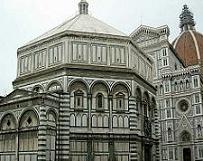
Baptistery, Florence And how do you like Florence? Why, well. It is pleasant to see how affectionately all the artists who have resided here a little while speak of getting home to Florence. And I found at once that we live here with much more comfort than in Rome or Naples. Good streets, industrious population, spacious well furnished lodgings, elegant and cheap Caffées, the cathedral & the Campanile, the splendid galleries and no beggars—make this city the favorite of strangers.
How like an archangel’s tent is the great Cathedral of many-coloured marble set down in the midst of the city and by its side its wondrous campanile! I took a hasty glance at the gates of Baptistery which Angelo said ought to be the gates of paradise “degne chiudere il Paradiso” and then of his own David & hasted to the Tribune & to the Pitti Palace. I saw the statue that
enchants the world. And truly the Venus deserves to be visited from far. It is not adequately represented by the plaster casts as the Apollo & the Laocoon are. I must go again & see the statue. Then I went round this cabinet & gallery & galleries till I was well night “dazzled & drunk with this beauty.” I think no man has an idea of the powers of painting until he has come hither. Why should painters study at Rome? Here, here.

***

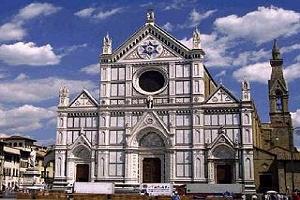
Santa Croce, FlorenceWhen I walk up the piazza of Santa Croce I feel as if it were not a Florentine nor an European church but a church built by & for the human race.
I feel equally at home within its walls as the Grand duke, so
hospitably sound to me the names of its mighty dead. * Buonarroti & Galileo lived for us all. As Don Ferrante says ** of Aristote, 'non è né antico né moderno; è il filosofo, senza più.'

—Ralph Waldo Emerson [from his journals, May 1 /18 1833], in EMERSON IN HIS JOURNALS, selected and edited by Joel Porte, Harvard University Press, Cambridge (Massachusetts) - London (England), 1982.

* The Basilica of Santa Croce is the burial place of some of the most illustrious Italians, such as Michelangelo, Galileo, Machiavelli, Foscolo, Gentile, Rossini, and Marconi, thus it is known also as the Pantheon of the Italian Glories (see Wikipedia).
** “[W]as neither an ancient nor a modern—he was the philosopher,” Alessandro Manzoni, The Bethroted, Capter 27.

October 2, 2008

Bye bye to Venetian pigeons

“Accept that some days you’re the pigeon, and some days you’re the statue,” someone once said. But Venetians don’t seem to fully appreciate the humor in the quote. In fact they are likely to have made a strategic decision to go beyond the alternation pigeon-statue … by getting rid of the pigeons—whose highly acidic droppings, as everybody knows, damage brickwork and marble—on behalf of centuries-old statues and buildings.

In practice feed vendors who sold grain to tourists wanting to feed the birds have been banned, and other moves to shoo the birds away have been taken by the city council, in the face of protests from animal rights groups. As a result, the pigeon population of St Mark's Square has been reduced from an estimated high of 20,000 to barely a thousand. Read here (and here) to learn more.


P.S. From an anonymous source, close to the city council, I have learned that from now on the official pigeon-related quote the lagoon city will adopt could be the following, by George Bernard Shaw,

Remember that you are a human being with a soul and the divine gift of articulate speech: that your native language is the language of Shakespeare and Milton and The Bible; and don’t sit there crooning like a bilious pigeon.

The Palin factor strikes again

“Forget Joe Biden,” wrote Ruth Marcus in yesterday’s Washington Post, “I’d like to see John McCain debate Sarah Palin.” What makes Marcus amazed about Palin is her attitude towards education and books. “The way that I have understood the world is through education, through books, through mediums that have provided me a lot of perspective on the world,” said once the GOP vice president candidate in an interview with Katie Couric. A completely different attitude, according to Marcus, than that of John McCain—she doesn’t like his insistence that he is a man of experience who has been “involved in virtually every major national security challenge we’ve faced in the last 20-some years,” unlike his book-learned and whippersnapper rival Barack Obama.

If this is so, however, I mean, if Sarah Palin has such a high regard for education and books, I don’t understand why intellectuals and academics so often show their bias and a certain distrustfulness towards Republican vice presidential candidate. Ok, they may want to be non-bipartisan, they have the right to be non-neutral in the presidential race, but they could be more decent and less black and white …

The following story, related by Norm, is in my view somehow paradigmatic :

An adjunct professor at Metro State College in Denver set his students the task of doing a piece of work critical of Sarah Palin. He asked them 'to write an essay to contradict what he called the "fairy tale image of Palin" presented at the Republican National Convention.' A student complained and this has led to an investigation by the college.

Of course, I cannot but agree with Norm’s comment:

In itself, there's nothing wrong with the assignment. Asking students to undertake such a critical exercise about any politician might just be a way of testing their linguistic and analytical powers. It all depends on what other assignments they are given. That is, are they asked to do this sort of thing about other politicians as well? Was it conceived as a critical exercise only, or as a way of promoting the teacher's own political preferences? That the assignment was later revised to allow students to write on any of the candidates suggests that he and/or the college didn't feel that all was well as things stood.

October 1, 2008

Spain's crackdown on child porn

Spanish police have arrested 121 people in the country's largest ever operation against internet child pornography. (BBC News)

Investigators say they have been helped by a software program which enables them to detect and gather the names and addresses of Internet users who connect to the pornographic sites. (AFP)

Who said that “good news is not news?”

If French Muslims find haven in Catholic schools


Imam Soheib Bencheikh is a former grand mufti in Marseille, France. He is also founder of the Marseille-based Higher Institute of Islamic Studies. And his oldest daughter attends Catholic school. Why? “Laïcité has become the state’s religion, and the republican school is its temple,” he says. “It’s ironic,” he adds, “but today the Catholic Church is more tolerant of—and knowledgeable about—Islam than the French state.”

Now in France Muslim students make up more than 10 percent of the two million students in Catholic schools. In ethnically mixed neighborhoods in Marseille and the industrial north, the proportion can be more than half. In today’s New York Times.

September 30, 2008

Avevate dimenticato il "conservatorismo compassionevole" di Bush?

A quanto pare sì, come giustamente Christian Rocca fa notare oggi sul Foglio. Niente male, insomma, per uno che

è stato criticato dai suoi compagni conservatori per aver creato un nuovo Leviatano di destra, per aver ampliato a dismisura il programma federale Medicare (500 miliardi di dollari per le medicine gratuite agli anziani), per aver istituito un nuovo ministero, quello della Sicurezza del territorio nazionale, che era una vecchia idea della sinistra liberal. E per aver moltiplicato il peso di quello dell’Istruzione, che i conservatori avrebbero voluto cancellare. Bush, invece, s’è battuto assieme a Ted Kennedy per il “No child left behind Act”, il gigantesco programma di recupero scolastico finanziato da Washington.