September 19, 2009

Speaking Ill of the Dead

~ “LETTERS FROM AMERICA” - by The Metaphysical Peregrine ~

Traditionally it shows poor form to speak ill of the dead. In the case of Ted Kennedy, it’s necessary. Statists of course love him. This is the guy that was born into wealth and privilege and spent his life legislating taking money from some people to give to others. He started his career being drunk, driving off a bridge and killing a woman; then running away and hiding for about ten hours. No punishment. He was a drunk all his adult life until he was too sick. He was expelled from Harvard for cheating (allowed to return later). He claimed to be a Catholic yet supported state financed abortion, and promoted homosexual behavior. My view is that if you don’t agree with the position of an institution or organization, why belong to it?

When Robert Bork, one of the most brilliant jurists of the late 20th Century was nominated, Kennedy had this to say, "Robert Bork's America is a land in which women would be forced into back-alley abortions, blacks would sit at segregated lunch counters, rogue police could break down citizens' doors in midnight raids, schoolchildren could not be taught about evolution, writers and artists could be censored at the whim of the Government, and the doors of the Federal courts would be shut on the fingers of millions of citizens." That and other vile things were said about and to Judge Bork, so we now have the adjective, ‘borking’. Since then every Republican judicial nominee to any level has to some degree been borked. The idea is to destroy both the life and career of the nominee. Nice.

In 1983 he worked with the Soviet Union, at the height of the Cold War, to undermine and defeat Ronald Reagan. This information is from letters released when the KGB opened its archives. In the letters he blamed the Reagan Administration, not the Soviet Union, for increasing hostilities. Nice.

He passed legislation that benefited him and friends. He’s for wind energy, but not off the coast of his beach front mansion, so he stopped offshore windmills even though they were over the horizon and couldn’t be seen. He used legislation to cramp major oil companies while making millions from small oil companies protected by his legislation.

He did not personally sacrifice for the poor, time or money. He never curtailed his conspicuous consumption.

I’m sad for the family and loved ones that will miss him. We do miss those we love when they die.

America though, is better off without him. As the magazine “National Review” noted: “The bad news for Ted Kennedy is that it’s not the press that will be judging him now.”
(They are still praising him in the Main Stream Media here.) RIP

Against Anti-Americanism

“Ours is a better world because of America. The world is safer because of the American soldier. The world is wealthier because of American enterprise. The world is healthier because of American technology. No nation is perfect, but imagine the world without America. I reject anti-Americanism. I declare myself a friend of the United States of America.”

That’s what is stated in the Global Declaration Against Anti-Americanism, issued by AmericaInTheWorld.com, the website of the London Centre for the Study of Anti-Americanism, a cross-party organization—which was launched and funded in October 2008 by “supporters of America”—aimed to “increase understanding of America, to debunk some of the leading myths about the United States, and to make a positive case for a continuing leading role for America in the world.”

The Declaration can be signed here.

“Anti-Americanism,” as the organization’s manifesto states, “is not just America’s problem.” And that is undoubtedly true. I have just signed up.

September 18, 2009

Honor to the fallen


Lieutenant Antonio Fortunato, 35; Corporal Matteo Mureddu, 26; Corporal Gian Domenico Pistonami, 26; Corporal Davide Ricchiuto, 26; Sergeant Major Roberto Valente, 37; and Corporal Massimiliano Randino, 32. They were paratroopers of the “Folgore” brigade.

Thursday’s suicide attack in Kabul was the single heaviest loss of life to be suffered by Italy since two car bombs in Nassiriya, Iraq, killed twelve Carabinieri military police, five army soldiers and two civilians on November 12, 2003.

They died supporting the cause of freedom in Afghanistan and served their country. How should we honor them? They gave their lives for what they believed in, as their parents, wives and fiancées are witnessing in these hours. So, let’s honor them by never forgetting them and what they believed in and fought for. That’s also why, along with Ignazio La Russa, the Italian defense minister, and foreign minister Franco Frattini, I think that the best answer is that ”these cowardly killers will not stop us,” and that such attacks “will not deter us from helping the Afghan people consolidate its democratic aspirations.”

September 15, 2009

Rainbow alphabet doggerel (S,T)

S is for Simple

Sailor Simon went to sea
In a ship with a single sail.
When a salty storm shook the ship
The sail was slit by the gale.

So when all seemed lost
And the squall shrieked on
He was seized by a shylock squid,
'If I take you to shore and save your soul,
It would only cost you a quid.'

(When sailor Simon went to sea
He only took sixpence
He surmised that if he offered that
The squid would take offence)

So as the ship sunk slowly
The squid squeezed out some ink,
'Just sign upon the dotted line,
Or else you're sure to sink.'

So sailor Simon's soul was saved
And so should suit his story
But since he's sadly still in debt
Such seems to shame his glory.
___

Sailor Simon went to sea
In a ship with a single sale
As he sailed the seas in search of the squid
His ship shook from the shock of a whale.

'I'm so sorry,' Simon said,
'I didn't see you there.'
The whale simply softly sighed
Then said he didn't care.

'Another scar upon my side
Seems no surprise to me,
But tell me Sir, why sail a ship
So blindly upon the sea?'

'I'm searching for the shylock squid
Who threatens me to sue.
I still owe him six shillings,
A sum sadly overdue.'

With a smart squirt from his spout
The whale spoke then slowly sank,
'I saw the squid on Saturday,
Stranded on a bank.'

'He hid his savings in the sand
And missed the final tide.
It seems that since from sunstroke
The shylock squid has died.'

So sailor Simon's soul was saved
And so were his six shillings,
For tides may serve as nature's way
Of settling final billings.

___


T is for Time

The toad shed a tear
As he sat on his stool
Thinking of old times
When he once went to school.

Such a tiny tadpole
Would much rather play
Than tediously try
To learn lessons each day.

'There's always tomorrow,'
The small tadpole thought,
'Always tons of time
For me to be taught.'

The toad blinked and sighed
Twitching his old toes.
One lesson he'd learnt
Was how quickly time goes.

___


Text & image © Mirino
(PW) image © Chiara. September, 2009
___

U and V

Q and R

September 13, 2009

'Your "allegria," the true one, has just begun!'


Mike Bongiorno has passed away. An American-born Italian television host, he was undoubtedly one of Italy’s most enduring and beloved TV personalities, the man who popularized quiz shows for generations of Italians. He was also known by the nickname il Re del Quiz (The Quiz King), and his gaffes—real or presumed—were legendary almost as his trademark greeting to viewers—“Allegria!” (“Cheers!”).

As most of my fellow countrymen, I am mourning his loss, though I have never been a follower of that kind of TV show. What I most liked about him was his professionalism and, at the same time, his “ingenuousness,” that is to say, the extraordinary way he performed his job, though I was not a lover of it.. And this in a country much less ingenuous—at least as it was supposed to be, because of its history and culture—than he himself was. But evidently his audience was made up of very ordinary people, the new Italians, less “subtle” and more pragmatic than their ancestors (and perhaps also more sensitive upon the subject of money and “success”). The Italians who made up the wealth of the country, after centuries of poverty and emigration.

Mike also happened to became so popular that the lefty Umberto Eco wrote a learned and ironic essay called the “Phenomenology of Mike Bongiorno.” Here is an excerpt from the essay:


Mike Bongiorno is not particularly good-looking, not athletic, courageous, or intelligent. Biologically speaking, he represents a modest level of adaptation to the environment. The hysterical love he arouses in teenage girls must be attributed partly to the maternal feelings he arouses in a female adolescent, and partly to the glimpse he allows her of an ideal lover, meek and vulnerable, gentle and considerate. Mike Bongiorno is not ashamed of being ignorant and feels no need to educate himself. He comes into contact with the most dazzling areas of knowledge and remains virgin, intact, a consolation to others in their natural tendencies to apathy and mental sloth. He takes great care not to awe the spectator, demonstrating not only his lack of knowledge but also his firm determination to learn nothing.
On the other hand, Mike Bongiorno displays a sincere and primitive admiration for those who do know things. He emphasizes, however, their physical qualities, their dogged application, their power of memory, their obvious, elementary methodology. A man becomes cultivated by reading many books and retaining what they say. Mike Bongiorno hasn't the slightest inkling that culture has a critical and creative function. For him, its only criterion is quantitative. In this sense (having to read many books in order to be cultured), the man with no natural gifts in that direction simply renounces the attempt.
Mike Bongiorno professes a boundless faith in the expert. A professor is a man of learning, a representative of official culture; he is the technician in the field. The question goes to him, to his authority. . But true admiration of culture is found only when, through culture, money is earned. Then culture proves to be of some use. The mediocre man refuses to learn, but he decides to make his son study. Mike Bongiorno's notion of money and its value is petit bourgeois: "You've now won a hundred thousand lire! A tidy sum, eh?"
Mike Bongiorno thus expresses to the contestant the merciless reflections that the viewers will be making at home: "You must be very happy with all this money, considering the monthly salary you earn. Have you ever put your hands on so much money before?"
[…]
Mike Bongiorno accepts all the myths of the society in which he lives. When Signora Balbiano d'Aramengo appears as a contestant, he kisses her hand, saying that he is doing this because she is a countess (sic).
With society's myths he accepts also society's conventions. He is paternal and condescending with the humble, deferential with the socially distinguished.
Handing out money, he instinctively thinks, without explicitly saying so, more in terms of alms than of deserved rewards. He indicates his belief that in the dialectic of the classes the one route of upward mobility is represented by Providence (which, on occasion, can assume the guise of Television).
Mike Bongiorno speaks a basic Italian. His speech achieves the maximum of simplicity. He abolishes the subjunctive, and subordinate clauses; he manages to make syntax almost invisible. He shuns pronouns, repeating always the whole subject. He employs an unusually large number of full stops. He never ventures into parentheses, does not use elliptical expressions or allusions. His only metaphors are those that now belong to the commonplace lexicon. His language is strictly referential and would delight a neo-positivist. No effort is required in order to understand him. Any viewer senses that he himself, if called upon, could be more talkative than Mike Bongiorno.

Mike Bongiorno rejects the idea that a question can have more than one answer. He regards all variants with suspicion. Nabucco and Nabuccodonosor are not the same thing. Confronted by data, he reacts like a computer, firmly convinced that A equals A and tertium non datur. An inadvertent Aristotelian, he is consequently a conservative pedagogue, paternalistic, reactionary.
Mike Bongiorno has no sense of humor. He laughs because he is happy with reality, not because he is capable of distorting reality. The nature of paradox eludes him; if someone uses a paradox in speaking to him, he repeats it with an amused look and shakes his head, implying that his interlocutor is pleasantly eccentric. He refuses to suspect that behind the paradox a truth is concealed, and in any case he does not consider paradox an authorized vehicle of expression.


Perhaps a bit harsh? Yes and no, in my view—I wonder whether I (to say nothing about the vast majority of the public) could have tolerated the kind of hosts Umberto Eco would have presumably liked in the days when he wrote his essay, back in 1963..

However, I suspect that Umberto Eco would have never be able to invent such a nice way to say goodbye to a friend: “Your allegria, the true one, has just begun. And will never end!” (Adriano Celentano, singer, songwriter and TV host). Luigi Accattoli is right: this was the best comment. Quite similar, in a sense (and equally nice), to the one another singer and songwriter, Lucio Dalla, made for Luciano Pavarotti back in September 2007: “His absence will be a temporary one, because I consider death as the end of the first half of an individual’s life.”

September 11, 2009

'Standardization by a low standard'

“ To put it shortly, the evil I am trying to warn you of is not excessive democracy, it is not excessive ugliness, it is not excessive anarchy. It might be stated thus: It is standardisation by a low standard. ”

~ Gilbert Keith Chesterton, “Culture and the Coming Peril” (lecture delivered at the University of London, reprinted in the “Chesterton Review,” Vol. 18, No. 2, August, 1992).

September 4, 2009

Dino Boffo steps down

Epicureans showed little interest in participating in politics, since doing so leads to trouble. So they preferred to live without pursuing glory or wealth or power, but anonymously, enjoying little things like food, the company of friends, etc. Now one might think that their favorite saying, Lathe biōsas (λάθε βιώσας, meaning “live secretly,” “get through life without drawing attention to yourself”), would apply to Dino Boffo, the editor of Avvenire—the Italian Bishops Conference’s daily—who criticized Silvio Berlusconi’s flamboyant lifestyle but just a few hours ago resigned after another newspaper, Il Giornale, owned by Berlusconi’s family, reported last week that Boffo had accepted a plea bargain and paid a fine in 2004 after being accused of harassing the girlfriend of a man with whom he was in a relationship. And that is why Vittorio Feltri, the editor of Il Giornale, had an easy time with Boffo when he called him a hypocritical moralist who should not criticize Berlusconi’s lifestyle because he had sexual skeletons in his own closet.

Yet, I myself have never liked Epicureans, I’ve always preferred Stoics, like Marcus Aurelius, who once wrote “Waste no more time arguing what a good man should be. Be one” (this seems to fit well into the whole story, doesn’t it? But ok, I can’t stand moralists—no one is perfect..). However, apart from quotations, that’s a very serious (and sad) story, and I am very sorry for Dino Boffo and his family, even though, at the same time, I can’t entirely blame Vittorio Feltri, who did his own (dirty) job, exactly the way the editor of la Repubblica did with Berlusconi (and that's why il Cavaliere is suing la Repubblica for defamation, asking for one million euros in damages for the newspaper’s recent coverage of the premier’s personal life).

But, honestly, what I regret most is the damage suffered by the Church, which however is not entirely innocent.. As Vittorio Messori put it (see yesterday’s Corriere della Sera, in Italian), after the conviction in the 2004 trial,

traditional prudence would have suggested to ask the “convicted” to step down, assuming less prominent roles, less exposed to blackmail and scandal news. And this even if the whole story had been a misunderstanding, a revenge, a miscarriage of justice.
[…]
The oblivion of the virtue of prudence costs dear.


Vittorio Messori is one of the most popular Catholic writers, and the author of Jesus Hypothesis (1976). He is also the first journalist in history to publish a book-length interview with a Pope, the best-selling Crossing the Threshold of Hope (1994). And I generally trust his opinion (as well as his knowledge on such matters).

August 28, 2009

Rainbow alphabet doggerel (Q,R)

Q is for Queen

The queen was in a quandary
And as querulous as can be.
She was locked up in her bedroom
And no one could find the key.

The knave climbed up a ladder
To the queen's balcony,
But so quarrelsome she quibbled
That he quivered fearfully.

The king was playing croquet
Enjoying the quiescent calm.
The key was in his pocket
And he, quite without a qualm.

___


R
is for Rat

The rat ran into the restaurant
And caused a bit of a fuss.
He was chased round the room
By the cook with a broom
Then ran out and got hit by a bus.

___


Text & images © Mirino
(PW) August, 2009
___

S and T

O and P

August 27, 2009

In the woods...


That's where I was yesterday, a little before noon, walking on a mountain path (Cima Sappada, Dolomites).

“ In the woods, is perpetual youth. Within these plantations of God, a decorum and sanctity reign, a perennial festival is dressed, and the guest sees not how he should tire of them in a thousand years. In the woods, we return to reason and faith. There I feel that nothing can befall me in life, -- no disgrace, no calamity, (leaving me my eyes,) which nature cannot repair. Standing on the bare ground, -- my head bathed by the blithe air, and uplifted into infinite space, -- all mean egotism vanishes. I become a transparent eye-ball; I am nothing; I see all; the currents of the Universal Being circulate through me; I am part or particle of God. The name of the nearest friend sounds then foreign and accidental: to be brothers, to be acquaintances, -- master or servant, is then a trifle and a disturbance. I am the lover of uncontained and immortal beauty. In the wilderness, I find something more dear and connate than in streets or villages. In the tranquil landscape, and especially in the distant line of the horizon, man beholds somewhat as beautiful as his own nature.

The greatest delight which the fields and woods minister, is the suggestion of an occult relation between man and the vegetable. I am not alone and unacknowledged. They nod to me, and I to them. The waving of the boughs in the storm, is new to me and old. It takes me by surprise, and yet is not unknown. Its effect is like that of a higher thought or a better emotion coming over me, when I deemed I was thinking justly or doing right.
”

—Ralph Waldo Emerson, Nature, 1836

August 23, 2009

Have a good vacation, Mr. President


I must confess I am a little embarrassed raising doubts and/or writing critically about U.S. President Barack Obama, and this for two reasons : first because, to be honest, this has been a rough summer for him and I do not want to be sadistic or something, and second, far less nobly, because these days, as much in Europe as in the U.S., it seems to have become unfashionable and “uninspired,” if not downright silly, to criticize the President.

To be precise, I’m thinking about what happened only a few days ago when British historian Niall Ferguson—he is the Laurence A. Tisch Professor of History at Harvard University and the William Ziegler Professor of Business Administration at Harvard Business School—dared to compare President Obama with Felix the Cat. When I first read the article I thought it was a very good one : good-naturedly ironic, but an cute and penetrating analysis of the first six months of Obama’s presidency. Well, he has been plainly accused to have played “the racist card.” As Ferguson himself puts it, “the seemingly dead body of political correctness just twitched.” I myself was frankly astonished and couldn’t believe my eyes when I took note of that and other similar reactions to Ferguson’s article.

In other words, I would really hate to be accused of being a racist. But, at the same time, knowing by long experience what I am and what I am not, I feel like taking the risk. Hence this post. What I would say first, for instance, is that the future is dark (black actually) for liberty in America—without worrying, if possible, about any potential misunderstanding over whether or not the words “dark” and “black” can be interpreted in an ambiguous way—if you can no longer afford to be ironic about the President, whoever he may be. I found it rather paradoxical that Niall Ferguson might have felt compelled to justify his article by explaining that

1. Black cats are proverbially lucky.
2. Felix the cartoon character was a black cat, not an African-American cat - in other words, he was not one of the (quite numerous) 1920s figures in popular entertainment that mocked the mannerisms of the descendants of slaves.
3. Obama is a lucky president -- so far. Compare his first six months with Carter's and Clinton's if you don't get that bit.
4. As for the word "black", it's the same one used by the Congressional Black Caucus and the Harvard Black Alumni Society, among others.

I just hope Bill O’Reilly, who has written this amusing piece [thanks: Sandra Kennedy], will be more lucky than Professor Ferguson. But the Fox News anchorman carefully (and shrewdly) avoided any reference to black cats, or dogs, or other dark colored animals. He just limited himself to point out that, since “it has been a rough summer for Obama,” he “obviously needs to relax.”

After all,

[t]he economy continues to wobble, the Afghan war is brutal, and the health care chaos has diminished the president in the eyes of many Americans. His leadership on that vital issue has been inconsistent and, at times, downright confusing. I dare you to sit through an entire Obama town hall health care meeting and then explain what the president said. Talk about a tower of babble.

And that’s why he believes

it is important that no one yell at Obama during his vacation. He has certainly had enough of that recently. He needs some peace, some downtime. He needs to recharge using the Vineyard’s sun and wind. The president must get away from talk radio, tea bag protestors, and cap and trade.
Like Grant before him, Obama should just settle back with a cold one, turn on Fox News and enjoy the moments.

I think Bill is absolutely right, and what’s more, he is politically correct.

August 19, 2009

Old and new treasures

With this I complete my trilogy of religious & spiritual posts of middle summer..

Father Philip Neri Powell, OP, an American friar and a fellow blogger whom I deeply admire and respect (I love his humor almost as much as his homilies..), has been working on Treasures Old and New: Traditional Prayers for Today's Catholics until last June. Now the book—which is due out on September 15 August 21, 2009, but there will be a second volume out early next year—has gone to the printers. In the meantime, while faithfully and impatiently waiting to read it, readers have been given by Liguori Publications the opportunity to view some sample pages from the book.

Entering into Joy

“ If to any man the tumult of the flesh were silenced—silenced the phantasies of earth, waters, and air—silenced, too, the poles; yea, the very soul be silenced to herself, and go beyond herself by not thinking of herself—silenced fancies and imaginary revelations, every tongue, and every sign, and whatsoever exists by passing away, since, if any could hearken, all these say, “We created not ourselves, but were created by Him who abides for ever:” If, having uttered this, they now should be silenced, having only quickened our ears to Him who created them, and He alone speak not by them, but by Himself, that we may hear His word, not by fleshly tongue, nor angelic voice, nor sound of thunder, nor the obscurity of a similitude, but might hear Him—Him whom in these we love—without these, like as we two now strained ourselves, and with rapid thought touched on that Eternal Wisdom which remains over all. If this could be sustained, and other visions of a far different kind be withdrawn, and this one ravish, and absorb, and envelope its beholder amid these inward joys, so that his life might be eternally like that one moment of knowledge which we now sighed after, were not this “Enter into the joy of Your Lord?” [Matthew 25:21] ”

—Augustine of Hippo, The Confessions, Book IX, Chapter 10.
Translated by J.G. Pilkington. From Nicene and Post-Nicene Fathers, First Series, Vol. 1. Edited by Philip Schaff. (Buffalo, NY: Christian Literature Publishing Co., 1887.) Revised and edited for New Advent by Kevin Knight.

August 18, 2009

A silence "inhabited" by God

Thomas Merton once wrote: “We are so obsessed with doing that we have no time and no imagination left for being. As a result, men are valued not for what they are but for what they do or what they have—for their usefulness.” We tend to apply the same scheme of reasoning to God Himself: If God exists, people often argue, then He must busy Himself, otherwise He is a false god. We cannot accept the silence of God, as much as we cannot accept the silence tout court. People perceive it as an uncomfortable and awkward break in conversation, so they instinctively insist on filling the silence, and this because nowadays we perceive silence as an absence, as an emptiness. We cannot conceive a meaningful silence, and even less one “inhabited” by Someone: a silence “inhabited” by God. This is part, in my opinion, of the problem with our culture and way of life.

Mother Teresa once said: “We need to find God, and He cannot be found in noise and restlessness. God is the friend of silence. See how nature—trees, flowers, grass—grows in silence; see the stars, the moon and the sun, how they move in silence... We need silence to be able to touch souls.” The contemplative experience teaches the discipline of silence as exclusion of any noises and unnecessary chats, which would profane those spaces of silence. The true wise man—as a Camaldolese monk, Father Franco, once told me—speaks few words and his words are often “silence” at the same time. His words spring from a deep meditation. True silence keeps us away from narrow mindness. The word is a great thing, but it is not what is greatest: if word is silver, as the old proverb goes, silence is gold. Hi who aims at the higher levels of spiritual life needs silence as much as he needs his daily bread and rest for his body.

“In the attitude of silence—said Mahatma Gandhi—the soul finds the path in a clearer light, and what is elusive and deceptive resolves itself into crystal clearness. Our life is a long and arduous quest after Truth.” May the rest of the Summer be a time of renewal and, as far as possible, of silence, for me and for you, my good readers.


___

First written for The Metaphysical Peregrine
___

Rainbow alphabet doggerel (O,P)

O is for Ogre

Orid, the ogre
Was a villainous rogue
Who ate owls and oxen
And pies made with toad.

___


P is for Pig

The polyglot pelican
Spoke to the pig
Who wore pink pants
As he danced a jig.

'Your pants have the hue
Of a plump, ripe peach
And you proudly prance.
It's beyond all speech.'

(The pelican's pouch
Was so full of fish
That his pronunciation
Was not as he would wish)

But it mattered not
A purple plum
For the prancing pig
Was both deaf and dumb.

___


Text & images © Mirino (PW) August, 2009
___

Q and R

M and N

August 17, 2009

Living “La Vita Bella” in ancient Rome


That is “Luxus. The Pleasure of Life in Imperial Rome” (“Il piacere della vita nella Roma imperiale”), a show to be staged in Turin’s Museum of Antiquities (ANSA, see also here). It will offer visitors a taste of what life was like for Ancient Rome’s rich and famous (September 25, 2009 through January 30, 2010).

August 13, 2009

Under the Sharia Law

In case you were in doubt as to whether or not the world is a village, you should pay attention to this post. The author, who is a regular contributor of Wind Rose Hotel, is an Anglo-Scottish artist living in France (and speaking a little Italian) who happened to be on vacation in Italy last July. During his time over here he used to be a regular reader of the Corriere della Sera newspaper, in which on July 23 he happened to read a sharply critical article (in Italian) about the fact that, for the sake of multicultural integration and “with the incredible support of the seemingly unenlightened Archbishop of Canterbury and the Supreme Judicial Authorities of England,” the application of the Sharia as a parallel institution of law had been authorized in Great Britain some months ago (at least 85 Islamic sharia courts are already operating in Britain).

In his post Mirino wonders “if the legal authorities of Great Britain ever took time out to fully inform themselves of what Sharia law consists of.” This, in Mirino’s opinion, “applies equally to Rowan Williams, the Archbishop of Canterbury. Shouldn’t he be more supportive towards the principles of the religion he’s supposed to represent, and less concerned by pre-medieval Islamic laws that seem more prone to advocate intolerance?”

There is no need to say that I strongly agree with him. If it’s not already “too late,” he concludes,

to prohibit the application of Sharia law in Great Britain, and to encourage Muslims who wish to live according to Islamic law and Islamic values to return to where these are naturally more fully adhered to and respected, then it would seem primordial to do so without delay.

It could otherwise be that certain eminent, Right Honourable, robed, wigged, absent-minded and short-sighted lords of British justice have inadvertently lit the fuse to an Islamic time bomb destined to be more explosive than anything since the signing of the Magna Carta.

In the meantime it would be useful to know that more and more non-Muslims in Britain are going to Sharia court seeking judgment for legal matters. Of course critics are worrying that, by accepting Sharia courts as a convenience, the British public is clearing the way for the greater infiltration of Islamic law into their system, irrevocably changing it.. No need to say that I agree with them.

August 12, 2009

There is no justice in Burma


What to say about the guilty verdict and three year jail term with hard labour—commuted by Senior General Than Shwe to 18 months under house arrest—handed down to Nobel Peace Laureate and Burma’s democratic opposition leader Aung San Suu Kyi? My point is merely that the trial has been yet another travesty of justice perpetrated by the regime since it illegally assumed power in 1988, and that, as Tate Naing, Secretary of AAPP (Assistance Association for Political Prisoners), puts it, “there is no justice, no rule of law, and no independent judiciary in Burma,” and that “the continued detention of Daw Aung San Suu Kyi is the jailing of Burma’s future.”

As everybody knows the military rulers used the trial to prevent Aung San Suu Kyi from campaigning ahead of the next general elections, which are the first since 1990, that is when Suu Kyi’s National League for Democracy party won 392 of the 485 parliamentary seats but was never allowed to rule. To this end they fulfilled their purpose.

For now we can only hope that the international community will respond to this latest injustice with a clear message to the junta that its tyrannical actions will no longer be tolerated.

FREE BURMA!!!

August 9, 2009

Summer readings

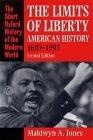
As everybody knows, Summer is a great time for reading (more than writing, at least in my case). What I’m reading these days is an Italian translation of The Limits of Liberty: American History 1607-1992 (“Short Oxford History of the Modern World”), by historian Maldwyn A. Jones. As the “product description” states it’s a major survey of the American past from the earliest colonial settlements to the present day, in which the Author “assesses not only the epic achievements of the nation, but also the tensions and limitations of the society behind the 'American Dream'.” As far as I know it’s also the most comprehensive one volume history of the United States. A very interesting reading, even though not that friendly towards some American heroes..

Rainbow alphabet doggerel (M,N)

M is for Moon

"I have made a mistake,"
Said the man in the moon,
"For the sun is still shining,
I've arisen too soon

But then I am mad
So it's best I eclipse,
I shall go down to Margate
And buy fish and chips".
___

O
n Monday Mr. Murgles
Sold some melons to my mummy.
This may have caused the gurgles
That meander in my tummy.

____


N is for Noah

Noah was a naval man
Who made a naval ark
And filled it full of animals
From Nairobi's National Park

There were elephants and buffalos
And even kangaroos,
Giraffes as well as zebras
And naturally gnus

There were anteaters and ostriches,
Two of every kind.
Only nasty nurgles and wild knackersnaps
Were those Noah left behind.

(This extra last verse is reserved for adults,
especially those who still believe in Darwin's theory)


Noah knew a shapely girl
And vowed to save her life,
So by the time it started raining
He had also left his wife.

___

Text & images © Mirino (PW) August, 2009
___

O and P

K and L

August 7, 2009

With the Mistral wind blowing

Hello everyone! I am back but blogging will be light the next week or two, because it is still summer, so vacation is not exactly over yet..

This is where I have been the past days, with the Mistral wind blowing (La Maddalena Island, Sardinia, I loved it ..):