After everything Senator John McCain went through to get to the David Letterman Show yesterday, three weeks after he raised the ire of the generally mild-mannered host by canceling at the last minute ...
Ok, he is likely to lose the election, but would be a winning president, wouldn’t he?
October 17, 2008


October 16, 2008
Qui Nuova York ...
Oggi Camillo imperversa nella blogosfera. Una serie di post interminabile, di cui due da non perdere. Uno è un breve rimando a una cosa di Paul Berman, blogger per l’occasione, in cui si parla di un certo Bill Ayers, il quale pare che sia da gran tempo “l’uomo più stupido d’America,” politicamente parlando, è chiaro, oltre che uno scomodo “vicino di casa” del candidato democratico alla presidenza degli Stati Uniti (quest’ultimo detto anche “The One,” per chi ancora non lo sapesse). L’altro è un commento (domani sul Foglio) sul terzo e ultimo dibattito tra Obama e McCain. Questo lo cito abbondantemente qui di seguito. Dimenticavo, oggi il Foglio inaugura anche la sua “versione catodica.” Inutile dire che è sempre di Christian Rocca che si tratta ... [continua a leggere]
October 14, 2008
McCain's new economic proposals
 After Barack Obama’s new programs to help employers, automakers, homeowners, the unemployed, and state and local governments, here are John McCain’s new economic proposals ($52.5 billion) to relieve financial distress on the nation’s seniors, workers and the unemployed.
The proposals come the day after McCain delivered a speech focused more on what he would do as president and less on his recent personal attacks on his rival—better late than never, I’d say!
“We will learn from this crisis,” he said, “to prevent the next one, with much stricter oversight.”
No more wild overleveraging, no more liabilities concealed from the public and from shareholders, no more bundling of assets to maximize profit by assuming insane risks. Those days are over on Wall Street. With new rules of public disclosure and accounting, my reforms will make certain these betrayals of shareholders and the public trust are never repeated.
October 10, 2008
La fine del 'secolo americano'
Con la consueta (e implacabile) lucidità, Angelo Panebianco ha disegnato sul Corriere di oggi uno scenario più che plausibile per i prossimi anni, cioè la nuova era post-crisi del 2008: non la fine del capitalismo, bensì quella del «secolo americano», un mondo multipolare che sarà “più pericoloso ancora di quello che abbiamo conosciuto e nel quale, inoltre, le prospettive della libertà (per milioni di persone) si faranno ancor più precarie di oggi.” Infatti ... [continua a leggere]
Is it really over for McCain?
 While watching the latest Obama-McCain debate I had the same feeling as FT journalist Gideon Rachman, that is to say that “McCain was a slightly odd mix of avuncular and aggressive. […] I thought he looked a little old.” I was a little bored, for instance, by his repeated “My friends” trope as well as by what I could only describe as a certain condescending attitude towards Obama, and what is worst, the voters.
But, apart from personal feelings, the fact is that John McCain’s campaign—even according to his supporters—is lurching badly. The polls say that Obama is ahead by significant margins. But is it really over for McCain? That is the question the Guardian asked nine prominent US commentators. And their answers are not that obvious, even though, as Elaine C. Kamarck of the John F. Kennedy School of Government at Harvard University puts it, “we know historically that when people are concerned about their pocket books they turn to the Democratic party.” And though, in addition to this, according to Stephen Hess of the Brookings Institution, if McCain were to win this election “it would truly be the biggest upset in American political history.” That is to say that you cannot “have an economic situation this bad, and not expect to throw out the in party.”
Yet, it is still doable for McCain. According to political columnist David Yepsen, for instance,
there are also two wild cards. One is race: how many people can’t vote for Obamabecause of his race. We know it’s out there, but people don’t like to talk about it and it’s difficult to measure. The other wild card is voters under 25, the millennials. There are huge registration numbers out there. The challenge will be to produce those young people. It’s one thing to sign them up. It’s another to turn them out.
A very interesting reading, indeed. Read also what Norman Geras has to say on the topic. He is very pessimistic about MacCain: “Yes, it's over for McCain. The reason is the economic crisis. There is no way McCain can evade the evident fact that this matured during Bush's presidency.”
October 7, 2008
Non c'è che Max
 E’ parecchio che su questo blog non si parla di Veltroni, e non a caso: uno non fa in tempo ad elogiare, a complimentarsi per le novità e le intuizioni dell’ex sindaco di Roma ed ecco che qualche settimana dopo si trova spiazzato e smentito clamorosamente da dichiarazioni e proclami che contraddicono in pieno le circostanze che avevano provocato l’iniziale esultanza!
Certo, uno può prendere il tutto con filosofia (o con un pizzico di cinismo), perché in fondo non è successo nulla—nulla di nuovo, cioè—e semplicemente tutto torna ad essere come è sempre stato, con una sinistra che non si schioda dagli animal spirits girotondini, marcotravalisti e dipietristi, ecc. Tutto un déjà-vu, déjà-vécu, insomma. Una scrollata di spalle e ognuno per la sua strada. Eppure dispiace, ma vabbè, così vanno le cose, così è l’Italia, così è la sinistra in questo Paese. E non consola constatare che persino i liberals americani non sfuggono a questo karma, basti pensare al trattamento riservato a Sarah Palin dai mainstream media, una cosa che lascia di stucco. Ma che diavolo è successo a questa gente?
Oggi, sul Giornale, Luca Telese ha fatto un po’ il punto sulla svolta veltroniana, ma anche sulle difficoltà e sugli ostacoli che Veltroni deve in qualche modo gestire. Una lettura utile, direi, anche a chi fosse rimasto assente dall’Italia per qualche secolo, vale a dire più o meno dall’era del “Veltrusconi” o del CaW, come dicono al Foglio, ad oggi (e tornando dubitasse di essere atterrato per sbaglio in un universo parallelo, tipo film di fantascienza). Non sto a riassumere o a citare, mi limito a segnalare. Quanto ai come e perché, di cui Telese non si occupa, ricordo soltanto un errore tanto madornale quanto evidente fin da subito: l’alleanza con Di Pietro. Errori e ingenuità come questi si pagano sempre. Si poteva evitare? Sicuramente sì, secondo me, anche perché la decisione di scaricare i comunisti—scelta “strategica” di grande coraggio e dignità—condannava automaticamente il Pd alla sconfitta (scontata già di suo), e dunque perché tirarsi appresso quegli altri, che con la cultura riformista e garantista della sinistra democratica c’entrano come i cavoli a merenda?
Poi una considerazione semplice-semplice: avere buone intuizioni/intenzioni, avere “visione” e coraggio—doti che Veltroni ha dimostrato di possedere, anche se gli è mancato quel sovrappiù di coraggio che sarebbe stato necessario per scaricare anche l’Italia dei Valori—non è sufficiente per essere uno statista. Ci vuole anche la capacità di tenere ferma la barra del timone, di infischiarsene di chi mugugna e di chi, ad esempio, lancia accuse di debolezza e subalternità.
Ma se Veltroni non è riuscito a essere/diventare uno statista, la colpa non è solo sua. E’ anche della compagine che lui deve rappresentare: un mix “micidiale” di ex comunisti ed ex cattolici democratici, niente ex socialisti (praticamente), niente liberali di sinistra, marginali personaggi come Letta e Bersani. Insomma, solo un vero statista, appunto, poteva riuscire nell’impresa di creare, con quelle premesse, un partito degno del nome che porta, non l’uomo del «ma-anche».
Ormai tutte le residue speranze sono nelle mani di Massimo D’Alema, l’unico leader vero di cui quel partito dispone. Lui forse ha quel manca a Veltroni, ma che possegga anche “visione” lo deve ancora dimostrare, ma gli auguro di cuore di riuscirci.
October 6, 2008
Call for tolerance
 Annette Bening, the American Beauty star, disagrees with Palin's political views. In fact she is a supporter of Barack Obama. Nevertheless she told Fox News that Republican vice presidential candidate deserves respect:
We really want to hear her views ... She’s obviously a very accomplished woman. I’m a Democrat, I’m a supporter of Barack Obama but she certainly deserves our respect.
Let this be a lesson to many other Obama supporters, especially in the media. (Via Camillo)
'And how do you like Florence?'
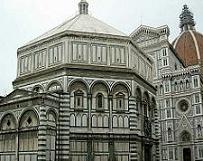 “ And how do you like Florence? Why, well. It is pleasant to see how affectionately all the artists who have resided here a little while speak of getting home to Florence. And I found at once that we live here with much more comfort than in Rome or Naples. Good streets, industrious population, spacious well furnished lodgings, elegant and cheap Caffées, the cathedral & the Campanile, the splendid galleries and no beggars—make this city the favorite of strangers.
How like an archangel’s tent is the great Cathedral of many-coloured marble set down in the midst of the city and by its side its wondrous campanile! I took a hasty glance at the gates of Baptistery which Angelo said ought to be the gates of paradise “degne chiudere il Paradiso” and then of his own David & hasted to the Tribune & to the Pitti Palace. I saw the statue that enchants the world. And truly the Venus deserves to be visited from far. It is not adequately represented by the plaster casts as the Apollo & the Laocoon are. I must go again & see the statue. Then I went round this cabinet & gallery & galleries till I was well night “dazzled & drunk with this beauty.” I think no man has an idea of the powers of painting until he has come hither. Why should painters study at Rome? Here, here.”
***
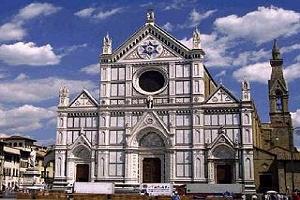 “When I walk up the piazza of Santa Croce I feel as if it were not a Florentine nor an European church but a church built by & for the human race.
I feel equally at home within its walls as the Grand duke, so hospitably sound to me the names of its mighty dead. * Buonarroti & Galileo lived for us all. As Don Ferrante says ** of Aristote, 'non è né antico né moderno; è il filosofo, senza più.' ”
—Ralph Waldo Emerson [from his journals, May 1 /18 1833], in EMERSON IN HIS JOURNALS, selected and edited by Joel Porte, Harvard University Press, Cambridge (Massachusetts) - London (England), 1982.
* The Basilica of Santa Croce is the burial place of some of the most illustrious Italians, such as Michelangelo, Galileo, Machiavelli, Foscolo, Gentile, Rossini, and Marconi, thus it is known also as the Pantheon of the Italian Glories (see Wikipedia).
** “[W]as neither an ancient nor a modern—he was the philosopher,” Alessandro Manzoni, The Bethroted, Capter 27.
October 3, 2008

October 2, 2008
Bye bye to Venetian pigeons
 “Accept that some days you’re the pigeon, and some days you’re the statue,” someone once said. But Venetians don’t seem to fully appreciate the humor in the quote. In fact they are likely to have made a strategic decision to go beyond the alternation pigeon-statue … by getting rid of the pigeons—whose highly acidic droppings, as everybody knows, damage brickwork and marble—on behalf of centuries-old statues and buildings.
In practice feed vendors who sold grain to tourists wanting to feed the birds have been banned, and other moves to shoo the birds away have been taken by the city council, in the face of protests from animal rights groups. As a result, the pigeon population of St Mark's Square has been reduced from an estimated high of 20,000 to barely a thousand. Read here (and here) to learn more.
P.S. From an anonymous source, close to the city council, I have learned that from now on the official pigeon-related quote the lagoon city will adopt could be the following, by George Bernard Shaw,
Remember that you are a human being with a soul and the divine gift of articulate speech: that your native language is the language of Shakespeare and Milton and The Bible; and don’t sit there crooning like a bilious pigeon.
The Palin factor strikes again
 “Forget Joe Biden,” wrote Ruth Marcus in yesterday’s Washington Post, “I’d like to see John McCain debate Sarah Palin.” What makes Marcus amazed about Palin is her attitude towards education and books. “The way that I have understood the world is through education, through books, through mediums that have provided me a lot of perspective on the world,” said once the GOP vice president candidate in an interview with Katie Couric. A completely different attitude, according to Marcus, than that of John McCain—she doesn’t like his insistence that he is a man of experience who has been “involved in virtually every major national security challenge we’ve faced in the last 20-some years,” unlike his book-learned and whippersnapper rival Barack Obama.
If this is so, however, I mean, if Sarah Palin has such a high regard for education and books, I don’t understand why intellectuals and academics so often show their bias and a certain distrustfulness towards Republican vice presidential candidate. Ok, they may want to be non-bipartisan, they have the right to be non-neutral in the presidential race, but they could be more decent and less black and white …
The following story, related by Norm, is in my view somehow paradigmatic :
An adjunct professor at Metro State College in Denver set his students the task of doing a piece of work critical of Sarah Palin. He asked them 'to write an essay to contradict what he called the "fairy tale image of Palin" presented at the Republican National Convention.' A student complained and this has led to an investigation by the college.
Of course, I cannot but agree with Norm’s comment:
In itself, there's nothing wrong with the assignment. Asking students to undertake such a critical exercise about any politician might just be a way of testing their linguistic and analytical powers. It all depends on what other assignments they are given. That is, are they asked to do this sort of thing about other politicians as well? Was it conceived as a critical exercise only, or as a way of promoting the teacher's own political preferences? That the assignment was later revised to allow students to write on any of the candidates suggests that he and/or the college didn't feel that all was well as things stood.
October 1, 2008
Spain's crackdown on child porn
 Spanish police have arrested 121 people in the country's largest ever operation against internet child pornography. (BBC News)
Investigators say they have been helped by a software program which enables them to detect and gather the names and addresses of Internet users who connect to the pornographic sites. (AFP)
Who said that “good news is not news?”
If French Muslims find haven in Catholic schools

Imam Soheib Bencheikh is a former grand mufti in Marseille, France. He is also founder of the Marseille-based Higher Institute of Islamic Studies. And his oldest daughter attends Catholic school. Why? “Laïcité has become the state’s religion, and the republican school is its temple,” he says. “It’s ironic,” he adds, “but today the Catholic Church is more tolerant of—and knowledgeable about—Islam than the French state.”
Now in France Muslim students make up more than 10 percent of the two million students in Catholic schools. In ethnically mixed neighborhoods in Marseille and the industrial north, the proportion can be more than half. In today’s New York Times.
September 30, 2008
Avevate dimenticato il "conservatorismo compassionevole" di Bush?
A quanto pare sì, come giustamente Christian Rocca fa notare oggi sul Foglio. Niente male, insomma, per uno che
è stato criticato dai suoi compagni conservatori per aver creato un nuovo Leviatano di destra, per aver ampliato a dismisura il programma federale Medicare (500 miliardi di dollari per le medicine gratuite agli anziani), per aver istituito un nuovo ministero, quello della Sicurezza del territorio nazionale, che era una vecchia idea della sinistra liberal. E per aver moltiplicato il peso di quello dell’Istruzione, che i conservatori avrebbero voluto cancellare. Bush, invece, s’è battuto assieme a Ted Kennedy per il “No child left behind Act”, il gigantesco programma di recupero scolastico finanziato da Washington.
September 29, 2008
Se Bush salva Ferrara in corner
Con Giuliano Ferrara lo scrivente ha un conto aperto. E questo è un fatto—di cui al mio prossimo non potrà importare di meno, d’accordissimo, ma se permettete per me conta eccome. No, io non gli perdonerò mai, dico mai, di aver mollato Otto e mezzo, l’unico appuntamento quasi fisso con la tv nazionale, consegnandomi in teoria alla noia di tutti gli altri anchormen, e lasciandomi in pratica orfano della politica in scena sul piccolo schermo.
Se poi penso che gli avevo già perdonato la svolta a pagamento sul Foglio in pdf, devo ritenere che, avendo appunto già dato, la scorta è esaurita e per lui non ce n’è più—di attenuanti, di giustificazioni ex ante ed ex post, in una parola, anzi due, di benevola condiscendenza.
Epperò, direbbe Massimo Bordin, epperò essere schiavi di una questione di principio non è né laico né ragionevole, e dunque un’eccezione nella linea di comportamento così stabilita nei confronti del Nostro, che nel frattempo incredibilmente continua a scrivere—sì, a quanto pare ne è ancora capace—, un’eccezione, dicevo, quando ci sta, bisogna poterla fare. Ed oggi è per l’appunto il caso di farla. Il suo editoriale su Bush e sui voltagabbana che ora maramaldeggiano sul presidente incamminato sul viale del tramonto è sacrosanto. E per quanto sulla guerra in Iraq io sia sempre stato su posizioni più blairiane che bushiane, gli do ragione su tutto il fronte. Tanto gli dovevo, e adesso posso fare di nuovo l’offeso—et pour cause!
Se poi penso che gli avevo già perdonato la svolta a pagamento sul Foglio in pdf, devo ritenere che, avendo appunto già dato, la scorta è esaurita e per lui non ce n’è più—di attenuanti, di giustificazioni ex ante ed ex post, in una parola, anzi due, di benevola condiscendenza.
Epperò, direbbe Massimo Bordin, epperò essere schiavi di una questione di principio non è né laico né ragionevole, e dunque un’eccezione nella linea di comportamento così stabilita nei confronti del Nostro, che nel frattempo incredibilmente continua a scrivere—sì, a quanto pare ne è ancora capace—, un’eccezione, dicevo, quando ci sta, bisogna poterla fare. Ed oggi è per l’appunto il caso di farla. Il suo editoriale su Bush e sui voltagabbana che ora maramaldeggiano sul presidente incamminato sul viale del tramonto è sacrosanto. E per quanto sulla guerra in Iraq io sia sempre stato su posizioni più blairiane che bushiane, gli do ragione su tutto il fronte. Tanto gli dovevo, e adesso posso fare di nuovo l’offeso—et pour cause!
September 26, 2008
In memory of Burma’s Saffron Revolution (one year ago today)

If Burma is to achieve genuine democracy—said once Aung San Suu Kyi, Burma’s pro-democracy leader and Nobel Peace laureate—the result of the elections of 1990 must be recognized.
It must be recognized by the military regime, as it has been recognized by the people, and by the world at large. It is through this recognition that we will be able to make genuine progress in Burma. The results of the 1990 General Elections must be implemented is a resolution already taken by the United Nations. We already know that the General Assembly of the United Nations has accepted the notion that the will of the people has been expressed in the 1990 General Elections. This is something we cannot abandon. It will be to the detriment of our country if after an election has been held the results are not honoured and we do not resist attempts to trivialise it.
The world cannot ignore the lives of people scarified in 1988 mass uprising when more than 3000 people were gunned down, nor 2007 Saffron revolution when soldiers and riot police beaten and opened fire on Buddhist monks and peaceful demonstrators. A tremendous responsibility rests upon the United Nations Organisation.
 That is why I signed the following petition,
We the undersigned petition the United Nations Secretary General to implement 1990 Elections result so as to restore peace, stability and national reconciliation in Burma.
Click here to sign petition.
September 24, 2008
And Mahmoud Ahmadinejad is an honourable man
I heard what he said, but I cannot repeat it to you. The words of a powerful oppressor pierce the heart and fly away. He can rage at you for showing suspicion of him, and at the same moment make it clear that what you suspect is true; and he can insult you and claim that you have insulted him, mock you and demand satisfaction, threaten and complain at the same time. He can be both shameless and irreproachable. Do not ask me to repeat what he said.
 A couple of recent events reminded me of the above quote by Alessandro Manzoni (The Bethroted, Chapter 7). Both of them deal with Iranian President Mahmoud Ahmadinejad. It’s up to the reader to judge whether or not the reminiscence was appropriate.
Yesterday, in his blistering speech before the United Nations General Assembly, the little man of Teheran remained faithful to himself, as four prestigious personalities of American diplomacy and intelligence had easily foreseen in an open (and worried) letter to the Wall Street Journal published a couple of days ago. As expected, Mahmoud Ahmadinejad insisted Iran's nuclear activities are for peaceful uses only, but these claims clearly exceed the boundaries of credibility and science, as the four authors of the above mentioned article recall:
Iran's enrichment program is far larger than reasonably necessary for an energy program. In past inspections of Iranian nuclear sites, U.N. inspectors found rare elements that only have utility in nuclear weapons and not in a peaceful nuclear energy program.
[…]
Tehran's continual refusal to answer questions from the International Atomic Energy Agency (IAEA) about this troublesome part of its nuclear program suggests that it has something to hide.
At the same time Ahmadinejad blamed “a few bullying powers” for creating the world’s problems, and said—in a vaguely threatening way—the “American empire in the world is reaching the end of its road.” As for the Palestinian issue, even though he stopped short of calling for Israel to be “wiped off the map,” as he has in the past (2005), he said Zionists in Israel “have forged a regime through collecting people from various parts of the world and bringing them to other people's land, by displacing, detaining and killing the true owners of that land,” while the Security Council “cannot do anything, and sometimes under pressure from a few bullying powers, even paves the way for supporting these Zionist murders.”
 Almost a Buddhist philosopher, a true peacemaker/peacebuilder, n’est pas? Yet, apparently not everybody agrees. Last week, for instance, Italian Prime Minister Silvio Berlusconi told a Jewish organisation in Paris, in reference to President Mahmoud Ahmadinejad, that “we must pay the utmost attention to the lunacy of someone who says, perhaps for internal reasons, that Israel must be wiped off the map. […] We don't believe such things are real, but there has already been a certain gentleman who started off as a democrat but who went on to do what he did.”
Berlusconi is likely to remember that Ahmadinejad, visiting Rome earlier this year for a UN summit, also said Israel would vanish with or without the involvement of Tehran. Besides, he must have heard that just last Friday, in a telephone conversation with Hamas leader Ismail Haniyeh, Ahmadinejad expressed his hope for a victory celebration “after the disappearance of Zionists from Palestine and from the world.” He also added that “the Palestinian nation is fighting against the most despicable people on the face of this earth.” A propos of Buddhist philosophers & true peacemakers/peacebuilders.
But, since Mahmoud Ahmadinejad is an honourable man, Silvio Berlusconi’s accusation against the Iranian president caused serious protest in Tehran, which sent official note to the Italian Foreign Ministry protesting against the comparison of Iranian President and Adolf Hitler. Iranian Foreign Ministry spokesman Hassan Qashqavi described the Italian premier's comments as “absurd,” and “lacking of any logic and the high values of the Italian people and culture.” Of course he also criticised Berlusconi for “defending the Zionist criminals whose hands bear the blood of thousands of Palestinian children, women and people.”
I guess the reader thus is enabled to judge whether or not the quote has something to deal with the little man of Teheran.
September 17, 2008
Architecture is not building. International exhibition in Venice
 Are you in Venice during this time? Are you interested in architecture? Should your answers be “yes” to both these questions, then you shouldn’t reasonably miss the 11th International Exhibition of Architecture, entitled OUT THERE: Architecture Beyond Building. But if you trust, as I do, Cat Bauer, an American author living in Venice, then, just one “yes”—to the first question—should be binding enough: you have got to come! And this is why I decided I will overcome my laziness and go (well, it won’t be too big a sacrifice: it takes me only 30 minutes by train to get there …).
Started on Sunday, September 14, through Sunday, November 23, 2008, this year’s exhibition, directed by Aaron Betsky—for six years director of the Netherlands Architecture Institute (NAI) in Rotterdam, and since last year director of the Cincinnati Art Museum—, faces the fundamental changes taking place in contemporary architecture, and, as can be read in the official website of La Biennale, “turns to architecture beyond building to address the central issues of our society.” Instead of buildings, the festival presents installations made by architects who have responded to the impulse offered by Aaron Betsky, and accepted his challenge.
This challenge reverberates onto us, encourages our capacity for interpretation, and relies on emotion to give us the chance to make sense of the world and feel at home in it. Betsky points out “what should be an obvious fact: architecture is not building. Architecture must go beyond buildings because buildings are not enough. They are big and wasteful accumulations of natural resources that are difficult to adapt to the continually changing conditions of modern life”.
“Most buildings are ugly, useless and wasteful. Yet architecture is beautiful—says Betsky—it can place us in the world in a way no other art can. It can make us at home in modern reality. It offers and shapes that most precious and luxurious of all phenomena in the modern world: space. The exhibition seeks is to collect and encourage experimentation in architecture. Such experimentation can take the form of momentary constructions, visions of other worlds, or the building blocks of a better world. It does not want to present buildings that are already in existence and can be enjoyed in real life. It does not want to propose abstract solutions to social problems, but wants to see if architecture, by experimenting in and on the real world, can offer some concrete forms or seductive images.”
The exhibition presents two venues: Arsenale and Padiglione Italia at the Giardini. The Padiglione Italia is a survey of experimental work by young designers and five Masters. And over two dozen works of architecture are on display in the Arsenale.

Last, but not least, as Cat rightly points out, the image up there,
is the first thing you see when you walk into Arsenale. You can make all the points of light connect and change and move if you dance around and flash your energy up at the screen through your fingertips, just like a god. Any architecture exhibit that opens with something like that has got to be a window into the big brain, n'est pas?
September 12, 2008
Dreaming about Sarah Palin
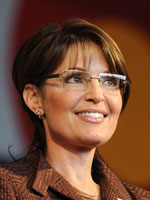 It’s curious how politics worldwide is ever more often mass psychology by another name, and how politicians, political analysts, and even activists of any kind are so often victim of their own obsessions. Here in Italy we know the symptom, or, still better, we are very familiar with it—we have Silvio Berlusconi in power now, along with the conservative, religious and anti-immigrants right, but even when the Cavaliere was the leader of opposition he was the most hated man in the country, accused of almost anything, from the time of Caesar’s assassination downwards.
Sometimes there are solid reasons why this happens. Not only the faults, but also the good qualities of men, leaders, parties, etc., when the latter are clearly overwhelming and humiliating for the opponents. To make an example, take the words Arturo Parisi—a prominent leader of the left-wing Democratic party—used a few days ago to attack the general secretary of his party, Walter Veltroni: “He should have learned from Berlusconi, who is a great politician and leader, able to learn from both his own mistakes and victories.” [Il Giornale, in Italian]
Perhaps something quite similar is happening in the U.S., where GOP vice-presidential nominee Sarah Palin, as David Plotz puts it in Slate [hat tip: Norm], “has gripped the American imagination in a way that seems designed to burrow into our dream lives.” “One Obama-supporting colleague,” he relates,
dreamed she had urged her young son to kill Palin with a string bean. Another dreamed she was at a fashion show and Palin served her crème fraîche on little scooped corn chips. A third says, “In the Sarah Palin dream I keep having, she has superhuman powers but is not really a person at all. In fact, she is more like the weather with glasses and an up-do, pushing clouds around and pitching lightning bolts.”
“Palin's supermom abilities,” he goes on,
provoke envy and anxiety in women, especially other working mothers. Her instant celebrity and dazzling speech have panicked Obama supporters who thought they had the election in the bag. And then there's her sex appeal. […]”
Definitely an interesting case. Much, much better than Berlusconi, in my view …
September 11, 2008
American by birth, hero by choice
There is a hero who saved lives on September 11, 2001. No one knew who he was and what he had done for several years after the events of that day. Read about him and see photos and a video here.
Subscribe to:
Posts (Atom)